


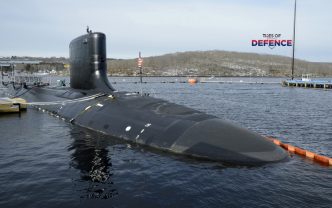
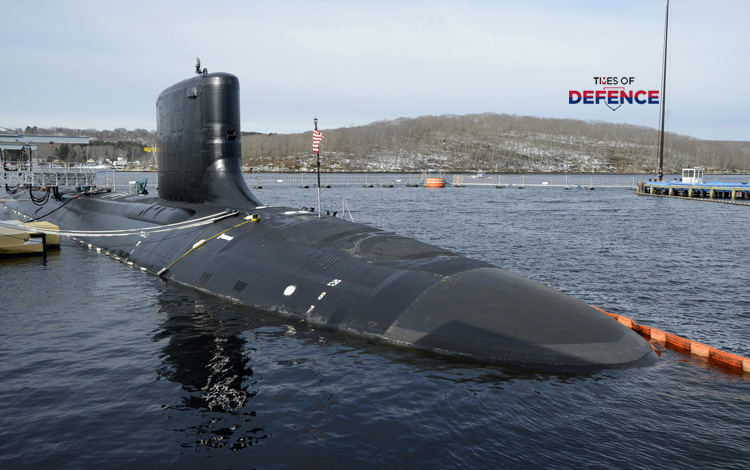
U.S. Secretary of War Pete Hegseth, Australian Deputy Prime Minister and Minister for Defence Richard Marles, and UK Secretary of State for Defence Wes Streeting have officially announced the designation of the Virginia-class fast-attack submarine USS Colorado (SSN 788) as the inaugural U.S. Navy platform assigned to Submarine Rotational Force-West (SRF-West) beginning in late 2027.
Operating from the Royal Australian Navy (RAN) base HMAS Stirling at Garden Island in Western Australia, SRF-West represents the operational cornerstone of AUKUS Pillar I. The rotational framework is projected to host up to four U.S. Navy Virginia-class submarines and one Royal Navy Astute-class nuclear-powered attack submarine (SSN). Concurrently, USS Colorado arrived at HMAS Stirling on October 27, 2026, to execute a scheduled Submarine Maintenance Period (SMP)—the third in 12 months—where over 30 certified Australian civilian technicians from ASC Pty Ltd are conducting routine maintenance on an operational U.S. nuclear submarine for the first time. This initiative accelerates Australia’s operational, technical, and regulatory readiness to independently own, operate, and maintain sovereign SSNs ahead of acquiring its own Virginia-class platforms in the 2030s.
TECHNICAL SPECIFICATIONS: USS COLORADO (SSN 788) VIRGINIA-CLASS BLOCK III ARCHITECTURE
Platform Lineage, OEM Build & Command Alignment
⚡ Ship Identity & Class: USS Colorado (SSN 788 — Block III Virginia-Class Fast-Attack Submarine)
⚡ Lead Shipbuilders: General Dynamics Electric Boat (Groton, CT) & HII Newport News Shipbuilding (Newport News, VA)
⚡ Administrative Command: U.S. Navy Submarine Force Pacific (SUBPAC / Commander, Submarine Group 7)
⚡ Operating Base (Post-2027 Rotation): HMAS Stirling (Garden Island, Rockingham, Western Australia — SRF-West Hub)
⚡ Planned Rotational Force Capacity: Up to 4× U.S. Virginia-class SSNs + 1× Royal Navy Astute-class SSN 
Hull Geometry, Hydrodynamics & Nuclear Propulsion Architecture
💥 Airframe & Pressure Hull Geometry: Length: 115 meters (377 ft) | Beam: 10.4 meters (34 ft) | Test Depth: >240 meters (>800 ft) | Submerged Displacement: 7,900 tonnes
💥 Powerplant Architecture: 1× General Electric S9G pressurized water reactor (PWR) driving an acoustic-canted pump-jet propulsor; Core Life: 33 years (life-of-ship design requiring no mid-life refueling)
💥 Kinematic Performance: Max Submerged Speed: >25 knots (46+ km/h) | Operating Range: Unlimited operational range (restricted solely by onboard crew provisions and maintenance schedules)
💥 Acoustic Signature Suppression: Exterior Anechoic Coating (Molded Rubber Tiles), isolated internal acoustic rafts, structural silencing, and quiet secondary system valves engineered for low acoustic signature profiles
Strike Ordnance, Sensors & Vertical Launch Architecture
🚀 Strategic Vertical Launch System (VLS): Block III configuration replacing 12 individual VLS tubes with 2× Large-Diameter Virginia Payload Tubes (VPTs), each capable of carrying 6× BGM-109 Tomahawk Land Attack Missiles (TLAMs) (12 total VLS Tomahawks ready-to-fire)
🚀 Heavyweight Torpedo Payload: 4× 533mm (21-inch) bow torpedo tubes capable of firing Mark 48 Mod 7 Common Broadband Advanced Sonar System (CBASS) heavyweight torpedoes and Encapsulated Harpoon anti-ship missiles (26 total torpedo room payload capacity)
🚀 Sonar Array Architecture: Large Aperture Bow (LAB) passive/active sonar array (hydro-acoustic spherical array replacement), wide-aperture lightweight fiber-optic flank arrays, chin sonar, and TB-29A / TB-33 thin-line towed arrays
🚀 Combat Management System: AN/BYG-1 Tactical Submarine Combat Control System linked with global C4ISR and satellite communications suites for multi-domain network-centric warfare
TIMES OF DEFENCE ASSESSMENT
The designation of USS *Colorado* (SSN 788) to lead Submarine Rotational Force-West in 2027 marks the transition of AUKUS Pillar I from diplomatic strategy to forward-deployed undersea capability. Establishing a permanent, rotational nuclear-powered attack submarine presence in Western Australia addresses the operational challenge facing U.S. and Royal Navy Pacific deployments: transit times between North American West Coast / UK bases and the Indo-Pacific theater.
From an engineering and force-projection perspective, deploying Virginia-class SSNs out of HMAS Stirling provides significant advantages:
1. **Extended Station Time in Critical Chokepoints**: Operating directly from Western Australia cuts transit times to the Sunda Strait, Lombok Strait, and the broader Indian Ocean/Western Pacific regions. This enables continuous, deep-sea Anti-Submarine Warfare (ASW) and strike coverage without burning reactor/crew hours on long Pacific transits.
2. **Industrial Sovereignty Transfer**: Conducting active Scheduled Maintenance Periods (SMPs) using Australian civilian technicians from ASC Pty Ltd creates the technical, nuclear-safety, and industrial maintenance framework required for Australia to field its own sovereign SSN fleet in the 2030s.
3. **High-Density Standoff Strike**: Equipping SSN 788 with the Block III Large-Diameter Virginia Payload Tubes provides forward-deployed land-attack and maritime strike capacity via BGM-109 Tomahawks, providing high-volume kinetic deterrence across contested maritime approaches.

