


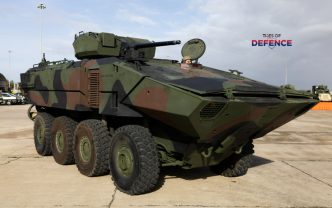
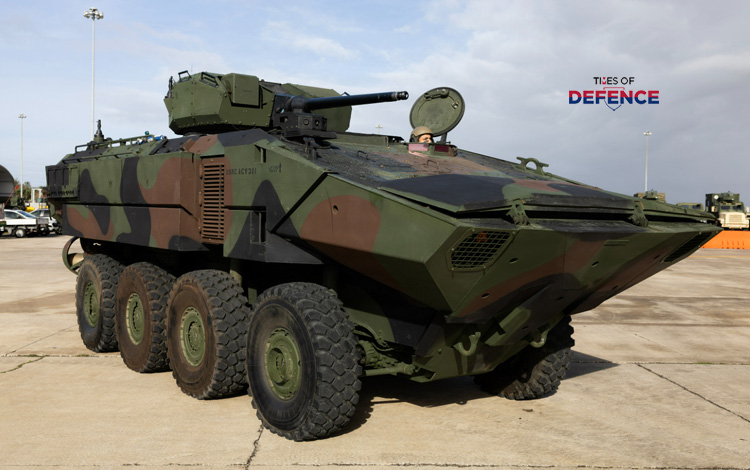
Logistics specialists and Marines at Marine Corps Support Facility Blount Island successfully completed transportability and clearance trials on November 4, 2026, confirming that the BAE Systems Amphibious Combat Vehicle 30mm Cannon variant (ACV-30) can be safely embarked, maneuvered, and secured within the cargo holds of maritime prepositioning ships.
Conducted aboard the Watson-class large, medium-speed roll-on/roll-off (LMSR) ship USNS Dahl (T-AKR 312), the assessment specifically targeted the ACV-30—the variant widely considered the most complex and restrictive to maneuver through internal shipboard ramps and holds due to its remote turret architecture. The resulting spatial clearance metrics, turning radius parameters, and lashing configurations will establish baseline embarkation load plans for positioning the wider ACV family aboard forward-deployed prepositioning vessels.
TECHNICAL SPECIFICATIONS: ACV-30 & MARITIME PREPOSITIONING INTEGRATION
Vehicle Architecture & Turret Integration
⚡ Prime Contractor & System Integrator: BAE Systems (in partnership with Iveco Defence Vehicles)
⚡ Platform Classification: 8×8 Wheeled Amphibious Combat Vehicle – 30mm Cannon Variant (ACV-30)
⚡ Primary Weapon System: Kongsberg Medium Caliber Remote Turret (MCRt) equipped with an XM813 30mm chain gun and coaxial machine gun
⚡ Mobility & Dimensions: Wheeled combat vehicle replacing legacy tracked Assault Amphibious Vehicles (AAVs); elevated center of gravity and spatial footprint introduced by the 30mm remote turret requiring specialized clearance evaluation for shipboard deck heights and ramp transitions 
USNS Dahl (T-AKR 312) Cargo Handling Parameters
💥 Vessel Class: Watson-class Vehicle Cargo Ship (Military Sealift Command Prepositioning Program)
💥 Cargo Deck Configuration: Multi-deck internal roll-on/roll-off (RORO) architecture featuring internal ramps, overhead clearance restrictions, and heavy-vehicle lashing tie-down grids
💥 Assessment Objectives: Document turning radiuses, ramp clearance limits, spatial maneuvering envelopes, and securement procedures for high-profile turreted variants
TIMES OF DEFENCE ASSESSMENT
The successful clearance testing of the ACV-30 aboard USNS Dahl highlights critical operational enhancements for U.S. Marine Corps global posture:
1. **Overcoming Spatial Constraints for Turreted Armored Variants**: Integrating a remote 30mm cannon turret onto an 8×8 amphibious chassis introduces distinct vertical and rotational clearance challenges within restricted shipboard decks. Empirically validating the turning and lashing parameters of the ACV-30 removes a major logistical bottleneck for fleet-wide maritime prepositioning.
2. **Reducing Deployment Footprint via Forward-Staged Prepositioning**: Staging ACV variants alongside dedicated battalion maintenance kits and tool packages aboard forward prepositioning ships minimizes the strategic lift burden required for deploying units. Marines can draw fully supported, combat-ready armored assets directly from theater stocks rather than transshipping them from the continental United States.
3. **Streamlining Fleet-Wide Amphibious Modernization**: As the wheeled ACV family completely replaces legacy tracked AAVs across Marine expeditionary units, standardizing shipboard load plans for specialized variants like the ACV-30 ensures seamless integration across Military Sealift Command’s prepositioning squadron architecture.

