


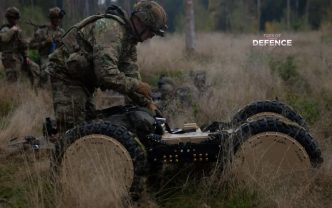
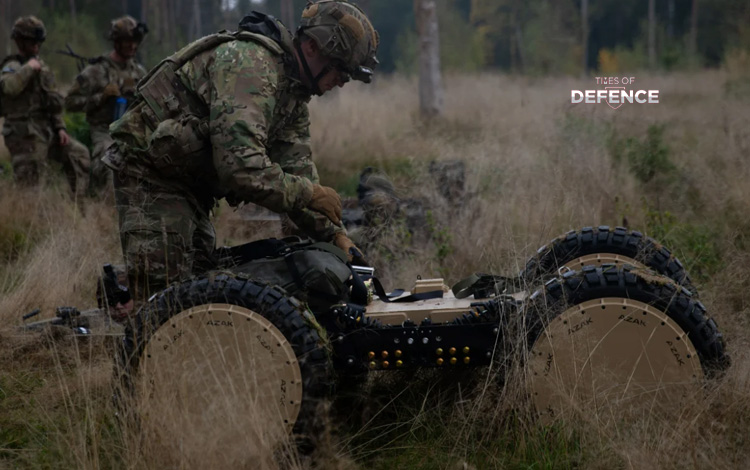
U.S. Army soldiers assigned to the 2nd Squadron, 2nd Cavalry Regiment (Vilseck, Germany) have executed the first European operational fielding and live-fire casualty evacuation (CASEVAC) exercises utilizing the AZAK S26 modular unmanned ground vehicle (UGV).
Conducted on October 21, 2026, during a platoon situational training exercise at Grafenwoehr Training Area, troops from Eagle Troop’s 1st Platoon integrated the S26 “Stoat” UGV configuration to haul heavy infantry weapons—including 60mm mortar systems and Bangalore torpedoes—over 8 km of rough terrain before executing an automated casualty extraction from an enemy trench line. The deployment follows the delivery of the first 3 of 26 total AZAK systems awarded by the U.S. Army’s Global Tactical Edge Acquisition Directorate under an Other Transaction Agreement (OTA). Built around self-contained robotic drive wheels, the AZAK S26 represents the U.S. military’s first wide-scale operational unit rollout of self-contained, wheel-integrated electric UGV architectures for last-mile battlefield logistics.
TECHNICAL SPECIFICATIONS: AZAK S26 “STOAT” MODULAR ROBOTIC WHEEL ARCHITECTURE
Developer, Acquisition Directorate & Operator Profile
⚡ Lead Systems Integrator: AZAK Inc. (Denver, Colorado)
⚡ Acquisition Authority: U.S. Army Global Tactical Edge Acquisition Directorate (OTA Contract)
⚡ Operational Unit: 2nd Squadron, 2nd Cavalry Regiment (” Stryker Brigade / Dragoon”), U.S. Army Europe and Africa
⚡ Platform Nomenclature: AZAK S26 Modular Robotic Wheel System / “Stoat” UGV Configuration 
Wheel-Integrated Drive Dynamics & Structural Engineering
💥 Wheel-Centric Drive Architecture: Self-contained propulsion module — each 26-inch wheel houses its own electric motor, motor controller, braking system, and internal Li-Ion battery pack
💥 Wheel Dimensions & Weight: Diameter: 26 in (66 cm) | Width: 8 in (20.3 cm) | Mass: 86–94 lb (39–42 kg) per wheel assembly
💥 Quick-Connect Frame Mounting: Toolless two-buckle latch mechanism allowing 3-second wheel installation or field swap directly onto lightweight cargo frames (“Stoat” board)
💥 Drivetrain Redundancy & Puncture Tolerance: Independent drive processing enables full mobility continuity even if 2 out of 4 wheels suffer severe mechanical destruction, ballistic penetration, or total power loss
Kinematics, Powerplant & Payload Envelopes
🚀 Payload Capacity (4-Wheel Stoat Baseline): Rated cargo payload: >230 kg to 680 kg (500–1,500 lb operational load depending on terrain profile)
🚀 Torque & Speed Performance: Single Wheel Torque: 147 lb-ft (199.3 Nm) | Combined 4-Wheel Torque: 588 lb-ft (797.2 Nm) | Max Sprint Speed: 12 mph (19.3 km/h)
🚀 Range & Operational Radius: 32 km to 97 km (20 to 60 miles) operating range on full internal charge | Charge Time: 1.5 hours
🚀 Air Mobility & Insertion Rating: Certified airborne jump capability from up to 36,000 ft (10,973 m); 463L pallet transportable (fits 99 wheels and 24 frames per standard pallet)
C2 Networks, Autonomy & Payload Configurations
🚀 Command & Control Options: Handheld RF controller, physical tethered control (SHUI interface), or full autonomous waypoint navigation
🚀 Mission Flexibility: Swappable top boards support stokes stretchers (CASEVAC), heavy weapon mounts (mortars/ATGMs), drone launch/recharge pads, or tactical supply boxes
🚀 C4ISR & Sensor Options: Integrated CAN bus architecture interfaces with ATAK (Android Tactical Assault Kit) and EO/IR camera payloads for GNSS-denied navigation
TIMES OF DEFENCE ASSESSMENT
The operational fielding of the AZAK S26 UGV to the 2nd Cavalry Regiment in Germany highlights a practical approach to modern military ground robotics. In high-intensity combat zones—particularly in Ukraine—last-mile supply lines and casualty evacuations have become prime targets for hostile FPV drones and artillery airbursts. Relying on human stretcher-bearers to transport wounded soldiers or carry heavy ammunition across contested terrain creates severe personnel risk and slows operational tempo.
From an engineering and sustainment perspective, the core innovation of the AZAK system lies in its wheel-integrated propulsion design. By housing the motor, battery, and controller inside individual wheel hubs, the platform eliminates traditional vehicle failure points—such as central driveshafts, complex gearboxes, and vulnerable differential linkages. If two wheels are destroyed by landmines or shrapnel, the remaining wheels continue driving. The toolless, 3-second wheel replacement mechanism allows frontline infantry units to maintain UGV availability without relying on specialized depot repair teams, providing combat squads with a resilient, modular asset for last-mile logistics and casualty extraction.

