


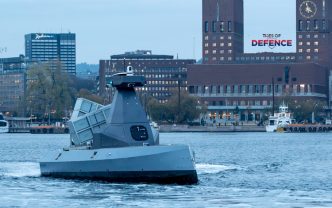
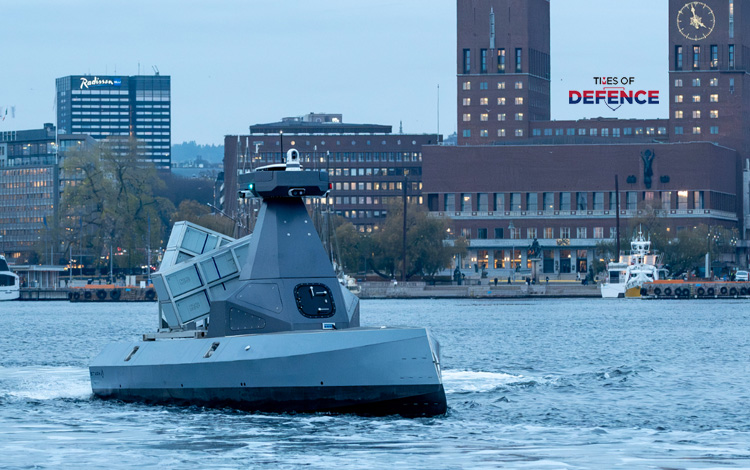
British Minister for Defence Readiness and Industry Luke Pollard personally took control of STARK’s Vanta 12—a 12-meter uncrewed surface vessel (USV) armed with MBDA Sea Venom anti-ship missiles—during a high-visibility capability demonstration in Oslo, Norway.
Conducted alongside a meeting of the Joint Expeditionary Force (JEF), the demonstration highlighted the strategic convergence of allied maritime autonomous systems with traditional strike elements, including the nearby presence of the Royal Navy’s flagship carrier HMS Prince of Wales. Developed and tested in Plymouth, UK—recognized as a national hub for marine autonomy following a recent £50 million defense growth injection—the Vanta 12 represents a modular, rapidly deployable architecture designed for long-endurance patrols, maritime interdiction, and critical infrastructure defense across northern European waters.
TECHNICAL SPECIFICATIONS: STARK VANTA 12 USV & WEAPON INTEGRATION
Platform Dimensions, Propulsion & Endurance Architecture
⚡ Prime Contractor & Developer: STARK Defence (Berlin-headquartered with regional R&D and manufacturing, including Dartmouth and Plymouth, UK)
⚡ Hull Dimensions: Length 12 meters (39 feet); beam 4.0 meters; full displacement ~13.7 tonnes
⚡ Payload Capacity: Up to 2,000 kg (4,400 lbs) modular cargo and weapons payload volume
⚡ Kinematic Performance & Range:
• Maximum Sprint Speed: In excess of 40–42 knots
• Cruising Range: ~1,200 nautical miles at economic patrol speed (~10 knots)
• Operational Persistence: Engineered to remain deployed at sea for “weeks at a time” in severe operating conditions (rated up to Sea State 5/6)
⚡ Onboard Sensors & Navigation: Integrated maritime navigation radar, electro-optical/infrared (EO/IR) stabilized pan-tilt-zoom camera gimbals, multi-constellation GNSS, and secure SATCOM/OneWeb data links managed via STARK’s *Minerva* command-and-control software 
Modular Kinetic Armament Configuration
💥 Anti-Ship Missile Suite: Box launcher aft configured for up to 4× MBDA Sea Venom light anti-ship missiles (matching the armament deployed by Royal Navy Wildcat helicopters)
💥 Loitering Munition Integration: Forward 10-cell modular canister launcher carrying STARK’s *Cascade* loitering munition (featuring a 5 kg warhead and 100 km range) for a scalable “high-low” strike mix
💥 Future-Proof Modular Open Architecture: Designed to accommodate auxiliary mission payloads, including laser weapon systems, towed-array sonars, or lightweight anti-submarine torpedoes
TIMES OF DEFENCE ASSESSMENT
The demonstration of the Vanta 12 in Oslo underscores key doctrinal and industrial transitions in European uncrewed naval warfare:
1. **Delivering Corvette-Class Strike Power via Attritable USVs**: Combining heavy-payload capacity (2 tonnes) with sophisticated precision effectors like the Sea Venom missile and Cascade loitering munitions allows a 12-meter uncrewed craft to project tactical stand-off punch against surface vessels and coastal threats at a fraction of the cost of a manned corvette.
2. **Securing Critical Maritime Infrastructure and Chokepoints**: Operating persistently across the Baltic Sea, North Sea, and English Channel, the Vanta 12 addresses acute post-2022 security vulnerabilities—such as monitoring suspect “shadow fleet” tankers, protecting subsea communications cables, and guarding critical energy pipelines against hybrid sabotage.
3. **Validating UK Regional Defense Industrial Specialization**: Leveraging British shipbuilding nodes in Dartmouth and Plymouth alongside substantial government investments in marine autonomy trials infrastructure positions the U.K. as a leading exporter of sovereign uncrewed surface platforms to NATO allied navies.

