


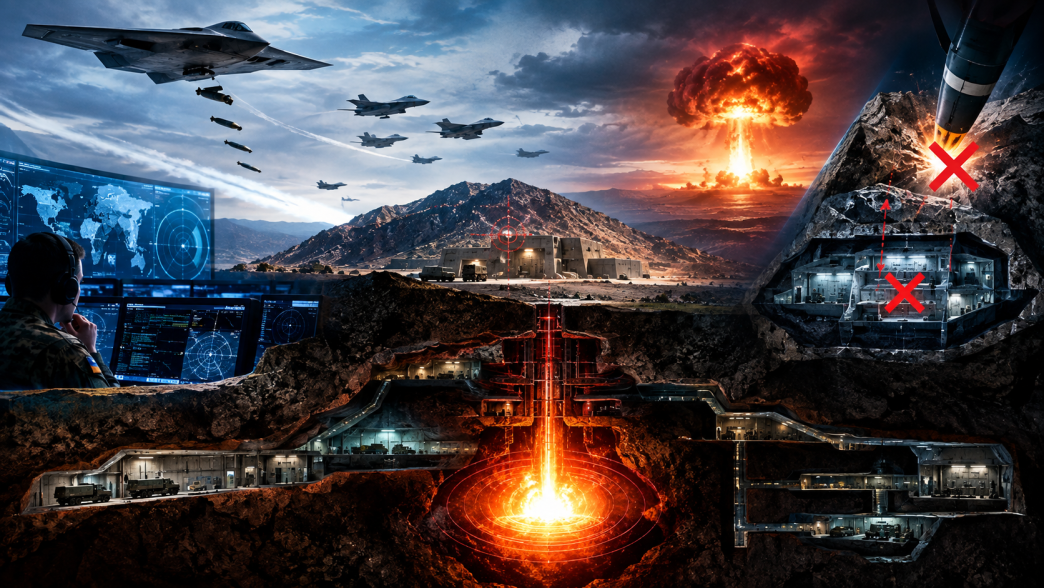
The Israeli and US attacks on Iran’s nuclear program have provided an important example of how even high-tech air power can face significant limitations against strategic infrastructure buried underground.
The operations carried out last year targeted enrichment facilities at Natanz and Fordow, the nuclear technology center in Isfahan, the heavy-water reactor at Arak, and various facilities linked to centrifuge production.
Although the attacks inflicted serious damage on Iran’s nuclear infrastructure, the resulting picture showed that nuclear capabilities cannot be eliminated simply by striking specific buildings or facilities. Iran has an infrastructure that allows it to increasingly move critical activities to more protected and difficult-to-reach locations.
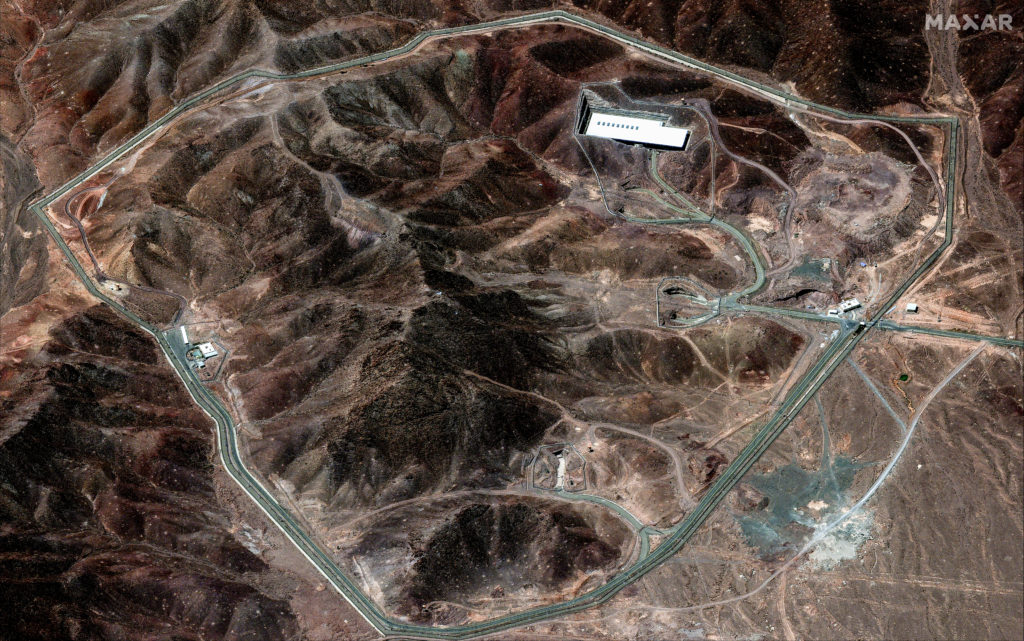
One of the most notable examples of this is the underground complex known as Pickaxe Mountain. There is still no definitive picture internationally regarding the facility’s actual purpose. Iran had initially stated that the site was planned to house a facility for manufacturing the centrifuges used in uranium enrichment.
Over time, however, assessments have increased that the facility could also be used for more sensitive nuclear activities or for the secure storage of strategic nuclear material.
Depth is changing the rules of warfare
The significance of the Pickaxe Mountain example is not limited to the question of what the facility is being used for. The geological structure in which the facility is located and its tunnel system extending dozens of meters underground directly demonstrate the limitations of modern airstrikes.
Analyses based on satellite imagery indicate that some parts of the facility are located approximately 80 to 100 meters beneath a granite mountain. This depth makes the facility an extremely difficult target for conventional airstrikes. Even the GBU-57 Massive Ordnance Penetrator, the most advanced conventional bunker-busting munition in the US arsenal, could face limitations in completely destroying such a deep and hardened structure.
This reveals a broader consequence for modern warfare. Having air superiority does not necessarily mean that strategic infrastructure located underground can be completely eliminated. Facilities built deep inside hard rock formations, with multiple tunnels and entrances, can be designed in ways that reduce the impact of attacks.
The difference between Fordow and Pickaxe becomes important at this point as well. Although Fordow’s depth provided significant protection, some structural characteristics of the facility created vulnerabilities that could be exploited by an attacker. The tunnel architecture at Pickaxe Mountain, by contrast, appears to be more complex and may have been designed to reduce the effects of direct attacks.
Iran is reshaping its nuclear infrastructure
Satellite imagery indicates a significant increase in construction activity around Pickaxe Mountain in recent months. The expansion of roads, reinforcement of tunnel entrances, establishment of a security perimeter and efforts to make access points more protected all indicate that the facility’s security architecture is continuously being strengthened.
The earthen barriers constructed along roads leading to the tunnel entrances are particularly noteworthy. Such structures are assessed not only to reduce the facility’s visibility from outside, but also potentially to provide additional protection against possible attacks by controlling access and movement in and out of the complex.
Another notable feature of the facility’s architecture is the bends along the tunnel routes. U-shaped connections could prevent munitions from traveling directly through the tunnels and make it more difficult for blast pressure to penetrate deeper sections of the complex.
For this reason, the facility is not simply a reinforced concrete structure. The mountain itself has effectively become part of the facility’s defensive system.
Uncertainty increases the military risk
At the same time, the lack of certainty at the international level over the exact purpose of Pickaxe Mountain is one of the most important dimensions of the issue.
The International Atomic Energy Agency has repeatedly raised requests for information about and access to the facility, but the site has yet to be opened to international inspection. The Iranian government, meanwhile, argues that satellite imagery alone cannot establish the facility’s function and maintains that the situation could be better understood if inspectors were allowed to conduct an on-site inspection.
This uncertainty creates a serious challenge for the monitoring of nuclear programs. Determining from the outside whether a facility is actually being used for centrifuge production, enrichment activities, or research activities relocated from facilities previously attacked is extremely difficult.
Assessments by US-based strategic research organizations have also identified three main possibilities. Iran may be constructing the centrifuge-production facility it previously announced. It may be developing a new enrichment infrastructure capable of processing its existing stockpile of highly enriched uranium. Alternatively, it may have moved part of the nuclear research previously conducted at facilities damaged in earlier attacks to this location.
Each of these possibilities points to a different security picture.
The boundary between military power and diplomacy
The debate over Pickaxe Mountain ultimately raises a question that extends beyond Iran’s nuclear program: Where are the limits of military power at a time when strategic infrastructure is increasingly being moved underground?
It may be possible to strike a country’s nuclear infrastructure from the air. But eliminating that country’s scientific capabilities, engineering expertise, human resources and capacity to rebuild through the same method is an entirely different matter. Destroying a facility does not automatically prevent the activities carried out there from being restarted elsewhere.
Iran’s approach in recent years also demonstrates this reality. As critical infrastructure is moved into deeper, more dispersed and more heavily protected locations, the costs for the attacking side increase. Each new attack can encourage the other side to further fortify its next facility and develop an even more complex underground architecture.
This is not only an example relevant to Iran, but also an important case for future strategic competition. Moving critical elements such as nuclear infrastructure, missile production facilities, command-and-control centers and strategic weapons storage underground is reshaping the balance between defense and offense even in an era of highly precise weaponry.
The limits of a lasting solution
The fundamental issue surrounding Iran’s nuclear program therefore needs to be assessed within a broader framework than simply asking whether individual facilities can be struck. Destroying a target and ending a nuclear program are not the same thing.
The picture emerging from Pickaxe Mountain demonstrates that military operations can delay or seriously damage specific infrastructure, but completely eliminating knowledge, technology and capabilities that have been moved underground is a far more complicated task.
For this reason, the relationship between military pressure and diplomatic mechanisms is becoming increasingly important when it comes to permanently constraining nuclear programs. As nuclear infrastructure is buried deeper underground, dispersed and further fortified, every new military operation can result in even more difficult targets emerging at the next stage.
The fundamental reality demonstrated by the Iranian example is this: In modern warfare, there is an increasingly wide gap between striking a country’s nuclear infrastructure and eliminating its nuclear capabilities. As this gap widens, the cost and uncertainty of military options increase, while the importance of diplomatic mechanisms in producing lasting results rises to the same extent.
Source: Times of Defence
