


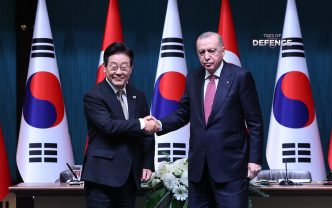
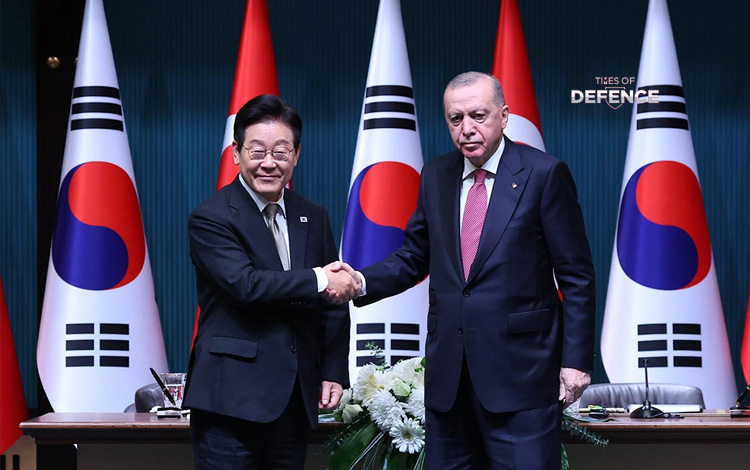
Turkish President Recep Tayyip Erdoğan confirmed during an official state interview on November 2, 2026, ahead of his bilateral summit in Seoul, that South Korea’s Defense Acquisition Program Administration (DAPA) has initiated formal inquiries regarding the procurement and integration of the TEI-PD170 turbodiesel aviation engine.
Developed indigenously by TUSAŞ Engine Industries (TEI), the TEI-PD170 is a class-leading 170-horsepower turbodiesel engine engineered to power Medium-Altitude Long-Endurance (MALE) Unmanned Aerial Vehicles (UAVs). South Korea’s interest follows operational evaluation of the engine’s performance aboard Turkish combat-proven platforms (TUSAŞ ANKA and AKSUNGUR) as Seoul seeks reliable, high-altitude propulsion solutions for its next-generation tactical and surveillance UAV programs. The potential deal signals a notable reversal in defense exports, given South Korea’s traditional role as a hardware supplier to Türkiye (such as supplying Hyundai Doosan Infracore / SNT Dynamics powertrains for the ALTAY Main Battle Tank).
TECHNICAL SPECIFICATIONS: TEI-PD170 TURBODIESEL AVIATION ENGINE ARCHITECTURE
Developer, Program Lineage & Export Framework
⚡ Developer & OEM Prime: TUSAŞ Engine Industries (TEI — Eskişehir, Türkiye)
⚡ Engine Classification: 4-Stroke, 4-Cylinder In-Line Liquid-Cooled Turbodiesel Aviation Engine
⚡ Target Platforms (Operational): TUSAŞ ANKA MALE UAV, TUSAŞ AKSUNGUR, Baykar Bayraktar TB3 (PD170 derivative / PD200 baseline)
⚡ Fuel Compatibility: Aviation Kerosene / Jet-A1, Jet-A, JP-8 (Single-fuel defense logistics compliance)
⚡ Procurement Context: Under formal technical evaluation by South Korea (DAPA) for integration into domestic reconnaissance UAV prototypes 
Engine Core Kinematics & Power Outputs
💥 Takeoff / Rated Power: 170 hp (126 kW) up to 20,000 ft; sustained 130 hp output at 30,000 ft altitude
💥 Operational Service Ceiling: Certified for operational ceilings exceeding 40,000+ ft (demonstrated 42,000 ft ceiling on TUSAŞ AKSUNGUR)
💥 Two-Stage Serial Turbocharger System: Features a custom sequential two-stage turbocharger architecture maintaining sea-level manifold pressure at high altitudes without severe power drop-off
💥 Fuel Efficiency & Endurance Metrics: Best-in-class Specific Fuel Consumption (SFC) enabling extended endurance (proven 45-hour continuous flight on AKSUNGUR and 35-hour flight on ANKA)
💥 Dry Weight & Power-to-Weight Ratio: Dry Weight: ~162 kg (including dual turbochargers, intercooler, and full dual-redundant FADEC system)
Avionics, Control & Sub-system Redundancy
🚀 Engine Control Unit: Fully digital, indigenously developed Dual-Redundant FADEC (Full Authority Digital Engine Control) system preventing single-point electrical failures
🚀 Electrical Generation Architecture: Dual 28V DC alternators integrated directly to meet high onboard payload power demands for synthetic aperture radar (SAR) and EO/IR pods
🚀 Mechanical Gearbox: Integrated propeller reduction gearbox with anti-vibration dampers designed for high-efficiency variable-pitch propellers
TIMES OF DEFENCE ASSESSMENT
South Korea’s interest in procuring the TEI-PD170 turbodiesel engine highlights a strategic maturation of the Turkish defense industrial base. Historically, Türkiye relied on foreign propulsion imports (such as Austrian Rotax engines or Ukrainian turbofans). Developing and exporting sovereign aviation engines represents the highest tier of defense industrial independence.
From an engineering and strategic procurement perspective, this development offers three core insights:
1. **High-Altitude Power Maintenance Solution**: Designing turbodiesel engines for aircraft requires managing oxygen reduction at high altitudes. The TEI-PD170’s two-stage sequential turbocharging suite allows it to maintain 170 hp up to 20,000 ft and remain operational past 40,000 ft. South Korea’s interest indicates local indigenous UAV propulsion programs encountered power-loss or thermal management hurdles at high altitudes.
2. **Reverse Defense Transfer in Turkey–Korea Bilateral Relations**: For years, defense technology transfers flowed from Seoul to Ankara (e.g., K9 Thunder technology for the T-155 Fırtına obüs, K2 Black Panther tech for the ALTAY MBT). South Korea seeking Turkish UAV propulsion establishes a two-way strategic supply partnership based on specialized technology niches.
3. **Logistical Efficiency via Jet-Fuel Compatibility**: The PD170 operates on standard JP-8 / Jet-A1 fuel rather than specialized aviation gasoline (Avgas). For military operators like the Republic of Korea Armed Forces, single-fuel doctrine simplifies forward supply logistics, enabling UAV fleets to draw directly from naval vessel and airfield fuel reserves.

