


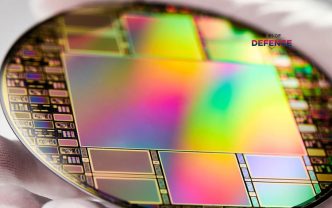
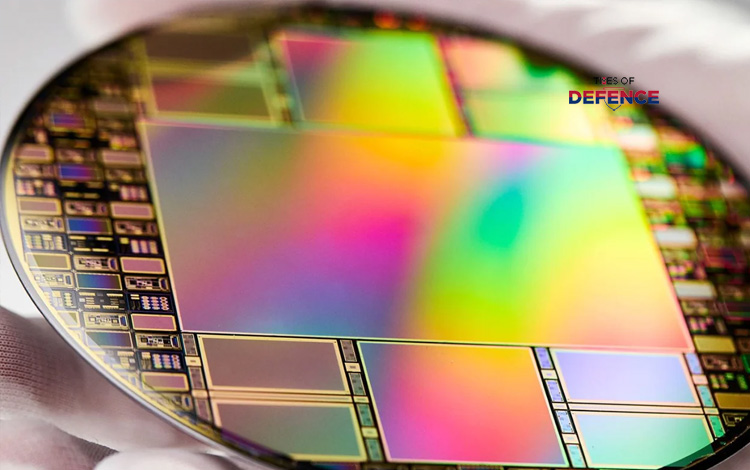
Defense technology prime Raytheon, an RTX business (NYSE: RTX), announced on November 3, 2026, that it has been awarded a Phase 1 contract under DARPA’s Photonic Integrated Circuit Architectures for Scalable System Objectives (PICASSO) program.
Managed by Dr. Anna Tauke-Pedretti within DARPA’s Microsystems Technology Office (MTO), the PICASSO program aims to eliminate electro-optic signal conversion bottlenecks by performing complex signal processing entirely within the optical domain. Under the multi-phase effort, Raytheon’s Advanced Technology team will design, simulate, and demonstrate scalable, high-density Photonic Integrated Circuits (PICs). Semiconductor electronic design automation (EDA) software provider Synopsys will supply advanced optical design, simulation, and PDK (Process Design Kit) frameworks for the project.
TECHNICAL SPECIFICATIONS: DARPA PICASSO ALL-OPTICAL SIGNAL PROCESSING
Program Governance, Architecture & Subcontractor Framework
⚡ Program Authority: Defense Advanced Research Projects Agency (DARPA / MTO)
⚡ Lead Integrator & Prime Contractor: Raytheon Advanced Technology (RTX Business Unit)
⚡ EDA & Simulation Partner: Synopsys, Inc. (Providing optical modeling, waveguide synthesis, and circuit simulation suites)
⚡ Core Program Objective: Transition photonic integrated circuits from discrete components into ultra-high-density, large-scale integrated systems operating natively in the optical domain
⚡ Phase Structure & Scope: Phase 1 (18 months) focuses on foundational circuit-level architectures, crosstalk suppression, and back-reflection mitigation; Phase 2 (18 months) down-selects for functional application-specific all-optical processing sub-assemblies 
Physics of All-Optical Processing vs. Electro-Optic Conversion
💥 Technical Bottleneck (Traditional PICs): Standard photonic architectures convert light back into electrical signals (photodiodes/ADCs) for processing, introducing thermal noise, latency delays, signal degradation, and severe power consumption
💥 All-Optical Domain Mechanics: Processes raw optical signals directly using linear and non-linear integrated optical waveguides, phase shifters, and optical logic gates without intermediate electrical conversion
💥 Signal Integrity Protections: Engineering novel circuit-level isolation topologies to suppress back-reflections, optical insertion loss, thermal drift, and cross-channel optical crosstalk
💥 Scaling Metrics: Photonic equivalent of Very Large-Scale Integration (VLSI), maximizing waveguide density and optical component counts per millimeter on a single substrate
Operational Benefits & Defense Platform Applications
🚀 Latency Reduction: Speed-of-light signal manipulation minimizes delay across processing chains, enabling microsecond threat processing for dynamic electronic warfare (EW) environments
🚀 High Bandwidth & Low Thermal Footprint: Eliminates power-hungry high-speed analog-to-digital converters (ADCs), reducing system heat dissipation while processing multi-gigahertz RF/EO signals simultaneously
🚀 Target Application Spectrum: Advanced Active Electronically Scanned Array (AESA) radar beamforming, wideband Electronic Support Measures (ESM), optical computing, and high-frequency sensor fusion for contested air defense and hypersonic environments
TIMES OF DEFENCE ASSESSMENT
Raytheon’s selection for DARPA’s PICASSO program highlights a technical shift in military microelectronics and high-speed signal processing.
From an aerospace electronics and defense engineering perspective, this initiative provides three main insights:
1. **Solving the Electro-Optic Processing Wall**: Traditional radar and SIGINT platforms collect optical or high-frequency RF data but bottleneck at the electro-optic conversion boundary. By developing integrated circuits that filter, combine, and process signals using photons instead of electrons, Raytheon and DARPA are laying the groundwork for processing architectures that operate at light speed while drawing a fraction of the power.
2. **Enabling High-Density Electronic Warfare Suites**: In modern contested electromagnetic environments, radar and EW systems must process wide frequency bands instantly to defeat agile jamming and low-RCS threats. All-optical processing allows EW receivers to handle broad multi-GHz spectral bandwidths without overheating or overwhelming onboard mission computers.
3. **Strengthening Domestic Photonic Foundry Infrastructure**: DARPA’s PICASSO program emphasizes domestic onshore fabrication to secure critical supply chains. Partnering Raytheon’s defense integration with Synopsys’s commercial design tools establishes a standardized U.S. design-to-foundry pipeline for military-grade photonic microchips.

