


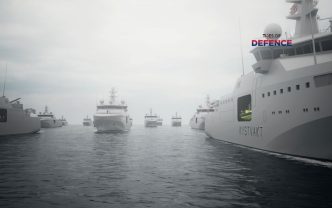
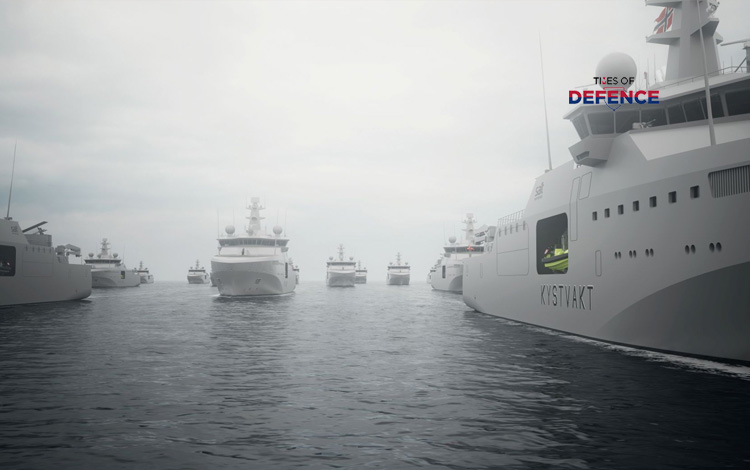
The Norwegian Defence Materiel Agency (Forsvarsmateriell / FMA) has released updated procurement parameters for Project P1118 (the Standardised Vessel Programme), establishing a multinational shipbuilding framework for up to 20 ocean-going vessels shared across Norway, the United Kingdom, and Lithuania.
Engineered around a modular concept design developed by Kongsberg Defence & Aerospace and Salt Ship Design AS, the program seeks to replace more than ten legacy vessel classes with unified, cost-effective platforms. Under the newly formalized acquisition structure, FMA will run two parallel competition tracks resulting in two distinct shipbuilding contracts—one for up to 14 naval-variant ships and another for up to 6 coast guard vessels—with a strict rule prohibiting any single bidder from winning both awards to guarantee industrial capacity, delivery resilience, and market competition. Contract awards are targeted for 2027, with the first vessel scheduled for delivery in 2030.
TECHNICAL SPECIFICATIONS: PROJECT P1118 STANDARDISED VESSEL ARCHITECTURE
Multinational Fleet Distribution & Acquisition Structure
⚡ Concept Design & Systems Integrators: Kongsberg Defence & Aerospace and Salt Ship Design AS (selected in March 2026 to develop the baseline architecture)
⚡ Total Ocean-Going Requirement (Up to 20 Vessels): Distributed across Norway (up to 6 Coast Guard vessels and up to 4 Royal Norwegian Navy vessels), the United Kingdom (up to 6 Royal Navy vessels—comprising 3 firm mine-countermeasures motherships plus 3 options under a November 2026 bilateral deal), and Lithuania (up to 4 naval-variant vessels following a July 2026 Memorandum of Understanding)
⚡ Parallel Shipbuilding Contracts: Divided into Contract A (up to 14 naval-variant vessels for Norway, the UK, and Lithuania) and Contract B (up to 6 ocean-going vessels for the Norwegian Coast Guard); suppliers may qualify for both tracks but cannot be awarded both contracts
⚡ Acquisition & Delivery Schedule: Prequalification initiated in late 2026 (incorporating limits on foreign hull-completion percentages to protect domestic shipyard participation), formal contract awards in 2027, and initial vessel delivery in 2030 
Modular Hull Design, Mission Payloads & Unmanned Integration
💥 Common Hull & Mission Bay Architecture: Built around a standardized, adaptable commercial-military hybrid hull design featuring expansive open working decks, containerized mission module interfaces, and standardized propulsion/power-generation plants to simplify lifecycle maintenance across allied fleets
💥 Mine Countermeasures (MCM) & Unmanned Systems Mothership Role: Configured to deploy, recover, and command autonomous surface vessels (USVs), unmanned underwater vehicles (UUVs), and aerial drones—keeping sailors outside active minefields while supporting undersea infrastructure protection and anti-submarine warfare (ASW) on NATO’s northern flank
💥 Multi-Domain Coast Guard & Patrol Capabilities: Coast guard variants incorporate ice-strengthened features, extended North Atlantic/Arctic endurance, towing and oil-spill response gear, search-and-rescue facilities, and sovereign maritime law-enforcement sensor suites
TIMES OF DEFENCE ASSESSMENT
The Norwegian Defence Materiel Agency’s twin-track acquisition blueprint for Project P1118 highlights three decisive trends in European naval procurement and NATO maritime cooperation:
1. **Industrial Risk Mitigation Through Split Shipbuilding Awards**: By barring a single shipyard group from winning both the 14-ship naval contract and the 6-ship coast guard contract, Oslo prevents production bottlenecks at a single yard while stimulating competitive pricing across Norwegian and allied European shipbuilders.
2. **Operationalizing Allied Interoperability Through Shared Hulls**: With the United Kingdom selecting the P1118 naval variant for its next-generation mine-hunting motherships (paired with Norway’s Type 26 frigate acquisition) and Lithuania adopting the same baseline hull, three NATO allies will operate standardized platforms capable of sharing spare parts, containerized mission modules, and crew training across the North Sea, High North, and Baltic Sea.
3. **Accelerating the Transition to Mothership-Led Unmanned Naval Warfare**: Rather than building expensive, single-purpose warships, Project P1118 exemplifies the shift toward modular “hybrid navy” motherships that project unmanned mine-hunting and seabed-surveillance systems at standoff distances.

