


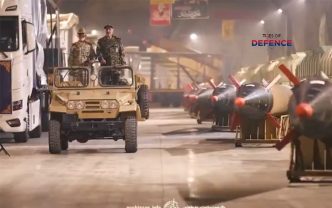
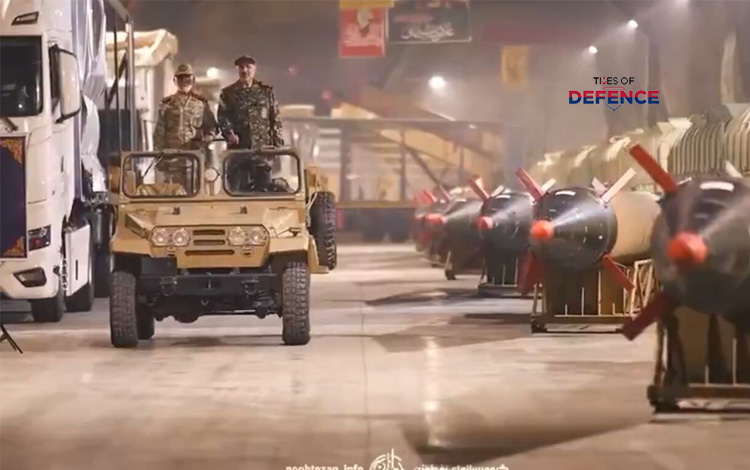
High-definition video footage released by Iranian state outlets on November 10, 2026, provided updated structural details on a subterranean “missile city” complex operated by the Islamic Revolutionary Guard Corps (IRGC) Aerospace Force.
The installation was inspected by Major General Ali Abdollahi, Chief of Staff of the Iranian Armed Forces, alongside Brigadier General Seyed Majid Mousavi, Commander of the IRGC Aerospace Force. The newly disclosed imagery documents extensive underground assembly bays, automated Transporter-Erector-Launcher (TEL) rail lines, and deep-bunker production infrastructure housing advanced solid-fuel Medium-Range Ballistic Missiles (MRBMs), cruise missiles, and detachable maneuverable reentry vehicles (MaRVs). The complex highlights Tehran’s strategic shift toward relocating critical weapon assembly, solid-propellant mixing, and launch-support infrastructure into hardened mountain facilities designed to withstand high-yield penetrator munitions.
TECHNICAL SPECIFICATIONS: SUBTERRANEAN MISSILE INFRASTRUCTURE & MA R V ARCHITECTURE
Fortification Engineering & Facility Layout
⚡ Operating Authority: IRGC Aerospace Force (Iran)
⚡ Architectural Profile: Subterranean tunnel network (“Missile City”) excavated beneath deep granite/sedimentary mountain layers
⚡ Hardening Standards: Reinforced concrete lining, blast-door airlocks, dispersed dual-entry launch hatches, continuous ventilation scrubbing, and subterranean power grids engineered to negate standoff earth-penetrating warheads (e.g., GBU-57 MOP)
⚡ Subterranean Logistics: Multi-track automated transport lines, high-bay overhead cranes for vertical missile integration onto heavy 6×6 and 8×8 TEL chassis, and subterranean warhead assembly nodes 
Kinetic Ordnance & Reentry Payload Matrix
💥 Fattah-1 Hypersonic Glide Vehicle (HGV) / MRBM:
• Range & Propulsion: ~1,400 km operational radius; solid-propellant two-stage rocket motor with vectoring nozzle
• Reentry Architecture: Integrated spherical solid-fuel apogee motor with thrust-vectoring control (TVC) enabling dynamic endo-/exo-atmospheric evasive maneuvers up to Mach 13–15
💥 Kheibar Shekan (Khorramshahr-4 derivative):
• Range & Payload: 1,450 km operational range carrying a 500 kg high-explosive warhead
• Maneuverable Reentry Vehicle (MaRV): Detachable tri-conic MaRV utilizing aerodynamic control fins for terminal evasion against land- and sea-based ABM interceptors (e.g., Arrow-3, THAAD, SM-3)
💥 Modular Warhead Configurations: Dissected video imagery revealed both standard conical unitary warheads alongside advanced MaRV assemblies featuring independent aerodynamic control surfaces
TIMES OF DEFENCE ASSESSMENT
The unveiling of the IRGC’s subterranean missile fortress highlights critical strategic lessons in asymmetric strategic preservation:
1. **Failure of Surface Standoff Strikes to Neutralize Deep Underground Infrastructure**: The operational survivability of Iran’s deep-buried missile cities demonstrates the limitations of air-launched standoff campaigns against heavily fortified target sets. Deep-bunker complexes constructed under hundreds of meters of solid rock, paired with blast-attenuating airlocks and redundant access points, preserve operational strike mass even during continuous aerial bombardment.
2. **Terminal Evasion Maturation via Integrated MaRV/HGV Design**: Transitioning from ballistic unguided reentry vehicles to maneuverable warheads like the Fattah-1 and Kheibar Shekan significantly degrades enemy anti-ballistic missile (ABM) intercept probabilities ($\text{P}_\text{k}$). Executing high-speed terminal lateral maneuvers forces defensive interceptors to expend excessive kinetic energy, straining surface-to-air missile inventories across the regional theater.
3. **Sustaining Dispersed Launch Volleys via Hardened Subterranean Logistics**: Operating self-contained underground production, fueling, and launch infrastructure allows the IRGC to maintain a stable fire cadence. Tunnels functioning as both storage depots and launch staging areas enable mobile TELs to emerge, fire, and retreat into subterranean cover before airborne sensors can complete target acquisition kill webs.

