



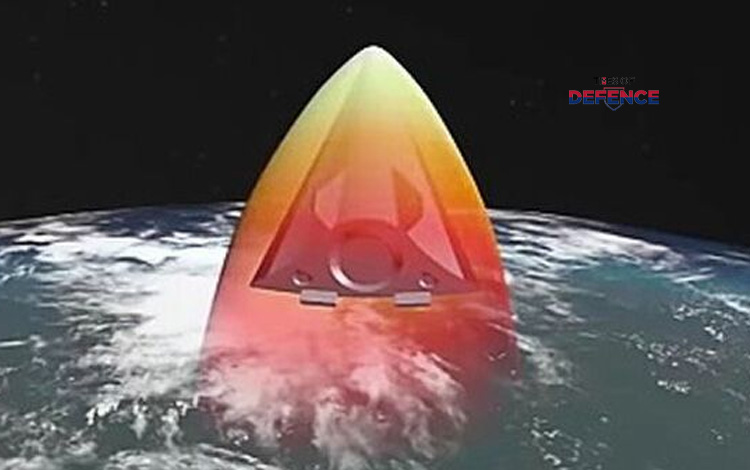
Islamic Revolutionary Guard Corps (IRGC) Aerospace Force Brigadier General Ali Reza Balali has released new operational and technical disclosures regarding the flight-control mechanics and penetration capabilities of Iran’s Fattah-2 Hypersonic Glide Vehicle (HGV).
Speaking following combat evaluations and operational deployments during the 2026 Middle East hostilities, Gen. Balali detailed how the Fattah-2 utilizes dynamic, multi-algorithm flight-control software rather than a fixed ballistic or single-curve trajectory. By continuously altering azimuth, altitude, and terminal approach vectors inside the upper atmosphere, the HGV is engineered to defeat predictive radar tracking models and saturate multi-layered Integrated Air Defense Systems (IADS).
TECHNICAL SPECIFICATIONS: FATTAH-2 HYPERSONIC GLIDE VEHICLE (HGV) ARCHITECTURE
Propulsion, Aerodynamic Airframe & Kinematic Envelope
⚡ Developer & Manufacturer: IRGC Aerospace Force / Aerospace Industries Organization (AIO) (Iran)
⚡ System Classification: Medium-Range Hypersonic Boost-Glide Weapon System (HGV)
⚡ Propulsion Architecture:
• First Stage: Solid-fuel rocket booster derived from the Kheibar Shekan/Fattah-1 airframe architecture
• Second Stage / Glide Body: Wedge-shaped aerodynamic lifting-body Hypersonic Glide Vehicle equipped with a liquid-fuel sustainer/maneuvering thruster unit
⚡ Operational Range: 1,400 to 1,500 km (covering strategic targets across the Levant, Persian Gulf, and Arabian Sea)
⚡ Velocity Profile: Peak velocity up to Mach 13–15 during boost-glide transition; maintains >Mach 5–10 terminal dive velocity
⚡ Payload & Warhead Configuration: 200 to 500 kg high-explosive (HE) or hardened-target kinetic penetrator warhead
⚡ Launch Infrastructure: Road-mobile Transporter Erector Launcher (TEL) vehicles enabling shoot-and-scoot survivability 
Multi-Algorithm Flight Control & Terminal Guidance Suite
💥 Trajectory Shaping Architecture: Employs multiple, switching guidance algorithms to execute non-ballistic skip-glide maneuvers at altitudes between 12 and 30 km, defeating linear ballistic trajectory calculators
💥 Azimuth Deception & Off-Axis Approach: Capable of executing late-stage lateral turns to strike targets from unexpected bearings, concealing the true launch azimuth from defending radar operators
💥 Navigation & Terminal Homing: Inertial Navigation System (INS) coupled with multi-constellation satellite navigation updates and active aerodynamic control fins for high-G terminal pull-down maneuvers
TIMES OF DEFENCE ASSESSMENT
The operational maturation and combat employment of the Fattah-2 HGV highlight pivotal shifts in regional missile warfare and air defense doctrine:
1. **Transition from Maneuverable Reentry Vehicles (MaRV) to True Boost-Glide Profiles**: Unlike the baseline Fattah-1—which relies on a solid-fuel booster and a thrust-vectoring Maneuverable Reentry Vehicle (MaRV) along a depressed ballistic arc—the Fattah-2 deploys a dedicated aerodynamic lifting-body glider. Gliding inside the 12–30 km atmospheric envelope compresses radar horizon detection windows, reducing reaction times for upper-tier endo/exo-atmospheric interceptors such as Arrow-3, THAAD, and SM-3.
2. **Invalidating Single-Vector Predictive Interception Models**: Traditional ballistic missile defense (BMD) relies on tracking a missile’s boost phase to compute a deterministic impact point. By integrating multi-algorithm lateral maneuvering and off-axis terminal approaches, the Fattah-2 forces defending fire-control radars to continuously recalculate firing solutions, significantly increasing interceptor expenditure per incoming threat.
3. **Forcing a Paradigm Shift Toward “Zone Defense” Air Defense Architectures**: As acknowledged by Israeli defense industry leadership (Rafael Advanced Defense Systems), chasing Mach 10+ maneuvering targets with faster kinetic hit-to-kill interceptors faces severe thermal and aerodynamic limits in the atmosphere. Consequently, the proliferation of operational HGVs in the Middle East is accelerating the shift toward distributed “zone defense” sensor grids, high-energy directed-energy weapons, and terminal point-defense saturation shields.

