



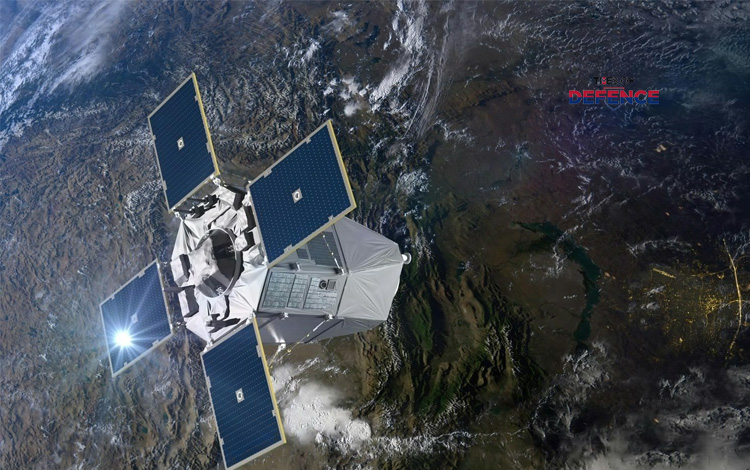
France’s Direction Générale de l’Armement (DGA) has formally awarded a multi-year industrial contract valued at more than €1.5 billion to a consortium comprising lead contractor Airbus Defence and Space and co-contractor Thales Alenia Space (TAS).
The contract encompasses the detailed system design, manufacturing, qualification, and testing of two next-generation **IRIS** (*Instruments de Renseignement et d’Imagerie Spatiale*) satellites, alongside development of the control and user ground segments, long-term in-orbit operations, and maintenance support running through the end of the 2030s. The program is designed to secure and advance France’s independent space-based imagery intelligence (IMINT) and situational awareness capabilities.
TECHNICAL SPECIFICATIONS: IRIS IMAGING SATELLITE ARCHITECTURE
Payload Performance, Optics & Artificial Intelligence Integration
⚡ Primary Mission Profile: Extremely High-Resolution (EHR) day-and-night optical and infrared reconnaissance across the visible and IR spectrums
⚡ Dual-Use Orbital Surveillance: Equipped to image orbital objects and space debris, providing dedicated Space Situational Awareness (SSA) and threat characterization capabilities
⚡ Industrial Division of Labor:
• Airbus Defence and Space: Prime contractor responsible for both satellite platforms, a significant share of the first satellite’s optical payload, and overall ground segment architecture
• Thales Alenia Space (TAS): Responsible for the advanced optical payload of the second satellite (described as the most advanced optical instrument built in Europe), critical elements of the first payload, and ground segment contributions
⚡ Advanced Sensor & Optical Technologies:
• Hyper-stable telescope incorporating active optics and ultra-sensitive, high-speed digital sensors
• Artificial Intelligence (AI)-based onboard and ground image processing pipelines to minimize data latency and accelerate tactical intelligence dissemination
• Key European Subcontractors: Lynred, Pyxalis, Sodern, Safran Reosc, and Air Liquide Advanced Technologies 
Constellation Succession & Operational Timeline
💥 Predecessor System Replacement: Succeeds the three-satellite CSO (*Composante Spatiale Optique*) constellation of the MUSIS programme (launched between 2018 and 2025)
💥 Deployment Schedule:
• First IRIS Satellite: Planned to enter service around 2033 to ensure operational continuity as CSO-1 and CSO-2 phase out
• Second IRIS Satellite: Scheduled to be in orbit by 2035, providing a generational leap in image resolution following the operational lifespan of CSO-3
💥 Command & Control: Operated by the French Air and Space Force’s Space Command (*Commandement de l’Espace* – CDE) from Toulouse
TIMES OF DEFENCE ASSESSMENT
The formalization of the IRIS contract highlights key strategic shifts in European defense space architectures:
1. **Securing Autonomous National Strategic Intelligence (IMINT)**: Replacing the aging CSO constellation with IRIS ensures that France preserves independent, ITAR-free oversight of global hotspots. By decreasing data latency and elevating image fidelity via AI processing, the French Armed Forces retain unconstrained sovereign decision-making power in rapidly shifting geopolitical environments.
2. **Expanding Space Situational Awareness (SSA) into Optical Reconnaissance**: Integrating space-tracking observation modes directly into a high-resolution Earth observation architecture reflects the growing militarization of orbital domains. The ability to characterize orbital threats complements traditional terrestrial surveillance.
3. **Preserving European Industrial Base Synergy and Open Cooperation**: While maintaining strict national sovereignty over core technologies, the IRIS framework preserves historical precedents set by MUSIS by remaining explicitly open to international cooperation with allied European partner nations.

