


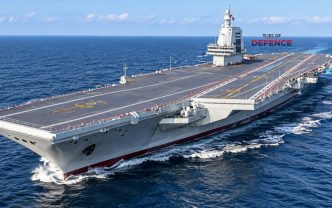
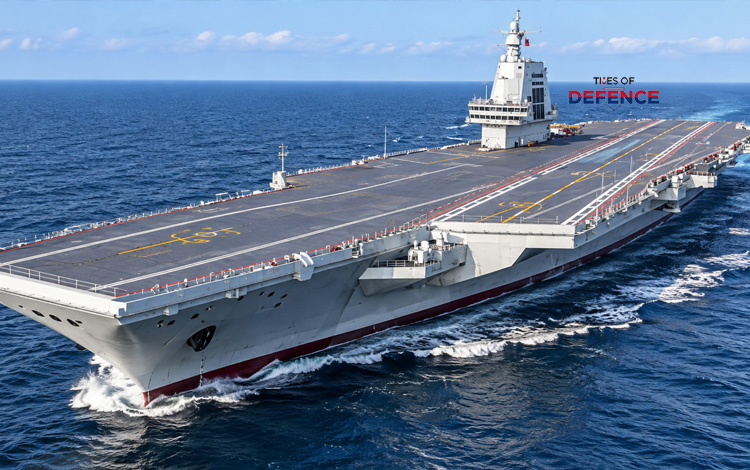
Commercial satellite imagery and defense-intelligence assessments published in late November 2026 indicate that China’s fourth aircraft carrier—widely designated by analysts as the Type 004—has reached advanced hull assembly at the Dalian Shipyard in Liaoning Province, positioning the supercarrier for a potential float-out launch as early as 2027.
Measuring approximately 322 meters along its unfinished hull as of October 2026—with projected completed dimensions of roughly 336 to 339 meters in length and a 46-meter waterline beam, surpassing the 316-meter conventionally powered Type 003 Fujian commissioned in November 2025—the vessel exhibits two shielded internal compartments (~15 by 15 meters each) that defense analysts at CSIS and Janes judge likely to house twin nuclear propulsion reactors. Combining nuclear power with electromagnetic aircraft launch systems (EMALS)—potentially expanding from Fujian’s three catapults to four—is assessed to eliminate propulsion refueling constraints, provide high electrical power reserves for rapid sortie generation without payload compromises, and support an embarked air wing of roughly 75 to 100 crewed and uncrewed aircraft ahead of multi-year fitting-out and sea trials following launch.
TECHNICAL SPECIFICATIONS: PLAN TYPE 004 NUCLEAR SUPERCARRIER PROJECTION
1. Construction Location, Timeline & Propulsion Architecture
⚡ Shipyard & Assembly Status: Under construction in the primary graving dock at Dalian Shipyard (the same facility used to refit Liaoning and build Shandong), where prefabricated modules first appeared in early 2025 and formed a recognizable hull within roughly two years
⚡ Projected Launch & Commissioning Horizon: Hull progress mirrors Type 003 Fujian roughly one year prior to its float-out, pointing to a potential launch in 2027 (potentially timed near the August 1, 2027 PLA centenary), followed by an estimated five to ten years of outfitting, harbor testing, and sea trials before operational deployment
⚡ Nuclear Propulsion Assessment: Unconfirmed by Beijing, though satellite imagery reveals two multi-layered, shielded ~15 m x 15 m internal hull compartments consistent with twin naval nuclear reactor containment structures (supported by land-based naval reactor prototype work linked to CSIC’s 701st Research Institute in Sichuan) 
2. Hull Dimensions, Electromagnetic Catapults & Embarked Air Wing
💥 Estimated Hull Dimensions & Displacement: Unfinished hull measured at ~322 m length and ~46 m beam in October 2026, with finished length projected around 336–339 m and full-load displacement estimated at 110,000–120,000 tonnes—placing it in the size class of U.S. Navy Nimitz- and Gerald R. Ford-class supercarriers
💥 Launch & Recovery Systems: Expected to feature Electromagnetic Aircraft Launch Systems (EMALS) powered directly by the ship’s nuclear electrical plant, with analysts rating a four-catapult layout (and potentially a third aircraft elevator) plausible to accelerate launch tempo and combat refueling turnarounds
💥 Projected Carrier Air Wing (~75–100 Aircraft): Envisioned to embark Shenyang J-35 stealth fighters, catapult-capable J-15T multirole fighters, J-15DT electronic-warfare aircraft, KJ-600 airborne early warning and control (AEW&C) aircraft, and carrier-capable unmanned combat aerial vehicles (such as GJ-11/GJ-21 derivatives)
TIMES OF DEFENCE ASSESSMENT
The rapid hull progression of China’s Type 004 aircraft carrier at Dalian ahead of a potential 2027 launch highlights three critical shifts in Indo-Pacific naval power, blue-water endurance, and shipbuilding tempo:
1. Transitioning From Regional Sea Control to Sustained Blue-Water Power Projection: Adopting nuclear propulsion frees the carrier from frequent fuel-oil replenishment, allowing PLAN carrier strike groups to sustain high-speed transits and extended operations well beyond the First and Second Island Chains.
2. High-Output Nuclear Electrical Generation Unlocks Peak EMALS Sortie Rates: Pairing twin nuclear reactors with up to four electromagnetic catapults removes power-generation bottlenecks, enabling heavier aircraft payloads and faster combat launch-and-recovery cycles than conventionally powered carriers.
3. Compressed Shipyard Assembly Cycles Narrow the Supercarrier Gap: Assembling a Ford-class-sized hull in under two years—even with five to ten years of outfitting and trials still ahead—demonstrates China’s dual-yard carrier shipbuilding capacity as Beijing works toward a broader multi-carrier fleet into the 2030s.

