


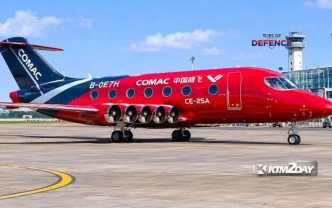
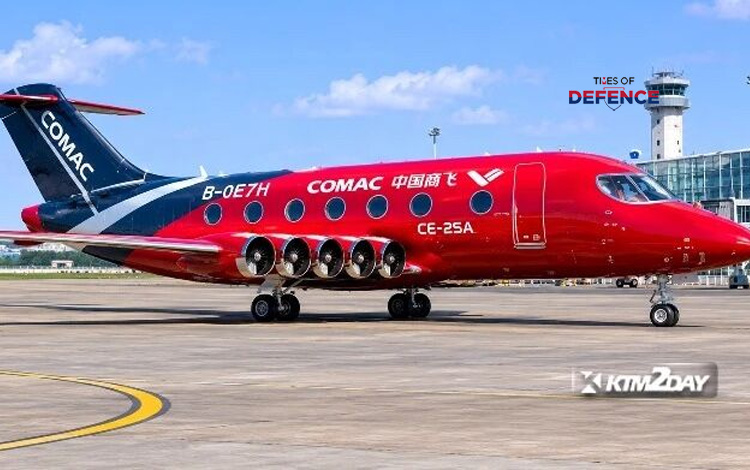
The state-owned Commercial Aircraft Corporation of China (COMAC), working in partnership with battery giant Contemporary Amperex Technology Co. Limited (CATL) and Shanghai Jiao Tong University, has successfully completed the maiden piloted flight of the **CE-25A**, marking a milestone in heavy all-electric aviation.
Conducted on November 14, 2026, in Binzhou, Shandong Province, the test sortie lasted 57 minutes and 46 seconds in total, including **16 minutes and 38 seconds of airborne flight** covering 60.4 kilometers with two pilots and a flight-test engineer aboard. Prior to the crewed milestone, the prototype (registered B-0EFH) logged **19 uncrewed autonomous test flights** beginning February 2, 2026. Designed under China’s CCAR-25 transport-category airworthiness standards—whose type-certificate application has been formally accepted by the Civil Aviation Administration of China (CAAC)—the 10-tonne aircraft demonstrates distributed electric propulsion, high-density energy storage, and thermal-management technologies with direct dual-use implications for military logistics and unmanned aerial systems.
TECHNICAL SPECIFICATIONS: COMAC CE-25A ALL-ELECTRIC TRANSPORT
Airframe, Distributed Propulsion & Flight Performance
⚡ Prime Contractor & Consortium: Commercial Aircraft Corporation of China (COMAC), CATL, and Shanghai Jiao Tong University
⚡ Maximum Takeoff Weight (MTOW): 10 metric tons (10,000 kg)
⚡ Propulsion Architecture: Distributed electric propulsion (DEP) layout utilizing **10 electric ducted fans** (five mounted in rows above each wing) on a T-tail regional commuter airframe, eliminating conventional turbofans or turboprops
⚡ Flight Performance Envelope: Cruise speed of **300 km/h** (186 mph) at a cruising altitude of **2,400 meters** (approx. 7,874 ft), with an operational range of **400 kilometers** (250 miles)
⚡ Payload & Seating Configuration: Engineered for short-haul intercity regional routes carrying up to **19 passengers** (or equivalent modular cargo loads) 
Energy Storage, Autonomy & Dual-Use Technology
💥 High-Density Battery Integration: Powered by advanced aviation-grade battery packs developed with CATL, integrating high-output electric motors, solid-state power distribution buses, and active thermal-management systems
💥 Autonomous Flight Controls: Validated across 19 uncrewed autonomous test sorties prior to crewed operation, proving fly-by-wire multi-motor thrust vectoring and autonomous flight-control algorithms
💥 Dual-Use Military Applications: Enables low-acoustic, low-thermal-signature tactical transport, scalable distributed propulsion for heavy unmanned combat/cargo platforms (complementing platforms like the YH-1000S hybrid cargo drone), and fuel-independent logistics
TIMES OF DEFENCE ASSESSMENT
The maiden crewed flight of the 10-tonne COMAC CE-25A represents three strategic breakthroughs for China’s aerospace and defense-industrial base:
1. **Advancing Distributed Electric Propulsion (DEP) for Military UAVs**: Operating 10 synchronized electric ducted fans across a 10-tonne airframe requires sophisticated power-management, thermal-dissipation, and flight-control software. Mastering multi-motor distributed propulsion directly accelerates China’s ability to build unconventional, low-signature military transport and heavy unmanned platforms.
2. **Insulating Logistics from Fossil-Fuel Chokepoints**: As a major net importer of crude oil, Beijing views aviation electrification alongside fourth-generation nuclear power and renewable grids as a strategic hedge. Scaling electric and hybrid-electric airlift reduces military and civil aviation vulnerability to maritime energy blockades during high-intensity conflicts.
3. **Weaponizing Commercial Battery Dominance for Aerospace**: Integrating CATL—the world’s largest battery manufacturer—into state aerospace programs allows China to rapidly transition commercial energy-storage breakthroughs into aviation-grade powerplants, creating an indigenous supply chain free from foreign export controls.

