


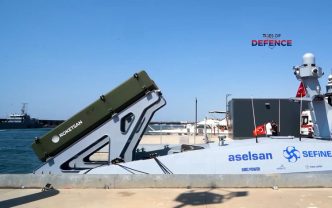
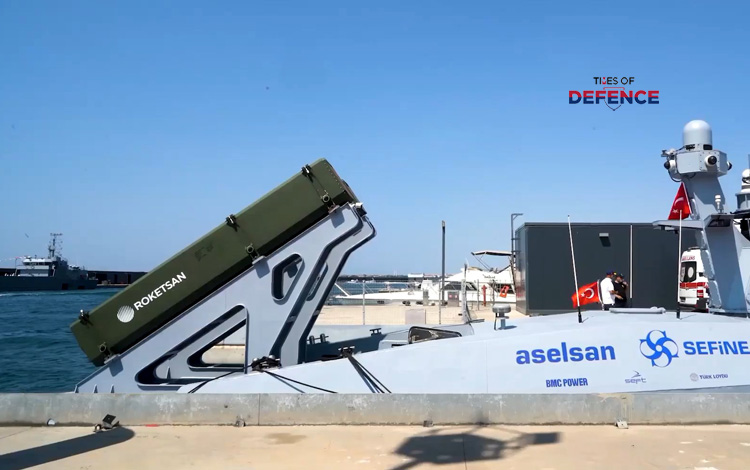
Following the Indonesian Navy’s (TNI AL) November 25, 2026 acceptance of its lead KSR X33 optionally crewed missile-capable fast attack boat—commissioned as Patkamla Geledek (II-5-46) from domestic shipbuilder PT Lundin Industry Invest (North Sea Boats)—defense reporting confirms that three larger follow-on KSR X33 vessels scheduled for delivery in 2027 will integrate Turkish ASELSAN mission and autonomous control systems while expanding armament capacity to four anti-ship missiles, with ROKETSAN’s ÇAKIR cruise missile under evaluation for series-production boats.
Built from carbon-fiber composite in Banyuwangi, East Java, the lead 20-meter KSR X33 employs Norwegian Kongsberg autonomous navigation and collision-avoidance technology alongside provisions for two anti-ship missiles. On the three enlarged follow-on hulls slated for 2027 handover, ASELSAN subsystems are planned to replace the initial unmanned mission architecture, doubling missile carriage to four rounds and pairing datalink-enabled combat management—supporting swarm coordination and over-the-horizon targeting—with ROKETSAN’s low-observable ÇAKIR cruise missile as a primary armament candidate.
TECHNICAL SPECIFICATIONS: ENLARGED KSR X33 UNMANNED ATTACK BOAT & TURKISH SUBSYSTEM SUITE
1. Hull Builder, Delivery Schedule & ASELSAN Autonomous Integration
⚡ Shipbuilder & Lead-Vessel Baseline: Built by Indonesian composite shipyard PT Lundin Industry Invest (North Sea Boats) in Banyuwangi, East Java; lead boat Patkamla Geledek (II-5-46) handed over on November 25, 2026, with three enlarged follow-on vessels scheduled for Indonesian Navy delivery in 2027
⚡ ASELSAN Mission & Autonomy Suite: Enlarged 2027 boats will integrate ASELSAN unmanned surface vessel (USV) mission, autonomy, and combat electronics in place of the lead hull’s Norwegian Kongsberg unmanned navigation package
⚡ Networked Warfare & Crew Flexibility: Supports both uncrewed remote/autonomous operation (via encrypted and satellite communications links) and optionally crewed operation with up to six personnel, featuring a datalink-enabled combat management system engineered for swarm tactics, coordinated strikes, over-the-horizon targeting, and long-range ISR 
2. Platform Kinematics & Four-Missile / ROKETSAN ÇAKIR Armament Envelope
💥 Propulsion & Speed Performance: Carbon-fiber composite hull driven by twin engines and twin waterjets; lead KSR X33 demonstrated a top speed of 58 knots on sea trials (surpassing its 50-knot contractual requirement) with a cruising speed near 30 knots
💥 Expanded Four-Missile Loadout: Increases anti-ship missile capacity from two launchers on the lead Patkamla Geledek to four anti-ship missiles on each of the three enlarged 2027 vessels, alongside a remote-controlled weapon station for close-in defense
💥 ROKETSAN ÇAKIR Cruise Missile Option: Evaluated for series-production boats; surface-launched ÇAKIR measures 3.8 m in length and 275 mm in diameter with a ~350 kg launch mass, turbojet propulsion offering a 150+ km surface-launched strike range, low radar cross-section, a 70 kg warhead (semi-piercing, blast fragmentation, or thermobaric), and a network-based datalink supporting man-in-the-loop target updates, re-attack, and mission abort
TIMES OF DEFENCE ASSESSMENT
The planned integration of ASELSAN autonomous systems and potential ROKETSAN ÇAKIR cruise missiles onto Indonesia’s 2027 KSR X33 unmanned attack boats highlights three critical shifts in archipelagic naval warfare, Turkish defense exports, and distributed maritime lethality:
1. Multiplying Long-Range Anti-Ship Salvo Density on Compact Composite Hulls: Doubling capacity from two to four cruise missiles on a 58-knot, optionally crewed carbon-fiber craft allows small, dispersed coastal units to project significant over-the-horizon anti-surface firepower across narrow straits and island chokepoints.
2. Deepening Turkish Electronics and Munitions Penetration in Southeast Asian Naval Programmes: Replacing initial European autonomy hardware with ASELSAN systems while positioning ROKETSAN’s ÇAKIR for series builds demonstrates Türkiye’s growing role as a full-stack combat-system and missile supplier to local shipbuilders.
3. Enabling Collaborative Swarm Tactics Without Risking High-Value Surface Combatants: Pairing datalinked combat management with man-in-the-loop cruise missiles enables coordinated multi-boat engagements and forward reconnaissance while keeping larger frigates and crews outside enemy coastal weapon envelopes.

