


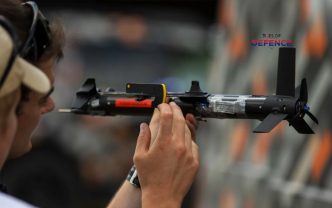
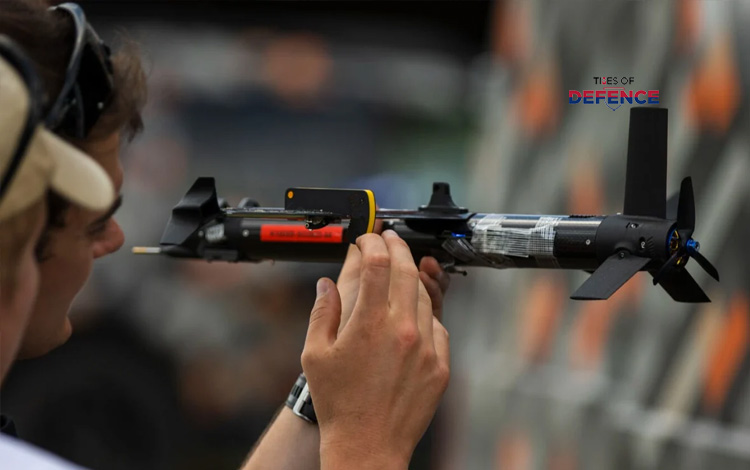
Swedish counter-unmanned systems company Nordic Air Defence (NAD) unveiled the K200 autonomous drone interceptor on November 20, 2026, announcing that the platform is deploying to Ukraine for operational testing and evaluation alongside the opening of a staffed Nordic Air Defence office in the country.
Developed in Stockholm— reportedly engineered within 70 days to meet urgent counter-threat requirements—the K200 serves as the next-generation successor to NAD’s Kreuger 100XR, offering higher speed, roughly double the airframe scale, and a larger 500-gram (1.1-lb) warhead designed to engage faster, jet-powered one-way attack drones such as Russia’s Geran-3 (and reported Geran-4 variants) at a fraction of the cost of conventional air-defense missiles. CEO and co-founder Karl Rosander noted that surging jet-powered Geran launches in 2026—reaching roughly 1,400 in the early months of the year versus 180 across all of 2025—underscore the need for affordable, high-volume interceptors, with NAD targeting in-house production of 1,000 interceptors per month by March 2027 alongside international industrial partnerships.
TECHNICAL SPECIFICATIONS: NORDIC AIR DEFENCE K200 INTERCEPTOR ARCHITECTURE
1. Airframe, Propulsion & Terminal Engagement Profile
⚡ Prime Developer & Manufacturer: Nordic Air Defence (Stockholm, Sweden; engineering and final assembly centralized in Sweden, with regional presence in Ukraine and partnerships across Europe including Poland and the UK)
⚡ Airframe & Warhead Class: Fixed-wing unmanned interceptor roughly twice the size of the Kreuger 100 family, fitted with a 500-gram (1.1-lb) warhead providing an estimated 10–12 meter lethal/blast radius (up from the 250-gram warhead and ~5-meter radius on earlier Kreuger 100/100XR variants)
⚡ Propulsion & Multi-Aspect Attack Geometry: Single-propeller configuration with higher speed than the Kreuger 100XR (~350–354 km/h class on the 100XR), capable of intercepting targets in tail-chase, head-on, or beam/crossing trajectories
⚡ Autonomous Re-Engagement Logic: Transitions from external cueing to autonomous onboard infrared terminal guidance, with capability to circle back and execute a second engagement attempt if an initial pass misses 
2. Sensor Cueing, Modular Launchers & Production Scaling
💥 Cued Midcourse & Infrared Terminal Guidance: Vectored toward targets via external radar and electro-optical/infrared (EO/IR) sensors integrated with air-defense command networks, then switches to its onboard infrared seeker for autonomous terminal homing
💥 Multi-Platform Launch Flexibility: Compatible with modular launchers deployable from ground vehicles, fixed critical-infrastructure sites, and naval vessels (building on NAD’s common launcher family and prior truck-mounted counter-UAS work with Volvo Defense)
💥 Volume Manufacturing Roadmap: Engineered from inception for rapid iteration and scalable serial manufacturing, targeting 1,000 interceptors per month internally by March 2027 supplemented by partner production
TIMES OF DEFENCE ASSESSMENT
Nordic Air Defence’s unveiling of the K200 and its immediate deployment to Ukraine highlight three critical shifts in counter-unmanned air defense, cost-exchange economics, and European defense scaling:
1. Racing to Close the Interceptor Speed and Lethality Gap Against Jet UAVs: As strike drones shift from slower piston-engined airframes toward 350–550 km/h jet-powered designs like the Geran-3, older low-speed or small-warhead interceptors face tighter engagement margins. Pairing higher speed and a 500-gram warhead with re-engagement logic addresses the tougher kinematic profile of jet-propelled threats.
2. Preserving High-Value Air Defense Missiles Through Low-Cost Mass: Expending costly surface-to-air interceptors against massed one-way attack drones rapidly depletes magazines and skews cost-exchange ratios in the attacker’s favor. Scaling autonomous propeller-driven interceptors toward 1,000 units per month by March 2027 aims to restore sustainable magazine depth for layered air defense.
3. Embedding European Defense Startups Directly in Active Threat Environments: Opening a staffed office in Ukraine and running field evaluations alongside domestic assembly in Sweden creates tight feedback loops between real-world threat signatures, software/seeker tuning, and modular launcher integration across land and naval platforms.

