


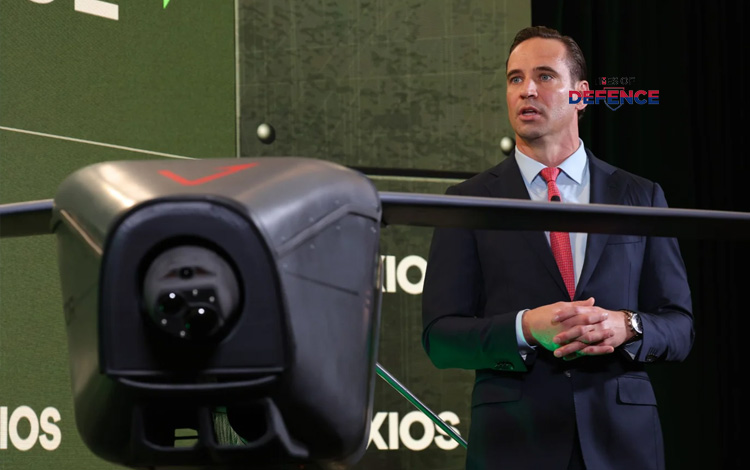
U.S. defense startup Vector (Vector Defense Inc.) unveiled BOMBARD, a ground-launched, pulse-jet-powered long-range one-way attack (LROWA) unmanned strike system, during the Axios Future of Defense Summit in Washington on November 19, 2026, following a company announcement on the same day.
Developed in Bluffdale, Utah—building on Vector’s experience scaling first-person-view (FPV) and tactical drones for the Defense Innovation Unit’s (DIU) Drone Dominance Program—BOMBARD expands the young company (founded in 2024) from short-range tactical drones into deep-strike loitering munitions capable of flying up to 1,100 km (683 miles) with a 50 kg (110 lb) payload at a 378 km/h (235 mph) cruise speed. CEO and co-founder Andy Yakulis confirmed that a variant of BOMBARD has already conducted flight testing while engineering validation continues, and disclosed that the system will also be manufactured locally in Saudi Arabia through the SR2Vector joint venture in Riyadh under the designation SKYWASP to serve an established Saudi demand pipeline.
TECHNICAL SPECIFICATIONS: VECTOR BOMBARD / SKYWASP ARCHITECTURE
1. Airframe, Pulse-Jet Propulsion & Range Envelope
⚡ Prime Developer & Manufacturer: Vector (Bluffdale, Utah; founded 2024), with localized Saudi manufacturing via the SR2Vector joint venture in Riyadh under the SKYWASP name
⚡ Range, Speed & Weight Class: Maximum range of up to 1,100 km (683 miles), cruise speed of 378 km/h (235 mph), maximum takeoff weight of 127 kg (281 lbs), and payload capacity of 50 kg (110 lbs)
⚡ Propulsion Architecture: Fuel-agnostic pulse-jet engine featuring minimal moving parts operating via rapid cyclic combustion bursts—a mechanical simplicity modeled on low-cost pulse-jet principles aimed at reducing build complexity, cost, and sustainment burden
⚡ Launch Mode & Production Scaling: Ground-launched one-way attack architecture engineered from inception for high-volume U.S. manufacturing and scalable attritable production rather than bespoke low-rate runs 
2. Autonomous Navigation, Modular Payload & Joint Venture Context
💥 End-to-End Autonomy & GNSS-Denied Navigation: Designed for autonomous flight from launch through terminal engagement with GPS-denied / anti-jam navigation capabilities to operate in contested electronic-warfare environments
💥 Modular Payload Interface: Incorporates a modular payload bay supporting mission-specific warhead or sensor configurations within its 50 kg (110 lb) payload envelope
💥 U.S.–Saudi Industrial Localization: Paired with SR2Vector (a joint venture between SR2 Defense Systems and Vector in North Riyadh) to localize long-range one-way attack drone manufacturing in Saudi Arabia as SKYWASP, supporting domestic defense industrial localization and regional deterrence
TIMES OF DEFENCE ASSESSMENT
Vector’s unveiling of the pulse-jet BOMBARD attack drone and its parallel localization path via SR2Vector’s SKYWASP program highlight three critical shifts in long-range attritable strike and defense manufacturing:
1. Pursuing Affordable Long-Range Mass via Simplified Pulse-Jet Propulsion: High-subsonic turbojets and complex piston engines can drive up unit cost and supply-chain bottlenecks in deep-strike one-way attack drones. Using a low-parts-count, fuel-agnostic pulse-jet design targets an attritable cost-exchange ratio against high-value targets and expensive air-defense interceptors.
2. Translating Tactical Drone Scaling Into Deep-Strike Munitions: Moving from compact FPV and tactical systems into a 1,100-km strike airframe while maintaining GNSS-denied autonomy reflects how agile defense startups are applying high-volume manufacturing lessons from Ukraine and DIU programs to longer-range precision effects.
3. Pairing U.S. Design Agility With Middle Eastern Sovereign Manufacturing: Building BOMBARD in the United States while establishing SKYWASP production in Riyadh through SR2Vector aligns rapid Western drone engineering with Gulf localization priorities and regional counter-asymmetric deterrence needs.

