


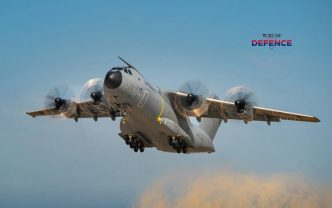
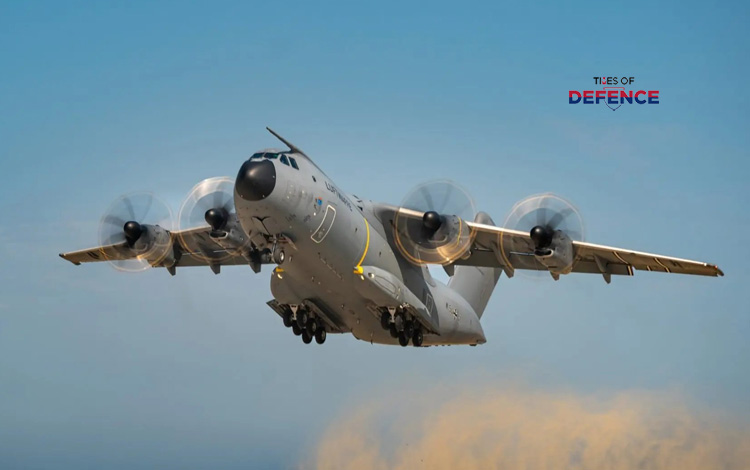
The German Bundestag Budget Committee has approved funding amendments authorizing the Federal Ministry of Defence (BMVg) to procure 16 new tactical-standard Airbus A400M Atlas airlifters to replace the German Air Force’s (Luftwaffe) earliest-delivered aircraft—all under 15 years old.
Stationed with Air Transport Wing 62 at Wunstorf Air Base, Germany’s 53-aircraft A400M fleet—completed with the handover of its final airframe in April 2026—includes 16 initial “logistical” baseline aircraft delivered starting in 2014. Because these early-build airframes lack full tactical self-protection suites—most notably the Elbit Systems J-MUSIC Directed Infrared Countermeasures (DIRCM) laser defense system—they are restricted from operating in contested airspace threatened by infrared-guided surface-to-air missiles and MANPADS. Rather than conducting costly structural retrofits on the older hulls, Defense Minister Boris Pistorius and German defense planners opted to acquire 16 factory-new tactical A400Ms equipped with full electronic warfare, missile warning, and DIRCM architectures, while divesting the 16 legacy logistical airframes to allied partner nations.
TECHNICAL SPECIFICATIONS: GERMAN AIR FORCE A400M TACTICAL STANDARD & ELBIT J-MUSIC DIRCM ARCHITECTURE
1. Airbus A400M Tactical Airframe & Heavy Airlift Performance
⚡ Prime Contractor & Assembly: Airbus Defence and Space (final assembly in Seville, Spain; major fuselage sections manufactured in Bremen, Germany)
⚡ Powerplant & Runway Autonomy: Powered by four Europrop TP400-D6 turboprop engines (~11,000 shp each) driving eight-bladed counter-rotating composite propellers, enabling operations from short, austere, and unpaved dirt or sand strips
⚡ Payload & Range Envelope: Carries a maximum payload of 37 tonnes (340 m³ cargo hold volume) across ranges up to 6,300 km (3,915 miles) at cruise speeds up to Mach 0.68–0.72, supporting strategic airlift, low-level tactical flight, paratroop drops, and air-to-air refueling 
2. Elbit Systems J-MUSIC DIRCM & Contested Airspace Survivability
💥 Directed Infrared Countermeasures (DIRCM): Integrates Elbit Systems’ J-MUSIC (Joint Multi-Spectral Infrared Countermeasure) multi-turret laser system (selected under a $260 million contract in July 2025) to detect, track, and blind incoming heat-seeking missiles with high-energy dual-band laser beams
💥 Integrated Missile Warning & Electronic Warfare: Pairs hyper-hemispherical DIRCM turrets with passive infrared Missile Warning Systems (MWS), radar warning receivers, and chaff/flare dispensers for fully autonomous threat engagement without pilot workload
💥 Fleet Standardization & Industrial Impact: Replaces the 16 non-tactical baseline airframes so all 53 Luftwaffe A400Ms share a unified combat-ready configuration, while extending Airbus’s A400M production backlog (currently 37 aircraft remaining out of 178 total orders) by approximately 43%
TIMES OF DEFENCE ASSESSMENT
Germany’s decision to replace 16 relatively young A400M transports with factory-new tactical aircraft highlights three critical shifts in European air mobility and defense industrial strategy:
1. Prioritizing Contested-Airspace Survivability Over Peacetime Logistics: Early-generation A400M deliveries were optimized for permissive peacekeeping and humanitarian airlift. In a high-intensity NATO deterrence scenario against modern integrated air defenses and proliferating MANPADS, an unshielded strategic airlifter lacking DIRCM protection cannot safely approach forward operating bases.
2. Economic Rationality of Fleet Replacement vs. Deep Structural Retrofits: Re-wiring and structurally modifying 16 early-build airframes to accommodate multi-turret DIRCM pods, power generation upgrades, and tactical datalinks entails severe downtime and engineering expense. Purchasing new-build tactical hulls while reselling the legacy logistical transports to partner nations preserves Luftwaffe fleet availability while lowering net acquisition cost.
3. Sustaining the European A400M Production Line: With Airbus’s A400M order backlog down to 37 airframes as of late 2026, Berlin’s 16-aircraft commitment injects vital industrial continuity for German fuselage plants in Bremen and final assembly lines in Seville—bridging the gap until potential follow-on orders from France, Poland, and Denmark materialize.

