



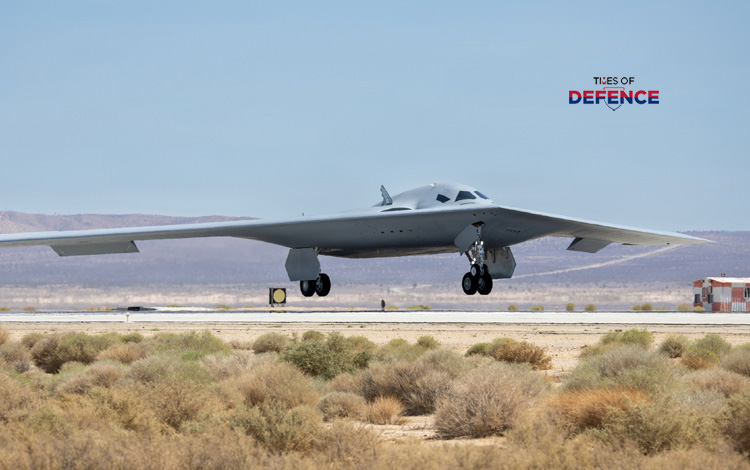
The Department of the Air Force announced on November 13, 2026, that it successfully executed a weapons release test for the sixth-generation B-21 Raider strategic stealth bomber during flight operations from Edwards Air Force Base, California, the previous week.
Executed by the B-21 Combined Test Force, the milestone transition shifts the platform from pure aerodynamic and flight envelope testing into functional weapons integration. During the sortie, a pre-production B-21 test aircraft successfully released a conventional munition, validating thousands of hours of virtual modeling within the aircraft’s digital twin environment alongside the maturity of its open systems architecture. Air Force leadership confirmed the program remains firmly on schedule to deliver its first operational aircraft to Ellsworth Air Force Base, South Dakota, in 2027.
TECHNICAL SPECIFICATIONS: B-21 RAIDER ARCHITECTURE & WEAPONS INTEGRATION
Airframe, Stealth & Digital Engineering Framework
⚡ Prime Contractor & Developer: Northrop Grumman (United States)
⚡ Platform Classification: Sixth-Generation Long-Range Penetrating Strike Strategic Bomber (Dual-Capable: Conventional & Nuclear)
⚡ Airframe Design & Crew: Low-observable flying-wing configuration utilizing next-generation stealth coatings and reduced-signature propulsion integration; configured for a two-pilot operational crew
⚡ Digital Twin & Open Architecture:
• Engineered using a high-fidelity digital twin model that predicted weapon separation aerodynamics and trajectory dynamics prior to live flight testing
• Built with a modular open systems architecture (MOSA) allowing rapid software updates and plug-and-play integration of emerging sensors, communications links, and weapons without structural airframe redesigns 
Payload Envelope, Arsenal & Fleet Modernization Roadmap
💥 Internal Weapons Bay: Single primary ventral weapons bay engineered to accommodate a diverse mix of direct-attack and stand-off munitions
💥 Planned Munitions Suite:
• Conventional: Precision-guided Joint Direct Attack Munitions (JDAMs), AGM-158 JASSM-ER stand-off cruise missiles, and next-generation penetrating bunker-busters
• Nuclear Triad Role: B61-12 gravity glide bombs, B61-13 high-yield bunker-buster variants, and the AGM-181A Long-Range Stand-Off (LRSO) nuclear cruise missile
💥 Fleet Procurement & Basing: Program of record calls for a minimum of 100 aircraft to replace legacy B-1B Lancer and B-2 Spirit fleets, with Ellsworth AFB serving as the first Main Operating Base (MOB-1) in 2027
TIMES OF DEFENCE ASSESSMENT
The successful live weapons separation test of the B-21 Raider underscores three critical shifts in U.S. strategic deterrence and aerospace acquisition:
1. **Validating Digital Engineering to Compress Test Schedules**: By relying on thousands of hours of virtual digital-twin simulation before dropping live ordnance, the B-21 Combined Test Force eliminated traditional physical prototyping bottlenecks, keeping a complex sixth-generation program on schedule for 2027 fielding.
2. **Future-Proofing Strike Lethality via Open Systems Architecture**: Modern anti-access/area denial (A2/AD) networks evolve rapidly. Proving that the B-21 can rapidly onboard new weapons through open software interfaces ensures the bomber can adapt to emerging munitions and electronic warfare threats over a multi-decade service life.
3. **Transitioning from Experimental Flight Test to Operational Readiness**: Moving into live weapons testing—coupled with recent aerial refueling validations and operational test-pilot flights—signals that the B-21 is maturing rapidly toward replacing aging B-1B and B-2 fleets as the survivable backbone of U.S. global strike power.

