


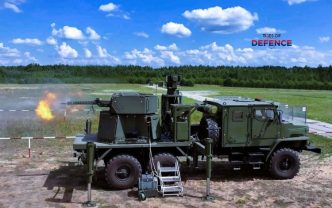
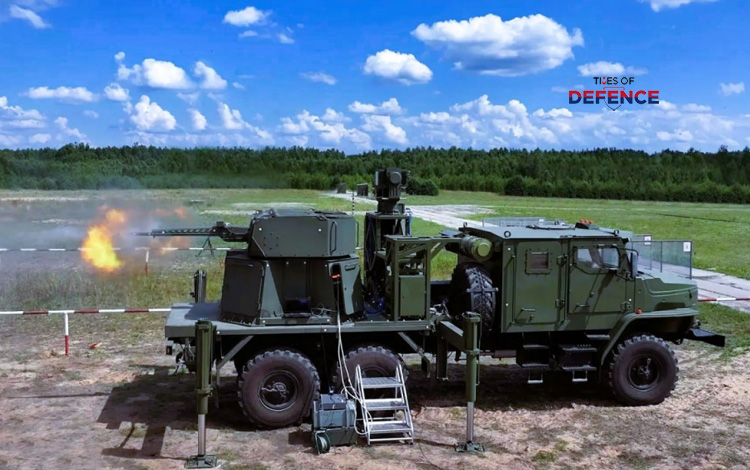
State-owned defense conglomerate Rostec officially announced on November 6, 2026, the development of a mobile, vehicle-mounted derivative of its Citadel anti-aircraft artillery system (AAS).
The new iteration integrates the system’s kinetic combat module, multi-band radar, and electro-optical (EO/IR) detection suites directly onto a high-mobility wheeled chassis. Engineered to expand operational flexibility, the mobile Citadel variant provides fast-response point defense for convoy escort, mobile fire teams, high-value industrial infrastructure, and field deployments against low-altitude unmanned aerial vehicles (UAVs) and low-observable cruise missiles. Rostec confirmed that the base stationary variant of the Citadel AAS has already completed field deployments in operational combat zones.
TECHNICAL SPECIFICATIONS: ROSTEC CITADEL MOBILE AAS ARCHITECTURE
System Architecture, Chassis Integration & Mobility Profile
⚡ Lead Integrator & Developer: High-Precision Systems / Rostec State Corporation (Russia)
⚡ Platform Configuration: Self-contained, highly mobile short-range air defense (SHORAD) module mounted on an armored 8×8 or 6×6 cross-country vehicle chassis
⚡ Target Engagement Spectrum: Low-RCS Class 1–3 tactical reconnaissance drones, kamikaze FPV loitering munitions, precision-guided munitions (PGMs), and subsonic cruise missiles
⚡ Operational Deployment Capability: Rapid setup-to-fire transition enabling quick displacement between firing positions to avoid counter-battery and standoff SEAD/DEAD strikes 
Fire Control, Sensor Integration & Smart Munition Kinematics
💥 Ordnance & Cannon Baseline: High-rate-of-fire rapid-burst automatic cannon module firing specialized airburst counter-drone munitions
💥 Advanced Fire-Control System (FCS): Integrated multi-frequency search/tracking radar combined with an automated day/thermal optical tracking channel featuring dynamic lead-angle computation
💥 Programmable Airburst Ammunition: Employs smart munitions with time-delayed, programmable fuse actuation. The FCS codes each projectile at the muzzle, detonating it immediately in front of target tracks to project high-density tungsten fragmentation clouds
💥 Operational Efficiency: Significantly reduces ammunition expenditure per kill compared to legacy unguided anti-aircraft guns (e.g., ZSU-23-4 Shilka, 2A38M), ensuring high engagement capability against multi-axis drone swarms
TIMES OF DEFENCE ASSESSMENT
The transition of the Citadel AAS from a fixed point-defense installation to a mobile, vehicle-mounted platform highlights important tactical shifts in counter-drone warfare:
1. **Closing the Point-Defense Gap Against FPVs and Swarms**: High-value SAM systems (such as S-300/S-400 or Tor-M2) face severe cost imbalances and magazine depletion when forced to engage low-cost suicide drones. Utilizing a mobile auto-cannon equipped with programmable airburst munitions offers a highly sustainable, low-cost-per-kill solution to protect military logistics and critical energy infrastructure.
2. **Mobility and Survivability for Mobile Air Defense Teams**: Stationary counter-drone positions are easily mapped by adversary satellite imagery and signals intelligence, making them vulnerable to standoff artillery or loitering munition strikes. Mounting the Citadel module on a wheeled chassis allows mobile fire teams (“hunter-killer” units) to rapidly redeploy along threatened axes, providing escort protection for tactical columns while minimizing counter-battery risk.
3. **Optimizing Kinetic Interception via Programmable Fragmentation**: Standard legacy AA guns rely on direct kinetic hits, requiring dense shell spreads to down small quadcopters. Incorporating programmable muzzle-fuzing technology allows the Citadel system to generate lethal shrapnel curtains directly in a target’s flight path, drastically improving first-burst kill probability while conserving ammunition magazine depth.

