


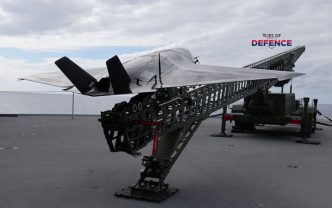
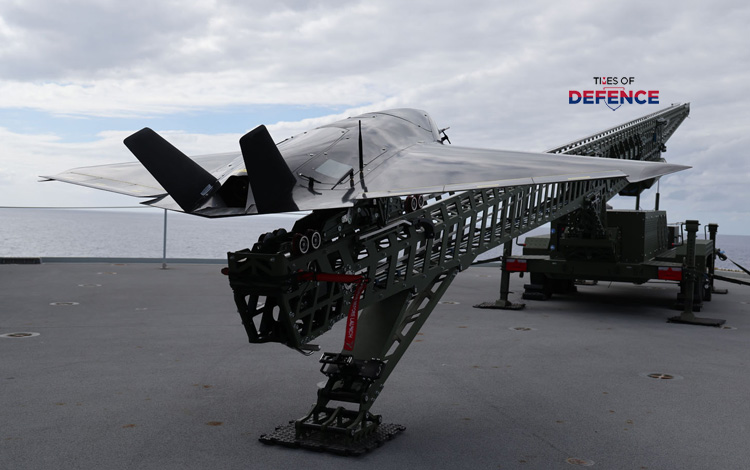
The UK Royal Navy, in coordination with BAE Systems entity Callen-Lenz, successfully launched Nyan One-Way Effector (OWE) uncrewed air systems from the flight deck of the aircraft carrier HMS Queen Elizabeth (R08) during Exercise Neptune Reach B in mid-October 2026.
This milestone marks the first operational launch of fixed-wing one-way strike drones from a Royal Navy aircraft carrier. During the North Atlantic trial, four separate Nyan OWE platforms launched from a pneumatic catapult rail setup on the flight deck, successfully navigating to and impacting designated maritime target points with a 100% strike rate. The trial follows initial seaborne launch evaluations conducted earlier in 2026 aboard the Royal Navy experimentation vessel XV Patrick Blackett during Exercise Neptune Reach A.
TECHNICAL SPECIFICATIONS: CALLEN-LENZ / BAE SYSTEMS NYAN OWE SYSTEM ARCHITECTURE
System Classification, OEM & Development Ecosystem
⚡ System Lead & OEM: Callen-Lenz (A BAE Systems company / Salisbury, Wiltshire, UK)
⚡ Innovation Framework: Developed under BAE Systems FalconWorks portfolio under Project Vantage
⚡ Platform Type: Compact, low-cost, jet-powered one-way attack (OWA) uncrewed air system / loitering munition
⚡ Operational Lineage:
• Terrestrial Trialing: Validated during British Army Exercise Spring Storm in Estonia (deep fires role)
• Littoral Testing: First seaborne launch from experimentation vessel XV Patrick Blackett (Neptune Reach A)
• Carrier Integration: Flight deck integration onboard HMS Queen Elizabeth (Neptune Reach B) 
Airframe Kinematics, Guidance & Launch Profile
💥 Airframe Features: Low radar cross-section (RCS) composite wing-body design with modular payload compartment
💥 Propulsion System: Miniature high-thrust internal turbojet engine
💥 Launch Mechanism: Pneumatic rail-launcher compatible with non-catapult STOVL flight decks and unprepared ground launch sites
💥 Navigation & Targeting Suite: Modular GNSS-denied navigation architecture, utilizing optronic/terrain matching and pre-programmed strike terminal homing
💥 Tactical Engagement Spectrum: Penetration deep strike, low-cost tactical decoy missions, activation/saturation of adversary integrated air defense systems (IADS), and contested maritime interdiction
TIMES OF DEFENCE ASSESSMENT
The launch of Nyan strike drones from HMS Queen Elizabeth demonstrates a practical shift toward hybrid carrier air wings within NATO naval operations.
From an aerospace defense and naval air warfare perspective, three key strategic insights emerge:
1. **Pioneering “Low-Cost Mass” on Non-CATOBAR Aircraft Carriers**: The Queen Elizabeth class was engineered specifically for Short Take-Off and Vertical Landing (STOVL) operations centered on the F-35B Lightning II, lacking catapult launch systems. Integrating self-contained, rail-launched jet drones allows the Royal Navy to project long-range strike capacity without requiring expensive catapult modifications or risking high-end crewed aircraft.
2. **Complementing 5th-Gen Crewed Fighter Operations**: F-35Bs deliver uncompromised stealth, deep sensing, and air superiority, but carry limited internal weapons capacity. Deploying affordable one-way jet effectors like Nyan alongside F-35Bs provides carriers with attritable strike weapons to suppress enemy air defenses (SEAD), act as target decoys, or strike heavily defended coastal sites without expending multi-million-dollar standoff missiles.
3. **Validating the UK’s Project Vantage & Multi-Domain Autonomous Framework**: The progression of Nyan—from British Army ground tests in Estonia to light naval launches off XV Patrick Blackett and full carrier integration—highlights rapid defense prototyping. The successful 4-for-4 strike execution validates the UK Ministry of Defence’s strategic drive to field scalable, autonomous combat systems under its multi-billion-pound drone capability investment strategy.

