


The Republic of Korea Air Force (ROKAF) and the United States Air Force (USAF) successfully concluded the bi-annual “Freedom Flag 26-2” joint aerial combat exercise on November 6, 2026. Held over a two-week period beginning October 26 and primarily hosted out of Kunsan Air Base, the high-intensity drills brought together multi-service fifth- and fourth-generation tactical platforms to sharpen combined readiness across the Korean Peninsula.
The iteration featured complex air domain mission profiles, including Defensive Counterair (DCA), Offensive Counterair (OCA), Air Interdiction (AI), and Close Air Support (CAS). A key highlight of Freedom Flag 26-2 was a senior-level “Friendship Flight” on October 27, where Lt. Gen. David Shoemaker (Commander, U.S. 7th Air Force) and Lt. Gen. Jun-sun Cha (Commander, ROKAF Air Force Operations Command) executed cross-cockpit sorties in an F-15K Slam Eagle and F-16 Fighting Falcon, respectively, validating operational integration at the leadership level.
TECHNICAL SPECIFICATIONS: FREEDOM FLAG 26-2 FORCE STRUCTURE & TACTICAL INTEGRATION
Participating Air Assets & Multi-Service Force Package
⚡ Primary Operating Hub: Kunsan Air Base (Home of the USAF 8th Fighter Wing “Wolf Pack”, Gunsan, ROK)
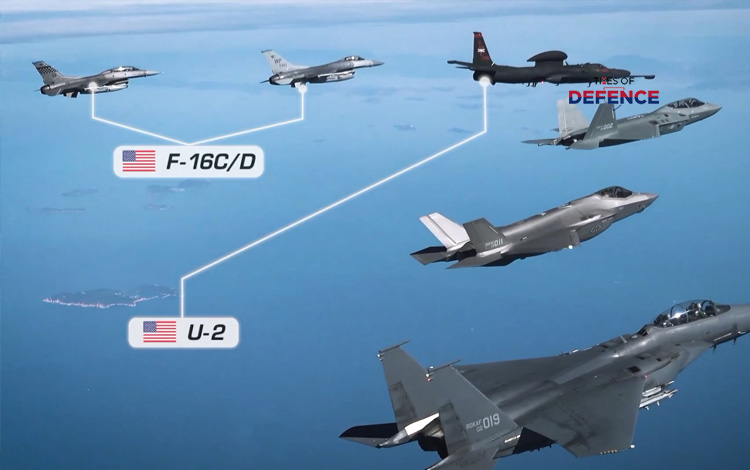
⚡ ROKAF Participating Fleet: F-35A Lightning II, F-15K Slam Eagle, KF-16, FA-50 Golden Eagle, F-5E/F, KC-330 Cygnus (A330 MRTT), E-737 Peace Eye (AEW&C), C-130J Super Hercules, HH-47 & HH-60 combat rescue platforms
⚡ U.S. Combined Air Component:
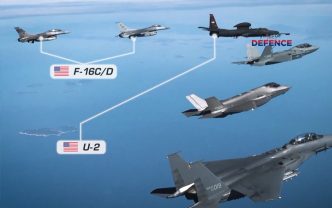
• USAF: F-16C/D Fighting Falcon, RC-135V/W Rivet Joint (SIGINT), KC-135 Stratotanker, U-2 Dragon Lady
• USMC: F-35B Lightning II (STOVL), MQ-9A Reaper (MALE UAS)
• USN: MH-60S Seahawk multi-mission maritime helicopters
⚡ Operational Command Node: Air Operations Center (AOC) integration executing real-time airspace management and combined ATO (Air Tasking Order) generation 
Tactical Mission Sets & OPCON Transition Objectives
💥 Defensive Counterair (DCA) & Integrated Air/Missile Defense: Simulated high-density surge engagements intercepting adversary low-altitude cruise missiles, ballistic threats, and multi-axis aircraft ingress vectors
💥 Deep Standoff Air Interdiction (AI): Precision strike packaging employing simulated joint standoff weapons (SLAM-ER, SPICE, JDAM) targeting hardened command nodes and mobile missile TELs behind frontline areas
💥 Cross-Cockpit Command & Control Validation: Senior commanders executed inter-service exchange flights—Lt. Gen. Shoemaker piloting a ROKAF F-15K and Lt. Gen. Cha piloting a USAF F-16—demonstrating real-time tactical C2 and interoperability
💥 Wartime Operational Control (OPCON) Alignment: Serves as a primary flight-level benchmark to validate ROKAF capability to lead future combined air component operations under sovereign command frameworks
TIMES OF DEFENCE ASSESSMENT
The execution of Freedom Flag 26-2 highlights the evolving structure of U.S.–ROK combined airpower:
1. **Strengthened Fifth-Generation Standoff Integration**: Operating land-based ROKAF F-35As alongside USMC F-35Bs deployed to the peninsula reinforces high-end low-observable capabilities. Integrating 5th-gen sensor fusion with 4th-gen strike assets (F-15K, F-16) ensures field units maintain air dominance in high-threat anti-access/area-denial (A2/AD) environments.
2. **Accelerating ROKAF Lead-Role Readiness for OPCON Transfer**: Freedom Flag replaced legacy large-scale drills (such as Vigilant Defense) specifically to allow ROKAF’s Air Force Operations Command to lead flight-test planning, ATO development, and execution. Proving ROKAF’s capacity to direct combined strike packages supports South Korea’s objective to assume wartime operational control.
3. **Multi-Domain Uncrewed Support Synergy**: Integrating USMC MQ-9A Reapers alongside high-altitude strategic ISR platforms (RC-135, U-2 Dragon Lady, E-737) provided persistent target tracking during the exercise. This multi-layered surveillance grid accelerates target identification for dynamic air interdiction sorties against mobile target sets.

