


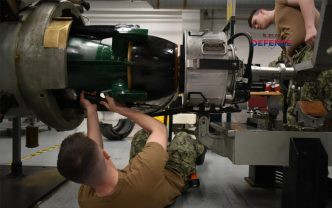
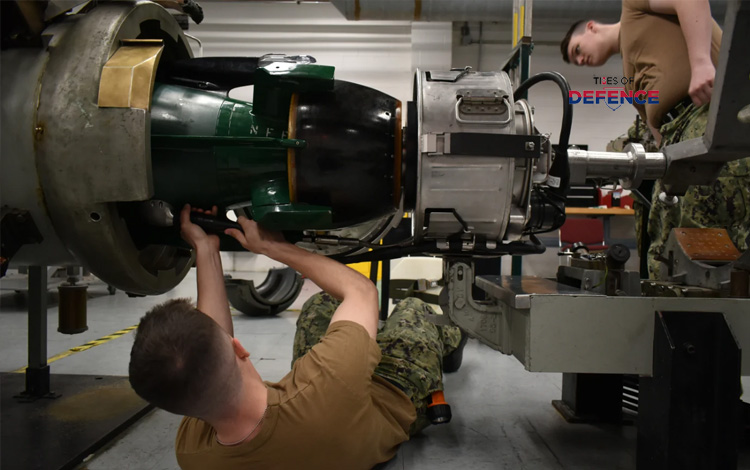
The Naval Undersea Warfare Center Division Newport (NUWC Code 45) awarded a $38.2 million sole-source task order (N6660426FC850) to Oceaneering International on September 2, 2026, to advance the development, testing, and deployment of the TETRA II Torpedo-Tube Launched and Recovered (TTL&R) remotely operated vehicle system.
Publicly released justification documents cite operational risks and deployment schedules as the rationale for bypassing competitive bidding. NAVSEA determined that opening the task order to alternative prime contractors would trigger a minimum 12-month schedule delay—resulting from baseline design re-certifications, hardware re-engineering, and operator retraining—causing the Navy to miss key operational submarine deployment windows.
TECHNICAL SPECIFICATIONS: TETRA II TTL&R SUBMARINE PAYLOAD ARCHITECTURE
System Classification, Submarine Integration & Operations
⚡ Program Authority: Naval Undersea Warfare Center Division Newport (Code 45 / Undersea Warfare Platforms & Payload Integration)
⚡ Prime Contractor: Oceaneering International (Hanover, MD Defense Operations / Houston, TX)
⚡ Acquisition Designation: Maritime Accelerated Acquisition (MAA) Program (Approved via OPNAV N94)
⚡ Interoperability Baseline: Engineered for deployment from standard 21-inch (533 mm) submarine torpedo tubes across Virginia-class (SSN) and Los Angeles-class (SSN) attack submarines
⚡ Operational Link & Guidance: Tethered / Datalink-integrated Remotely Operated Vehicle (ROV); maintains active “human-in-the-loop” operator oversight with real-time bidirectional data transmission back to the submarine’s Combat System (AN/BYG-1)
⚡ Mission Scope: Conceptual engineering, NAVSEA certification, firmware/software updates, dry-dock/shipboard installation, operator training, and delivery of prototype hardware 
Kinematics, Recovery Mechanics & Fleet TTL&R Comparison
💥 Torpedo Tube Recovery Physics: Solves the dynamic fluid dynamics challenge of guiding an uncrewed craft into a 21-inch tube opening on a submerged, moving submarine hull without relying on external divers or Dry Deck Shelters (DDS)
💥 Mission Payload Bay: Configured with a modular payload bay capable of dispensing offboard sub-payloads, intelligence sensors, or tactical effects in denied littoral waters
💥 Architectural Parallel — TETRA vs. Yellow Moray (REMUS):
• TETRA II (Oceaneering): Tethered/Datalinked ROV providing real-time data feedback and human intervention during sortie
• Yellow Moray (HII REMUS): Untethered autonomous survey UUV optimized for pre-programmed covert hydrographic mapping
TIMES OF DEFENCE ASSESSMENT
The sole-source award to Oceaneering for the TETRA II system highlights the priority the U.S. Navy places on operationalizing torpedo-tube uncrewed vehicle recovery.
From a naval engineering and undersea warfare perspective, this decision offers three main strategic insights:
1. **Prioritizing Deployment Timelines over Acquisition Competition**: Contracting delays often impede hardware fielding. By invoking FAR 16.505 logical follow-on rules, NAVSEA prevents a 12-month program stall, keeping TETRA II aligned with upcoming attack submarine deployment schedules.
2. **Mastering the 21-Inch Recovery Bottleneck**: Submarine launch and recovery has historically required specialized Dry Deck Shelters (DDS) or host-ship modifications. Recovering an ROV directly through a standard 21-inch torpedo tube allows any attack submarine in the fleet to project, control, and retrieve offboard sensors without permanent hull alterations.
3. **Complementary Undersea Payload Strategy**: Operating TETRA II alongside autonomous UUVs (such as HII’s Yellow Moray REMUS) gives submarine commanders flexible options. While autonomous UUVs handle long-range survey missions, tethered ROVs like TETRA II provide real-time sensor feeds for immediate tactical decision-making in contested littoral waters.

