


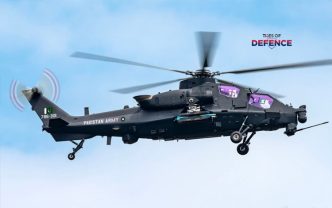
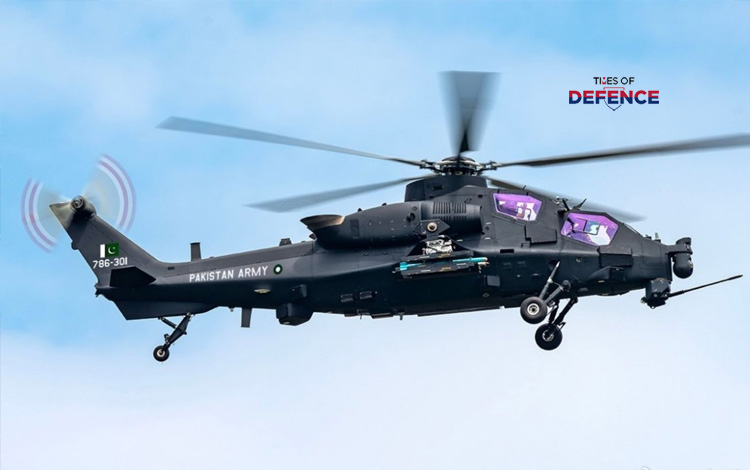
Recent defense intelligence tracking indicates that the Pakistan Army Aviation Corps’ procurement of Changhe Z-10ME attack helicopters may cover a total batch of 30 operational airframes.
According to reporting by the South China Morning Post (SCMP), citing an unverified corporate graphic shared on Chinese social media by military blogger “Sashoujian,” the contract between China National Aero-Technology Import & Export Corporation (CATIC) and Pakistan encompasses 30 Z-10ME platforms alongside associated technical support, maintenance packages, and flight simulator suites. While official acquisition channels in both Beijing and Islamabad have yet to publicly verify the exact final airframe count, the reported figure aligns with long-standing operational requirements to recapitalize Pakistan’s legacy Bell AH-1F Cobra fleet following blocked U.S. (AH-1Z Viper) and Turkish (T129 ATAK) procurement efforts.
TECHNICAL SPECIFICATIONS: CHANGHE Z-10ME ATTACK HELICOPTER ARCHITECTURE
Platform Engineering & High-Altitude Flight Envelope
⚡ OEM & Lead Integrator: Changhe Aircraft Industries Corporation (CAIC) / CATIC (China)
⚡ Primary Platform Baseline: Z-10ME (Heavy-duty export modernized variant featuring Z-10ME-02 avionics baseline)
⚡ Propulsion Plant: 2× WZ-9C turboshaft engines producing ~1,200 kW (1,600 shp) each, featuring dust-filtration mesh screens and upward-turned IR-suppressing exhaust nozzles
⚡ Gross Weight & Physical Dimensions: Max Takeoff Weight (MTOW): ~7,200 kg (15,873 lbs) | Fuselage Length: 14.2 m | Rotor Diameter: 13.0 m
⚡ Operational Flight Envelope: Maximum Speed: 290 km/h (156 knots) | Service Ceiling: >6,000 meters MSL | Tactical Range: 800 km (unrefueled)
⚡ High-Altitude Optimization: Tailored rotor dynamics and engine compressor margins specifically designed for high-altitude operations across the Himalaya and Karakoram mountain ranges 
Sensory Suite, Radar Architecture & Electronic Warfare (EW) Protection
💥 Mast-Mounted Radar: Top-mounted Millimeter-Wave (MMW) Fire Control Radar (similar to the AN/APG-78 Longbow configuration) for target acquisition through fog, rain, smoke, and EW interference
💥 Target Acquisition & Night Vision: Nose-mounted electro-optical/infrared (EO/IR) turret, pilot helmet-mounted display/sight (HMDS), and integrated night vision sensors
💥 Survivability Suite & Armor: Integrated Missile Approach Warning System (MAWS), Laser Warning Receiver (LWS), Radar Warning Receiver (RWR), Directional Infrared Countermeasures (DIRCM), and bolt-on ceramic appliqué armor plates protecting cockpit positions and engine bays
Armament Configuration & Multi-Role Kinetic Payloads
🚀 Primary Turret Cannon: 1× 23mm PX-10A chin-mounted single-barrel chain gun / revolver cannon on a flexible turret mount
🚀 Ordnance Hardpoints: 4× stub-wing pylons supporting up to 1,500 kg (3,300 lbs) useful weapon payload
🚀 Precision Guided Anti-Armor Ordnance: Up to 16× AKD-10 / BA-7 laser-guided anti-tank missiles, AKD-21 MMW anti-tank missiles, or CM-502KG Non-Line-Of-Sight (NLOS) strike missiles
🚀 Air-to-Air Defense & Standoff Weapons: Specialized TY-90 air-to-air missiles for helicopter-vs-helicopter engagements; 57mm/70mm/90mm unguided or guided rocket pods (FS70/GR-5)
TIMES OF DEFENCE ASSESSMENT
The reported 30-aircraft scale for Pakistan’s Z-10ME order marks a major strategic shift in South Asia’s rotary-wing arms balance.
From an aerospace engineering and threat assessment perspective, this procurement delivers three main operational dynamics:
1. **Resolution of High-Altitude Power Deficits**: Early evaluation trials of the baseline Z-10 in 2015 revealed severe power degradation when operating in high-altitude terrain. The induction of the Z-10ME variant—powered by upgraded 1,200 kW WZ-9C engines—addresses those density-altitude limitations, allowing Pakistan Army Aviation to deploy heavy anti-armor and precision fires across mountainous border sectors.
2. **Precision Standoff Targeting via Mast Radar**: Integrating mast-mounted MMW radars alongside CM-502KG NLOS missiles shifts tactics from direct visual-line-of-sight engagements to pop-up standoff strikes. Pilots can acquire armor tracks from behind mountain ridges or terrain masking, launch precision weapons, and disengage before being exposed to ground-based air defenses.
3. **Consolidation of Chinese Defense Industrial Lines**: Western ITAR engine restrictions blocked Pakistan’s prospective T129 ATAK deal and U.S. export policies halted the AH-1Z Viper transfer. Moving to the Z-10ME completes a wider shift toward Chinese defense hardware across air (J-10C, JF-17 Block III), land (VT-4 MBT), and rotary-wing domains.

