


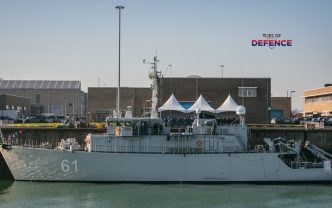
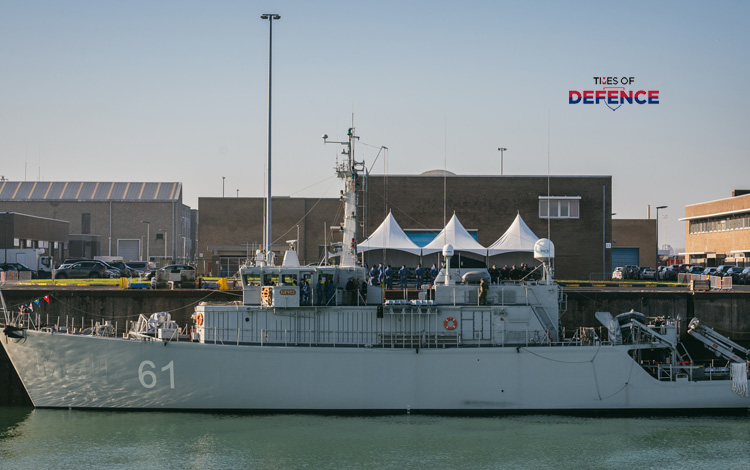
The Belgian Navy (Composante Marine) officially transferred the Tripartite-class minehunter BNS Bellis (M916) to the Bulgarian Navy during a handover ceremony held on October 30, 2026, at Zeebrugge Naval Base. Following the ceremony, the vessel was recommissioned into the Bulgarian Navy under the new name BNG Briz.
The transaction represents the initial operational delivery under a trilateral Memorandum of Understanding (MoU) executed between Belgium, the Netherlands, and Bulgaria covering the transfer of seven Tripartite minehunters (four from Belgium and three from the Netherlands). Under the defense agreement, Bulgaria funds vessel maintenance, overhaul, and deployment logistics, while providing training support for Ukrainian crews operating matching Tripartite/Alkmaar-class vessels. The transfer supports the phase-out of legacy Tripartite vessels as Belgium and the Netherlands field next-generation uncrewed mine countermeasures (rMCM) ships.
TECHNICAL SPECIFICATIONS: TRIPARTITE-CLASS MINEHUNTER ARCHITECTURE (BNG BRIZ / EX-BNS BELLIS)
Transfer Governance, Program Lineage & Trilateral Framework
⚡ Handover Authority: Belgian Ministry of Defence / Belgian Navy (Zeebrugge Naval Base)
⚡ Operational Recipient: Bulgarian Navy (Voennomorski sili na Republika Balgariya)
⚡ Vessel Name & Hull Re-designation: BNS Bellis (M916) → Renamed BNG Briz
⚡ Trilateral Transfer Agreement: 7-vessel total transfer architecture (4 Belgian hulls: Bellis, Crocus, Lobelia, Primula; 3 Dutch Alkmaar-class hulls)
⚡ Financial & Logistics Framework: Bulgaria funds restoration and operational deployment (capped at €6M per hull), supported by Belgian technical/industrial expertise
⚡ Ukrainian Training Provision: Bulgaria hosts training facilities/simulators for Ukrainian naval crews operating identical Tripartite-class platforms (such as ex-Dutch Chernihiv/Cherkasy hulls) 
Hull Dimensions, Hydrodynamics & Non-Magnetic Hull Construction
💥 Displacement & Dimensions: Full Load Displacement: 560 tonnes | Length Overall: 51.5 meters | Beam: 8.96 meters | Draft: 3.6 meters
💥 Hull Structural Composition: Glass-Reinforced Plastic (GRP) composite hull engineered with ultra-low magnetic and acoustic signatures to prevent triggering magnetic/acoustic influence sea mines
💥 Powerplant & Propulsion: 1× Werkspoor RUB 215 V12 diesel engine (1,370 kW / 1,837 hp) for main transit; 2× ACEC active rudders (180 kW each) paired with 1× HOLEC bow thruster for low-noise, precise dynamic positioning during mine hunting operations
💥 Speed & Operational Range: Max Transit Speed: 15 knots | Cruising Range: 3,000 nautical miles at 12 knots | Crew Complement: 36 personnel (4 Officers, 15 NCOs, 17 Enlisted)
Mine Countermeasures (MCM) Sensor Suite & Sub-surface Neutralization
🚀 Hull-Mounted Sonar: Thales Underwater Systems TSM 2022 Mk III active high-frequency mine-hunting sonar
🚀 Variable Depth Sonar (VDS): SAAB Bofors Double Eagle Mk III Self-Propelled Variable Depth Sonar for deep-water mine detection and classification in complex thermal layers
🚀 Mine Disposal Systems: Atlas Elektronik SeaFox Remote Operated Vehicle (ROV) submersible systems for visual inspection and explosive neutralization of tethered, bottom, and buried sea mines
🚀 Navigation & Self-Defense: Consilium Selesmar T-250/10CM003 navigation radar; 1× 20mm French naval gun mount and 0.50-cal heavy machine guns for surface self-defense
TIMES OF DEFENCE ASSESSMENT
The formal transfer of BNS Bellis (renamed BNG Briz) to Bulgaria marks a key shift in Black Sea naval security and NATO mine countermeasure (MCM) posture. Following the disruption of commercial maritime transit routes caused by unanchored drifting mines in the Black Sea, upgrading regional MCM capabilities is a priority for NATO’s Eastern Flank.
From a naval engineering and regional defense perspective, the vessel transfer offers three core operational advantages:
1. **Strengthening the Black Sea MCM Task Group**: Integrating four ex-Belgian and three ex-Dutch Tripartite minehunters significantly expands the operational capacity of the Mine Countermeasures Task Group Black Sea (MCM Black Sea)—co-managed by Bulgaria, Romania, and Türkiye. The non-magnetic GRP hull and low-acoustic signature of the Tripartite design provide effective mine clearing against modern multi-influence sea mines.
2. **Standardization with Ukrainian Operational Training**: Because Ukraine has received similar Tripartite/Alkmaar-class MCM vessels from European partners, Bulgaria’s commitment to host simulator and crew training streamlines logistics and maintenance across allied Black Sea navies.
3. **Transition to Unmanned rMCM Architectures**: The phase-out of the legacy Tripartite fleet allows Belgium and the Netherlands to transition to their joint replacement Mine Countermeasures (rMCM) program. The new 3,000-tonne rMCM vessels (such as the Dutch *HNLMS Vlissingen* and Belgian *Ostende*) rely on mothership platforms carrying autonomous underwater vehicles (AUVs), uncrewed surface vessels (USVs), and airborne mine-detection drones, replacing traditional direct-over-mine hunting with standoff autonomous clearance.

