


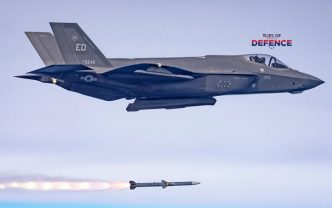
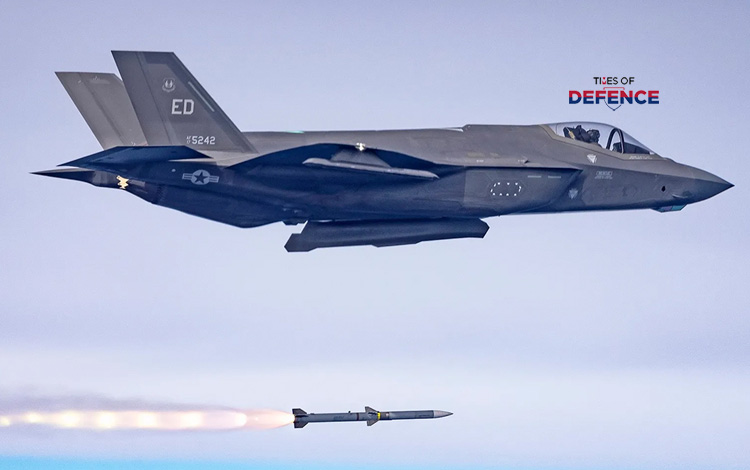
The United States Department of Defense and the Ministry of Defense of Japan have formally agreed to establish a Final Assembly and Check Out (FACO) facility in Japan for the Raytheon AIM-120 Advanced Medium-Range Air-to-Air Missile (AMRAAM).
Announced in late October 2026, the bilateral initiative marks Japan as the first international nation outside the United States authorized to execute final assembly and testing operations for the AIM-120 platform. Negotiated under the U.S.–Japan Defense Industrial Cooperation, Acquisition, and Sustainment (DICAS) framework, the partnership expands upon earlier feasibility studies involving RTX (Raytheon) and Mitsubishi Electric Corporation (MELCO). The effort aims to strengthen supply-chain resilience, offset global stockpile depletion, and increase production capacity for U.S. and allied Indo-Pacific air assets.
TECHNICAL SPECIFICATIONS: U.S.–JAPAN AMRAAM CO-PRODUCTION & INDUSTRIAL ARCHITECTURE
Contractual Governance, OEM Prime & Industrial Division of Labor
⚡ Program Framework: U.S.–Japan Defense Industrial Cooperation, Acquisition, and Sustainment (DICAS) Forum
⚡ Systems Prime & OEM: RTX / Raytheon (Tucson, Arizona, USA)
⚡ Primary Japanese Industrial Partner: Mitsubishi Electric Corporation (MELCO — Tokyo, Japan)
⚡ Facility Configuration: Final Assembly and Check Out (FACO) Facility & Local Component Manufacturing Center
⚡ Co-Production Scope: Local assembly, integration testing, and manufacturing of Circuit Card Assemblies (CCAs) and specialized electronic sub-components
⚡ Global Precedent: Represents the first international final assembly line established for the AIM-120 platform outside the United States 
AIM-120 Variant Baseline & Interoperability Profile
💥 Target Variants: Optimized for co-assembly of advanced export/allied variants, including the AIM-120C-8 and AIM-120D-3 (FMoTP baseline)
💥 Guidance & Seeker Suite: Active Radar Homing (ARH) terminal seeker paired with two-way datalink and inertial navigation system (INS) with GPS mid-course updates
💥 Propulsion & Speed: Solid-propellant rocket motor delivering speeds in excess of Mach 4 with an operational range extending from 110 km (C-variant) to 160+ km (D-variant)
💥 Platform Integration: Core BVR ordnance for 5th-generation (F-35A/B) and 4th-generation+ (F-15J/JSI, F-2, F-16) combat fleets, alongside NASAMS surface-to-air missile batteries
Supply Chain Resilience & Industrial Metrics
🚀 U.S. Base Rate vs. Overseas Expansion: Complements RTX’s domestic expansion target of scaling global AMRAAM deliveries toward 1,900+ missiles annually
🚀 Regional Fleet Support: Directly feeds air-to-air missile inventories for the Japan Air Self-Defense Force (JASDF), U.S. Pacific Air Forces (PACAF), U.S. Navy Carrier Air Wings, and regional NATO allies
🚀 Logistics Surge Vector: Establishes a forward depot and assembly hub in East Asia, mitigating transatlantic/transpacific shipping bottlenecks during high-intensity conflict scenarios
TIMES OF DEFENCE ASSESSMENT
The agreement between Washington and Tokyo to assemble AIM-120 AMRAAM missiles in Japan represents a major strategic shift in alliance defense industrial policy. Historically, U.S. policy tightly restricted overseas manufacturing of high-end, beyond-visual-range (BVR) missile guidance hardware due to technological protection standards and strict export controls.
From an engineering and defense logistics perspective, this decision offers three primary advantages:
1. **Addressing High-Burn-Rate Stockpile Depletion**: Global demand for AIM-120 missiles—driven by F-35 fleet proliferation, NATO re-armament, and consumption by NASAMS air defense batteries—has placed immense pressure on Raytheon’s primary production lines in Tucson. Establishing a second FACO hub in Japan creates immediate surge capacity for the Indo-Pacific theater.
2. **Industrial Co-Development via Mitsubishi Electric**: Transitioning from purchasing off-the-shelf Foreign Military Sales (FMS) to local FACO assembly allows Japanese industry to deepen its microelectronics and missile assembly capabilities. Integrating MELCO-manufactured circuit card assemblies into the supply chain strengthens regional manufacturing while keeping sensitive guidance intellectual property protected.
3. **Operational Readiness for Indo-Pacific Deterrence**: In the event of a maritime or air crisis in the Western Pacific, relying on transpacific sealift or airlift to deliver replacement air-to-air munitions creates operational friction. Local FACO facilities allow deployed U.S. forces and the JASDF to field, inspect, and maintain BVR missile stocks directly within the operating theater.

