


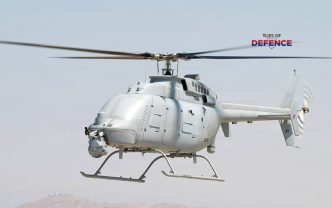
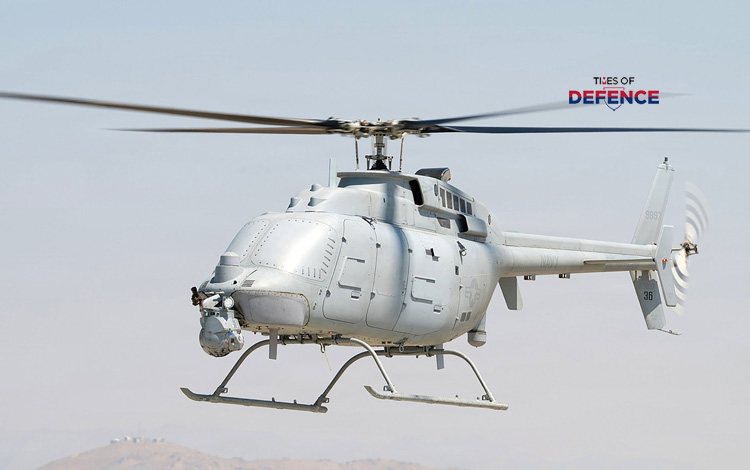
The U.S. Navy and U.S. Army have executed a inter-service asset transfer agreement, reallocating four divested U.S. Navy MQ-8C Fire Scout uncrewed helicopter systems to serve as specialized captive-carry airborne testbeds for the U.S. Army Redstone Test Center (RTC).
Formally managed under the Navy’s Multi-Mission Tactical Unmanned Aircraft Systems Program Office (PMA-266) and the U.S. Army Test and Evaluation Command (ATEC), the transfer redirects four operational MQ-8C airframes, two mobile mission control systems, spare Rolls-Royce 250-C47B engines, and associated ground support equipment to Redstone Arsenal, Alabama. Originally slated for phase-out by the end of FY 2026 under OPNAV N98 divestment mandates, the asset transfer yields over $70 million in direct acquisition savings for the U.S. Army while establishing a persistent, long-endurance rotary testbed for emerging sensor, reconnaissance, and electro-optical/infrared (EO/IR) targeting technology evaluations.
TECHNICAL SPECIFICATIONS: U.S. ARMY MQ-8C FIRE SCOUT CAPTIVE-CARRY TESTBED ARCHITECTURE
Program Governance, Inter-Service Transfer & Operating Facilities
⚡ Transferring Authority: U.S. Navy PMA-266 (Multi-Mission Tactical UAS Program Office, NAVAIR) / NAVSUP
⚡ Operating Service & Test Lead: U.S. Army Redstone Test Center (RTC) / ATEC (Redstone Arsenal, AL)
⚡ Transfer Package: 4× Northrop Grumman MQ-8C Fire Scout airframes, 2× Mobile Mission Control Systems (MMCS), spare engine suites, COMSEC assets, and support equipment
⚡ Primary Testing Locations: Redstone Arsenal (Huntsville, AL) & Dugway Proving Ground / Michael Army Airfield (Utah)
⚡ Financial Efficiency: Saves >$70 Million USD in Army platform procurement costs, while lowering overall RDT&E flight-hour costs 
MQ-8C Airframe Engineering, Propulsion & Kinematics
💥 Platform Heritage: Commercial Bell 407 4-bladed commercial helicopter airframe converted into an autonomous uncrewed vertical takeoff and landing (VTOL) platform
💥 Airframe Dimensions: Fuselage Length: 10.6 m (34.7 ft) | Rotor Diameter: 11.2 m (36.7 ft) | Max Takeoff Weight (MTOW): 2,721 kg (6,000 lb)
💥 Powerplant Architecture: 1× Rolls-Royce 250-C47B turboshaft engine producing 813 shaft horsepower (shp)
💥 Operational Flight Envelope: Max Speed: 140 knots (260 km/h) | Service Ceiling: 16,000 ft (4,876 m) | Max Endurance: 12 to 15 hours | Payload Capacity: >317 kg (700 lb) internal/external payload
Captive-Carry Testbed Modifications & Avionics Suite
🚀 Primary Operational Role: Serves as a surrogate airborne host platform for “captive-carry” testing of developmental Army radars, electro-optical/infrared (EO/IR) sensors, laser designators, and SIGINT/EW payloads
🚀 Payload Integration Architecture: Open-architecture payload bay interfaces and modular external hardpoints for rapid mounting and flight-testing of experimental sensor suites prior to operational fielding
🚀 Avionics & C2 Connectivity: Integrated military-grade COMSEC, secure UHF/VHF radios, transponders, tactical data-link modems, and onboard differential GPS/INS guidance
🚀 System Autonomy: Autonomous flight control system capable of precision VTOL operations from unprepared ground sites and automated grid surveillance tracks
TIMES OF DEFENCE ASSESSMENT
The transfer of the MQ-8C Fire Scout fleet from the U.S. Navy to the U.S. Army Redstone Test Center illustrates a practical approach to joint force asset management. While changing operational priorities led the Navy to divest the MQ-8C in favor of fixed-wing medium-altitude long-endurance (MALE) systems (such as the MQ-9M MAGTF UAS), the airframes retain considerable technical utility.
From an engineering and flight-test perspective, utilizing the MQ-8C as a captive-carry testbed provides key operational advantages:
1. **Low-Cost Sensor Flight Demonstration**: Developing advanced targeting sensors, synthetic aperture radars (SAR), and electronic warfare pods requires hundreds of flight-test hours. Using crewed helicopters (like UH-60 or AH-64 variants) as testbeds consumes pilot flight hours, burns expensive aviation fuel, and diverts operational airframes. The uncrewed MQ-8C offers 12+ hours of continuous loiter time at lower flight-hour operating costs.
2. **Representative Rotorcraft Dynamic Environment**: Testing optical, radar, and acoustic sensors on a true rotary-wing platform exposes developmental hardware to the actual vibration profiles, rotor downwash dynamics, and electromagnetic interference (EMI) encountered on combat helicopters—delivering realistic data during ground and flight trials at Dugway Proving Ground and Redstone Arsenal.
3. **Streamlined Joint Logistics Transition**: By working directly with Naval Supply Systems Command (NAVSUP) to recover essential COMSEC equipment, radios, and ground station modules from common stock, the Army avoided multi-year software and hardware procurement delays, enabling a 14-month transition from formal request to active flight testing.

