



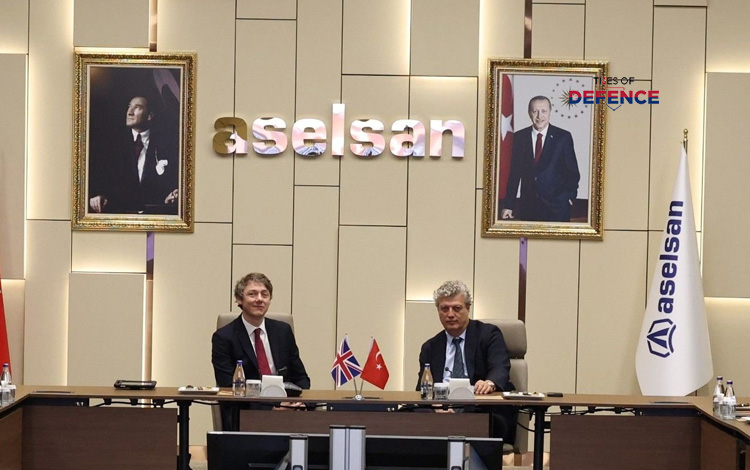
U.K. defense engineering leader Babcock International Group and Turkish defense electronics prime ASELSAN have progressed technical discussions following the execution of their strategic Memorandum of Understanding (MoU) signed in early 2026.
The follow-up engagements focus on defining architecture options for a Surface Electronic Warfare Threat (SEWT) training framework tailored for the Royal Air Force (RAF) under its broader Next Generation Operational Training (NGOT) initiative. The joint effort combines Babcock’s defense training integration, synthetic environment management, and live-virtual-constructive (LVC) infrastructure with ASELSAN’s electronic attack (EA), electronic support (ES), radar threat simulation, and integrated air defense system (IADS) emulation technologies. The objective is to construct realistic, dense electromagnetic spectrum (EMS) training environments capable of preparing allied aircrews for multi-domain anti-access/area-denial (A2/AD) threat umbrellas.
TECHNICAL SPECIFICATIONS: BABCOCK-ASELSAN SEWT TRAINING & EW ARCHITECTURE
Industrial Roles, Program Scope & Governance
⚡ Strategic Primes: Babcock International Group (UK) & ASELSAN A.Ş. (Ankara, Türkiye)
⚡ Baseline Framework: Early 2026 Memorandum of Understanding (MoU) for UK RAF Air Defense & SEWT Training
⚡ Target Service Alignment: UK Royal Air Force (RAF) — Next Generation Operational Training (NGOT) Program
⚡ Operational Objective: Replicate complex, multi-band modern Integrated Air Defense System (IADS) radar emitters, dense RF jamming, and surface-to-air missile (SAM) electronic threat signatures 
ASELSAN EW Hardware & Threat Simulation Sub-Systems
💥 Ground Threat Emitter (GTE) Integration: Multi-frequency threat radar emulators capable of replicating search, acquisition, tracking, and fire-control radar behaviors (E-band to K-band)
💥 Electromagnetic Spectrum Simulation: Dynamic RF signal injection and airborne Electronic Support Measures (ESM) / Radar Warning Receiver (RWR) stress-testing arrays
💥 Countermeasure Test & Verification: Real-time tracking and evaluation of airborne RF jammers, towed decoys, and chaff dispensations against simulated radar threat platforms
💥 Modular Deployment Baseline: Transportable ground containerized emitter units paired with software-defined radio (SDR) threat generation modules for flexible range placement
Babcock Training Systems & LVC Architecture Integration
🚀 Live-Virtual-Constructive (LVC) Framework: Integration of real-world GTE emissions with synthetic virtual threat overlays to generate thousands of non-emitting “constructive” threats simultaneously
🚀 After-Action Review (AAR) & Analytics: High-fidelity telemetry recording, electromagnetic spectrum mapping, and kill-web effectiveness metrics to evaluate pilot survivability and tactics
🚀 Open Architecture C2 Interface: Designed to interface natively with NATO STANAG-compliant training networks and combat flight simulators
TIMES OF DEFENCE ASSESSMENT
The deepening cooperation between Babcock and ASELSAN addresses a growing gap in Western military readiness: the scarcity of high-fidelity, high-density Electronic Warfare (EW) training ranges. Modern peer adversaries deploy dense, multi-layered IADS networks operating across broad bands of the electromagnetic spectrum. Preparing 4th, 5th, and emerging 6th-generation aircrews for these environments requires live ground threat emitters that accurately mimic active electronically scanned array (AESA) radar signatures and electronic attack protocols.
From an engineering and training perspective, the Babcock-ASELSAN partnership offers several key advantages:
1. **Convergence of EW Hardware and LVC Integration**: ASELSAN brings hardware expertise in radar design, electronic warfare pods, and threat emitters developed for contested regional theaters. Combining these hardware emitters with Babcock’s LVC flight training platforms allows the RAF to simulate high-density threat environments without incurring the cost of deploying hundreds of physical radar stations.
2. **Cost-Effective Threat Emulation**: Relying on software-defined threat emitters allows the system to rapidly update radar threat libraries as new adversary systems emerge, ensuring aircrews train against relevant threat profiles.
3. **Cross-NATO Defense Industrial Synergies**: The collaboration establishes a bridge between the U.K. and Turkish defense industrial bases, demonstrating how sovereign electronic warfare capabilities can be exported and integrated directly into NATO allied flight training frameworks.

