


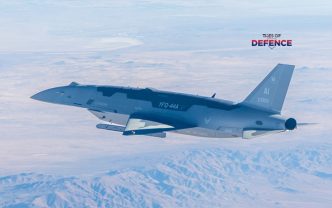
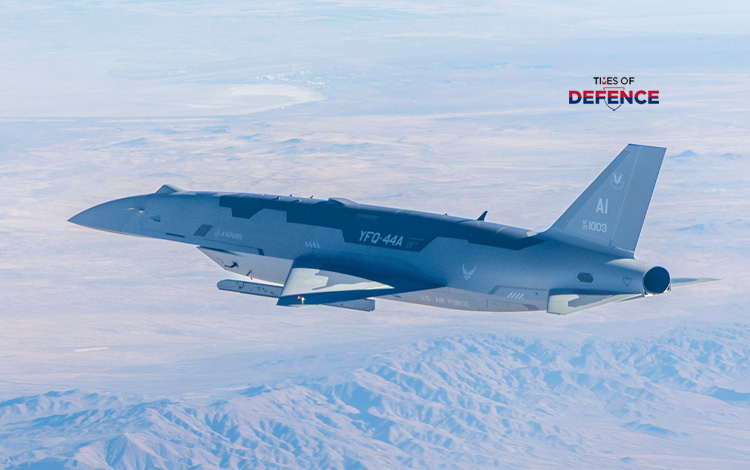
The U.S. Air Force has officially received its initial two Collaborative Combat Aircraft (CCA) prototype platforms at Creech Air Force Base, marking a milestone in the operationalization of autonomous human-machine teaming (HMT) for tactical air superiority.
Delivered to the Air Combat Command (ACC)-led Experimental Operations Unit (EOU), the aircraft comprise Anduril Industries’ YFQ-44A Fury (delivered in August 2026) and General Atomics Aeronautical Systems’ YFQ-42A Vengeance (delivered in September 2026). Operating under the Department of the Air Force’s (DAF) Increment 1 CCA initiative, the EOU has launched operational experimentation sorties over Nevada test ranges. The flight trials are designed to refine Tactics, Techniques, and Procedures (TTPs), validate command-and-control (C2) software links with 5th-generation manned fighters (F-35A and F-22A), and establish unit organizational structures for future operational CCA squadrons.
TECHNICAL SPECIFICATIONS: CCA INCREMENT 1 PROTOTYPE ARCHITECTURE (YFQ-44A & YFQ-42A)
Program Office, OEM Lead Primes & Deployment Parameters
⚡ Acquisition Lead: Department of the Air Force (DAF) / Air Force Life Cycle Management Center (AFLCMC)
⚡ Executing Command: Air Combat Command (ACC) — Experimental Operations Unit (EOU, Creech AFB, NV)
⚡ Selected Increment 1 Vendors: Anduril Industries (YFQ-44A Fury) & General Atomics Aeronautical Systems Inc. (YFQ-42A Vengeance)
⚡ Fleet Procurement Horizon: Initial operational production goal of 150+ Increment 1 airframes fielded by 2030, embedded across front-line fighter wings 
Anduril YFQ-44A Fury Technical Baseline
💥 Platform Heritage: Scaled airframe architecture derived from Blue Force Technologies’ Fury concept (acquired by Anduril)
💥 Aerodynamic Design: Compact, low-observable (LO) carbon-composite airframe featuring an inverted V-tail, high-aspect-ratio swept wings, and flush dorsal engine intake
💥 Kinematic Profile: High-subsonic / transonic speed envelope; flight ceiling >40,000 ft; high-G maneuver capability to match tactically bound crewed fighters
💥 Avionics & Autonomous Stack: Native integration with artificial intelligence flight control software, open-architecture autonomy stacks, and multi-band directional tactical data-links
General Atomics YFQ-42A Vengeance Technical Baseline
🚀 Platform Heritage: Derived directly from the GA-ASI XQ-67A Off-Board Sensing Station (OBSS) modular chassis baseline
🚀 Airframe Engineering: Modular common chassis architecture engineered for low-cost, high-rate manufacturing scalability
🚀 Kinematic Profile: Transonic performance profile optimized for extended loiter endurance, heavy internal weapons carriage, and long-range escort missions
🚀 Payloads & Sensor Integration: Internal bay capacity accommodating AIM-120 AMRAAM air-to-air missiles, passive IRST sensor arrays, or modular electronic attack (EA) jamming pods
Operational Experimentation & Human-Machine Teaming (HMT) Concept
🚀 C2 Architecture: Operates via non-traditional control interfaces—including tablet-based battle management software, cockpit-prompted cueing from F-35/F-22 flight leads, and autonomous mission-state execution
🚀 Combat Roles: Forward-deployed sensor screening (off-board radar/IRST cueing), weapons magazine extension (remote missile launch nodes), electronic warfare/SEAD distraction, and defensive counter-air (DCA) screening
🚀 Agile Combat Employment (ACE): High-reliability ground support architecture designed for rapid turnaround times with minimal maintenance footprints at austere expeditionary airfields
TIMES OF DEFENCE ASSESSMENT
The formal delivery of the YFQ-44A Fury and YFQ-42A Vengeance to Creech AFB marks a transition in USAF force structure planning. For years, loyal wingman and uncrewed combat concepts existed primarily as high-altitude technology demonstrators (such as the XQ-58A Valkyrie or XQ-67A). Assigning functional prototypes to Air Combat Command’s Experimental Operations Unit transitions the program from developmental flight testing into operational doctrine formation.
From an engineering and force-projection perspective, the CCA program addresses two critical vulnerabilities facing Western air power: high unit acquisition costs and shrinking tactical magazine depth. Advanced 5th- and 6th-generation manned stealth fighters (F-35, F-22, and future NGAD platforms) are costly assets that cannot be exposed to high-risk forward screening in heavily defended Anti-Access/Area-Denial (A2/AD) bubbles.
By pairing a single crewed fighter with 2 to 4 semi-autonomous CCAs costing a fraction of a crewed platform, the USAF effectively expands its tactical footprint. The YFQ-44A and YFQ-42A act as forward sensor nodes and missile-carrying “magazines,” absorbing adversary surface-to-air missiles (SAMs) and counter-air interceptors while preserving the crewed platform as a high-tier tactical battle manager. The trial period at Creech will prove whether current C2 data-link bandwidths and software autonomy can operate reliably in high-density electronic warfare environments without overloading the pilot’s cognitive capacity.

