


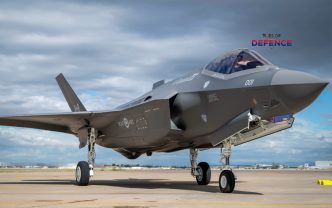
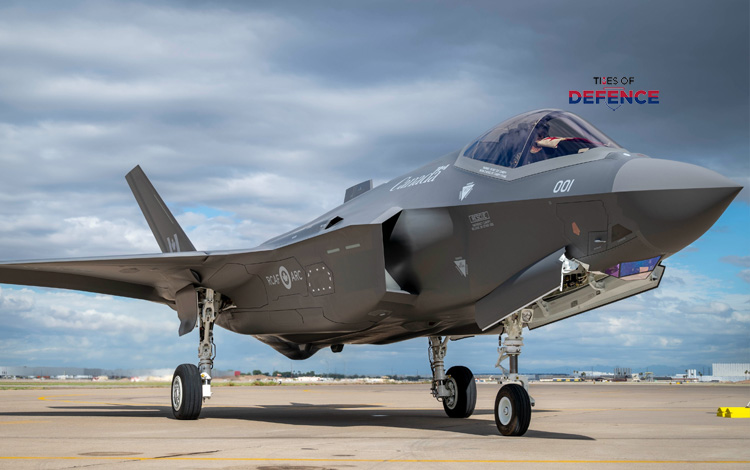
The Royal Canadian Air Force (RCAF) has officially taken delivery of its first two Lockheed Martin CF-35A Lightning II multi-role stealth fighter aircraft at Luke Air Force Base in Glendale, Arizona.
Transferred to the 56th Fighter Wing’s F-35A Pilot Training Center on October 22, 2026, airframes AR-1 and AR-2 represent the initial delivery wave under Canada’s $19 billion Future Fighter Capability Project (FFCP). The first eight RCAF CF-35A airframes will remain stationed at Luke AFB through 2027 to establish an initial cadre of Canadian instructor pilots and maintainers. This foreign-stationed training period allows Canada’s Department of National Defence (DND) to finalize secure infrastructure upgrades, sovereign C4I server rooms, and specialized maintenance facilities at 3 Wing Bagotville (Quebec) and 4 Wing Cold Lake (Alberta) ahead of the aircraft’s domestic arrival in 2028.
TECHNICAL SPECIFICATIONS: ROYAL CANADIAN AIR FORCE CF-35A SPECIFIC CONFIGURATION
Acquisition Framework & Operating Agency
⚡ Operating Force: Royal Canadian Air Force (RCAF) / Department of National Defence (DND)
⚡ Program Office: Future Fighter Capability Project (FFCP)
⚡ Prime Contractor: Lockheed Martin Aeronautics (Fort Worth, Texas)
⚡ Total Procurement Scope: 88 CF-35A aircraft replacing the legacy CF-188 (F/A-18A/B) Hornet fleet 
CF-35A Platform Kinematics & Stealth Geometry
💥 Airframe Geometry: Length: 15.7 m | Wingspan: 10.7 m | Wing Area: 42.7 m² | Max Takeoff Weight (MTOW): 31,800 kg (70,000 lb)
💥 Propulsion & Thrust Vector: 1× Pratt & Whitney F135-PW-100 augmented turbofan producing 28,000 lbf dry / 43,000 lbf military reheat
💥 Performance Envelope: Maximum Speed: Mach 1.6 (~1,975 km/h) | Operational Radius: >1,239 km (670 nmi) on internal fuel | Service Ceiling: 15,240 m (50,000 ft)
💥 Low-Observable (LO) Profile: Integrated Radar Absorbent Material (RAM) skin coatings providing an ultra-low radar cross-section (RCS) optimized against high-frequency engagement radars
Sovereign Modifications & Arctic Operating Suite
🚀 Drag Chute System Integration: Equipped with the specialized upper-fuselage drag chute pod (identical to Royal Norwegian Air Force F-35As) for icy, short-field Arctic runway operations
🚀 Probe-and-Drogue Refueling Capability: Configured for compatibility with RCAF CC-130J and CC-330 Husky (A330 MRTT) aerial refuelers
🚀 Tech Refresh 3 (TR-3) / Block 4 Architecture: Features high-speed core processing modules, panoramic cockpit displays, and an expanded internal weapons bay capacity (4x to 6x AIM-120D AMRAAMs)
🚀 Sensor Suite: AN/APG-81 Active Electronically Scanned Array (AESA) radar, Electro-Optical Targeting System (EOTS), and 360-degree Distributed Aperture System (DAS)
RCAF Base Infrastructure & Delivery Roadmap
🚀 Initial Phase (2026–2027): 8 aircraft based at Luke AFB, Arizona, dedicated to joint pilot and maintainer qualification
🚀 Domestic Arrival (2028): First operational airframes ferry to 3 Wing Bagotville, followed by 4 Wing Cold Lake
🚀 Initial Operational Capability (IOC): Projected for 2029–2030; Full Operational Capability (FOC) target set for 2032–2034 with 88 airframes
TIMES OF DEFENCE ASSESSMENT
The arrival of the RCAF’s first two CF-35A fighters at Luke AFB marks a crucial milestone in Canada’s long-delayed fighter fleet modernization. For decades, the RCAF relied on upgraded CF-188 Hornets to meet its NORAD air defense and NATO expeditionary commitments. However, aging airframes, declining availability rates, and increasing maintenance requirements highlighted the need for a modern, fifth-generation replacement.
From an engineering and strategic perspective, the CF-35A provides Canada with a multi-role stealth fighter tailored for sovereign Arctic operations. Equipping the aircraft with a reinforced drag-chute system ensures safe operations on ice-covered, short runways at forward operating locations like Inuvik and Iqaluit. Staging the first eight aircraft at Luke AFB allows Canada to build a core group of qualified pilots and technicians alongside U.S. and allied forces. This approach helps the RCAF smoothly transition away from the CF-188 while DND completes the secure hangar and C4ISR infrastructure required to support the stealth fighters when they land on Canadian soil in 2028.

