



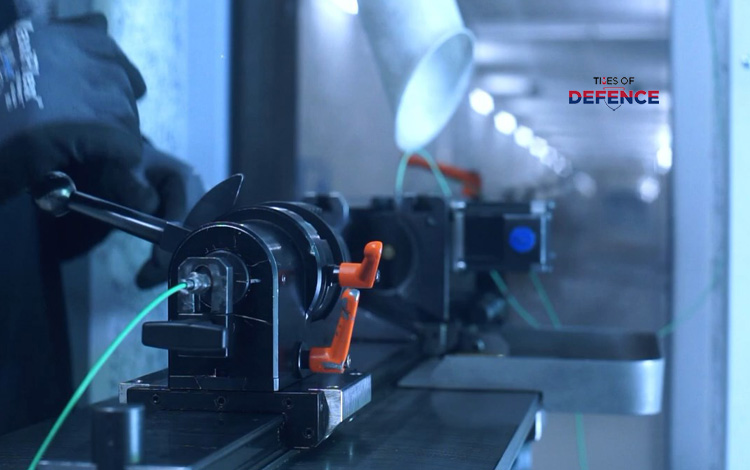
Small-caliber munitions manufacturer MFS Defense Inc. (formerly Mátravidéki Fémművek) has published a technical operational overview detailing the quality management framework at its manufacturing facility in Sirok, Hungary.
Operating under ISO 9001 and NATO AQAP (Allied Quality Assurance Publications) standards, the facility produces NATO-standard small arms ammunition, including 9×19mm Parabellum, 5.56×45mm NATO, and 7.62×39mm calibers for global defense, law enforcement, and military end-users. The company’s quality assurance workflow establishes a four-pillar verification protocol—comprising metallurgical laboratory analysis, coordinate dimensional metrology, manual visual/weight inspection (MEO), and real-time ballistic target range validation—ensuring precise dimensional tolerances, metallographic structural integrity, and velocity/pressure consistency under extreme operational conditions.
TECHNICAL SPECIFICATIONS: MFS DEFENSE QUALITY CONTROL & MANUFACTURING ARCHITECTURE
Manufacturer & Production Facility
⚡ Company Name & Location: MFS Defense Inc. (Mátravidéki Fémművek — Sirok, Heves County, Hungary)
⚡ Operational Standards: Quality Management Systems compliant with ISO 9001 and NATO AQAP 2110 certification
⚡ Core Caliber Portfolio: 9×19mm NATO, 5.56×45mm NATO (SS109/M193), 7.62×39mm, 7.62×54r, and civilian/law enforcement pistol rounds (.380 Auto, .40 S&W, .45 ACP) 
Pillar 1 — Metallurgical & Chemical Laboratory Analysis (Labor)
💥 Material Inspection: High-power optical and digital microscopy analyzing the crystal and grain structure of brass alloys and lead cores
💥 Hardness & Ductility Testing: Vickers/Rockwell hardness indentation on sample metallographic pucks to evaluate case-wall tensile endurance
💥 Chemical Analysis: Spectrometric analysis of raw brass/copper metal composition and chemical stability testing of smokeless propellant powders
Pillar 2 — Coordinate & Geometric Metrology (Mérőszoba)
🚀 Coordinate Measurement: Carl Zeiss CMM machines equipped with high-accuracy VAST tactile probes for automated 3D dimensional scanning
🚀 Critical Geometries: Sub-micron evaluation of cartridge case overall length (OAL), wall thickness gradient, rim profile, and case neck concentricity
🚀 Mechanical Gauging: Digital calipers, optical comparators, and dial indicators ensuring flawless chambering and extraction in NATO-standard firearms
Pillar 3 — Manual Visual & Mass Verification (MEO)
🚀 Human Inspection (MEO): Technicians working under illuminated magnifying lamps verifying primer seat depth, flash hole alignment, and case surface finish
🚀 Gravimetric Verification: High-precision electronic mass balance weighing of projectile, propellant charge, and completed cartridge to prevent double-charges or squib loads
Pillar 4 — Live-Fire Ballistic Testing (Ballisztika)
🚀 Test Range Infrastructure: Indoor ballistics range integrated with optical velocity barriers, piezoelectric transducer pressure barrels, and paper/gelatin target matrices
🚀 Reference Firearms Suite: Standardized proof barrels and service rifles, including the Heckler & Koch HK416 (5.56×45mm)
🚀 Dynamic Metrics Recorded: Muzzle velocity ($V_0 / V_{25}$), chamber pressure ($P_{max}$ via NATO EPVAT standards), action time, and group dispersion accuracy (MOA)
TIMES OF DEFENCE ASSESSMENT
The detailed breakdown of quality assurance processes at the MFS Defense Sirok facility underscores the vital role that rigorous quality control plays in small-arms ammunition manufacturing. In high-intensity military engagements, minor manufacturing defects—such as inconsistent propellant burn, case head separation, or out-of-spec case concentricity—can lead to catastrophic firearm malfunctions, barrel obstructions (squib rounds), or dangerous over-pressure events.
From an industrial and engineering standpoint, MFS Defense’s integration of automated CMM scanning, strict AQAP defense standards, and live-fire NATO EPVAT pressure testing ensures that mass-produced small-caliber rounds perform reliably across diverse environments. Utilizing real-world test platforms like the HK416 guarantees that ammunition lots maintain tight velocity tolerances and consistent point-of-impact metrics, reinforcing Hungary’s sovereign ammunition production capacity and supplying NATO allies with reliable small arms munitions.

