


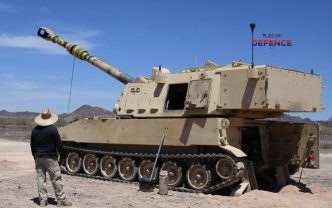
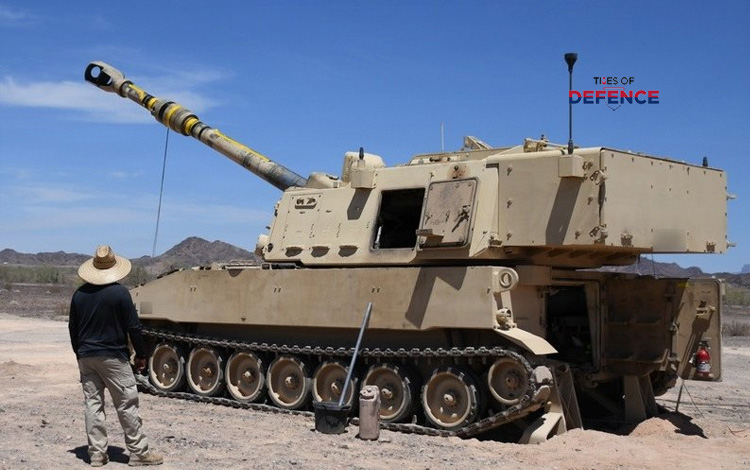
The U.S. Army has completed live-fire testing of three prototype XM1180 155mm guided artillery rounds featuring advanced terminal seeker technology designed to identify and track moving armored targets.
Developed under the Cannon-Delivered Area Effects Munition (C-DAEM) initiative, the test evaluated terminal seeker handover, internal guidance systems, and flight stabilization under high-g launch conditions. The successful firing sequence advances the XM1180 project to Technology Readiness Level 6 (TRL 6). Designed to give field commanders a precision counter-armor capability against relocatable and moving threats, the program is moving toward integrating these terminal seekers into GPS-denied environments and cross-adapting the guidance architecture into the XM1230 Extended Range Artillery Projectile (ERAP).
TECHNICAL SPECIFICATIONS: XM1180 & XM1230 PRECISION ARTILLERY PROJECTILES
Developing Agencies & Key Contractors
⚡ Development Authority: U.S. Army DEVCOM Armaments Center & Project Manager Cannon Artillery Systems (PM-CAS)
⚡ Primary Industrial Partners: Raytheon (Tucson, AZ) & BAE Systems (Scorpio-XR / XM1230 FALCON solution) 
Program Framework & Capability Goals
⚡ Umbrella Initiative: Cannon-Delivered Area Effects Munition (C-DAEM) Armor Program
⚡ Mission Roles: Precision engagement of stationary and moving heavy armor, C4ISR nodes, and mobile air-defense systems in contested environments
Airframe Architecture & Physical Parameters
💥 Caliber & Standard: 155 mm NATO-standard artillery projectile
💥 Airframe Features: Gun-hardened composite body, deployable glide wings/canards for trajectory adjustment, and high-g resilient internal avionics electronics
Guidance, Seeker Suite & Networked Navigation
🚀 Primary Seeker Configuration: Multi-mode terminal seeker combining Millimeter Wave (MMW) radar and Electro-Optical/Infrared (EO/IR) imaging for autonomous target recognition (ATR)
🚀 Electronic Counter-Countermeasures (ECCM): Designed for GPS-denied/contested navigation using inertial measurement units (IMU) backed by terminal optical/radar map-matching
🚀 Cooperative Networking Goal: Inter-round datalink capability enabling networked projectiles within a volley to share target data, avoiding duplicate target strikes
Kinematics & Operational Range Envelope
🚀 XM1180 Range Profile: Standard-length barrel compatibility (39 and 52-caliber guns) delivering tactical ranges exceeding 30–40 km
🚀 XM1230 (ERAP / Scorpio-XR) Range Profile: Extended-range hypervelocity rocket-assisted or sub-caliber glide airframe optimized for 58-caliber ERCA and 52-caliber systems, targeting operational ranges >70–100 km
🚀 Platform Compatibility: M109A6/A7 Paladin Self-Propelled Howitzers and M777A2 Towed Howitzers
TIMES OF DEFENCE ASSESSMENT
The successful live-fire demonstration of the XM1180’s terminal seeker technology represents a critical shift in how artillery forces counter armored formations. Traditional precision-guided artillery, such as early-generation GPS-guided shells, relies on fixed grid coordinates; this renders them ineffective against armored vehicles that relocate between sensor detection and shell impact. By embedding autonomous multi-mode seekers directly onto the projectile, artillery units can fire into a target area and allow the shell to actively search, classify, and track moving armor in its final descent phase.
From a tactical perspective, adapting this seeker architecture to the XM1230 Extended Range Artillery Projectile addresses the key challenge of modern peer-to-peer combat: operating in heavily contested, GPS-jammed environments. Pairing long-range glide kinetics with autonomous, GPS-independent terminal guidance eliminates reliance on satellite navigation while reducing collateral damage. Furthermore, integrating round-to-round datalinks into future procurement lots will allow salvoes of XM1180/XM1230 rounds to execute cooperative target allocation, maximizing destroyed armor per volley.

