


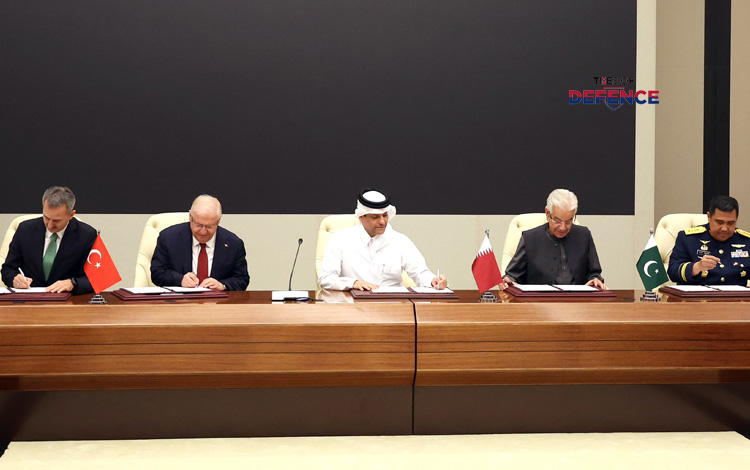
In a major expansion of multilateral defense industrial integration, the defense ministries of Türkiye, Qatar, Pakistan, and Indonesia officially signed the landmark “BEDİR” (Badr) Memorandum of Understanding (MoU) during a joint ministerial ceremony in Doha.
Named after the Arabic term for “full moon”—symbolizing the complementary defense industrial capabilities of the four signatory nations—the BEDİR Accord establishes a binding, multi-national framework to transition bilateral platform procurement into a synchronized defense manufacturing ecosystem. Coordinated by Türkiye’s Ministry of National Defence (MSB) and the Defence Industry Agency (SSB), the pact brings together Turkish Defence Minister Yaşar Güler, SSB President Prof. Dr. Haluk Görgün, Qatari Deputy Prime Minister Sheik Saud bin Abdulrahman Al Thani, Pakistani Defence Minister Khawaja Muhammad Asif, and Indonesian Deputy Defence Minister Yusuf Jauhari. Designed to execute joint hardware production, shared technology transfer, co-R&D, and technical military training, the agreement implements a two-tier operational mechanism—an Executive Board to identify defense initiatives and a Strategic Board to govern implementation schedules—establishing joint production lines serving partner countries and friendly sovereign nations across the Middle East, South Asia, and Southeast Asia.
TECHNICAL SPECIFICATIONS: BEDİR QUADRILATERAL DEFENCE COOPERATION FRAMEWORK
Managing Agencies & Sovereign Signatories
⚡ Coordinating Authority: Defence Industry Agency of Türkiye (SSB – Savunma Sanayii Başkanlığı) & MSB
⚡ Sovereign Signatory Entities: Ministry of Defence of Türkiye, Ministry of State for Defence Affairs of Qatar, Ministry of Defence Production of Pakistan, Ministry of Defence of Indonesia 
Pact Structure & Governance Governance Mechanism
⚡ Operational Structure: Two-Tier System — Executive Board (identifies joint projects & technical feasibility) + Strategic Board (approves timelines & executes production mandates)
⚡ Strategic Intent: Joint production, shared R&D, supply chain integration, technical military training, and sovereign technology transfer (ToT)
⚡ Mutual Defense Limitation: Industrial & technology focus only; contains no mutual defense clause or military intervention obligation
Baseline Defense Industrial Vectors & Co-Production Pillars
💥 Qatari Industrial Vector: Baykar Bayraktar TB2 MALE Armed UAVs, BMC Armored Fighting Vehicles, and BARQ Joint Venture local manufacturing of ASELSAN SARP remote weapon stations (RCWS) and EO/IR optics
💥 Pakistani Industrial Vector: BABUR-Class (PN MILGEM) Corvettes/Frigates (4-ship co-construction via ASFAT at Istanbul Naval Shipyard and Karachi Shipyard & Engineering Works)
💥 Indonesian Industrial Vector: KAPLAN MT / Harimau Medium Weight Main Battle Tank (jointly developed and produced by FNSS & PT Pindad featuring CMI Cockerill 3105 105mm turret)
Associated Sector Metrics & Economic Scope
🚀 Turkish Defense Export Run-Rate: Exceeded $10.0 Billion in FY2025 (+48% YoY growth) and surpassed $11.0 Billion over trailing 12-month periods
🚀 Historic Export Output: Over $30 Billion exported between 2023–2026 (accounting for over 55% of total sector exports since 2012)
🚀 Supplier Standing: Ranked 11th globally in defense equipment supply (122% export volume growth over 5 years)
TIMES OF DEFENCE ASSESSMENT
The signing of the BEDİR Agreement in Doha marks a structural transformation in non-Western defense diplomacy, establishing a cohesive, multi-regional defense-industrial bloc across the Middle East, South Asia, and Southeast Asia. By moving away from off-the-shelf platform procurement toward a formal two-tiered governance structure (Executive and Strategic Boards), the BEDİR framework creates an independent, cross-border supply chain resilient against Western or Eastern arms embargoes and export restrictions.
From an industrial and engineering perspective, BEDİR optimizes sovereign resources: combining Qatar’s strategic capital, Pakistan’s manufacturing scale, Indonesia’s regional market access, and Türkiye’s advanced aerospace, naval, and electronics engineering. By institutionalizing joint R&D and co-production across existing flagship programs like PN MILGEM corvettes, KAPLAN MT tanks, and Bayraktar UAVs, the signatory nations build long-term defense capacity, share development risks, and establish a competitive manufacturing counterweight capable of supplying allied nations across the Global South.

