


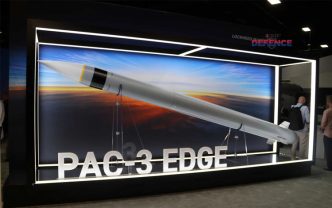
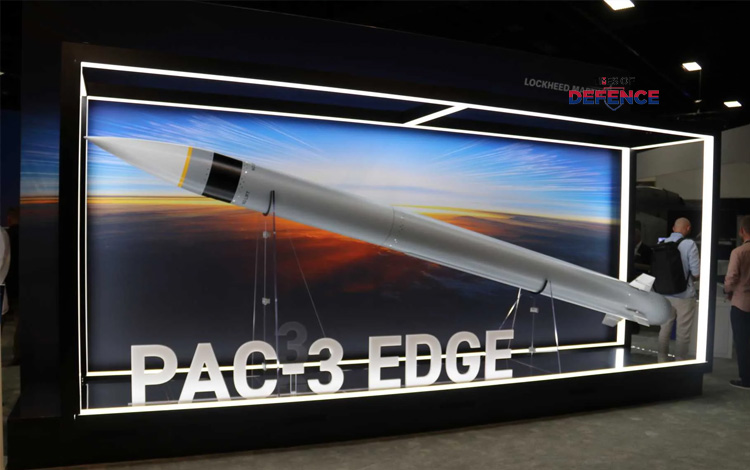
WASHINGTON — Lockheed Martin unveiled the Patriot Advanced Capability-3 (PAC-3) Edge interceptor at AUSA 2026, positioning the next-generation surface-to-air missile for the U.S. Army’s competitive Future Interceptor program.
Building upon the operational foundation of the combat-proven PAC-3 Missile Segment Enhancement (MSE), the PAC-3 Edge is engineered to significantly expand engagement slant-range, apogee altitude, and kinematic end-game maneuverability against complex maneuvering reentry vehicles (MaRVs) and emerging hypersonic glide threats. The interceptor integrates an advanced multi-pulse solid rocket motor developed by Northrop Grumman—which optimizes thrust energy distribution throughout extended flight profiles—alongside a proprietary next-generation active radar seeker developed via Lockheed Martin’s Strigo Product Center ($250M internal investment). Designed to integrate seamlessly with the U.S. Army’s Integrated Battle Command System (IBCS) and M903 launch stations, initial flight testing is targeted for 2027, with operational fielding projected for approximately 2031.
TECHNICAL SPECIFICATIONS: LOCKHEED MARTIN PAC-3 EDGE vs. PAC-3 MSE 
* Developer & Program Office: Lockheed Martin Missiles and Fire Control (Strigo Product Center)
* Tactical Role: Long-Range Kinetic Hit-to-Kill (HTK) Anti-Ballistic & Counter-Hypersonic Air Defense Interceptor
* Architectural & Structural Evolutions (PAC-3 MSE vs. PAC-3 Edge):
* Primary Propulsion Architecture:
* PAC-3 MSE: Aerojet Rocketdyne Dual-Pulse Solid Rocket Motor
* PAC-3 Edge: Northrop Grumman Advanced Multi-Pulse Solid Rocket Motor (sustained velocity & terminal energy management)
* Seeker & Sensor Suite:
* PAC-3 MSE: Ka-band active radar seeker with legacy signal processing
* PAC-3 Edge: Next-Generation High-Precision Active Radar Seeker (enhanced target acquisition & counter-electronic protection)
* Attitude & Trajectory Control Systems:
* PAC-3 MSE: Combined aerodynamic control fins + solid propellant Attitude Control Motors (ACMs)
* PAC-3 Edge: Upgraded high-altitude maneuvering control surfaces + enhanced pulse ACM array for high-mesosphere agility
* System Integration & Command Architecture:
* Command Post Network: Integrated Air and Missile Defense (IAMD) Battle Command System (IBCS)
* Fire Control Radar Interface: AN/MPQ-65A & LTAMDS (Lower Tier Air and Missile Defense Sensor – GhostEye)
* Launcher Compatibility: M903 Launching Station (Patriot battery architecture)
* Programmatic Lifecycle & Milestones:
* Prototype Unveiling: October 9, 2026 (AUSA 2026 / Washington, D.C.)
* Flight Testing Matrix: Initial flight and intercept trials scheduled for 2027
* Targeted Fieldings: Projecting Initial Operational Capability (IOC) ~2031
TIMES OF DEFENCE ASSESSMENT:
The emergence of the PAC-3 Edge highlights a critical doctrine shift within U.S. Army Integrated Air and Missile Defense (IAMD) toward countering high-speed, non-ballistic terminal maneuver threats. While the PAC-3 MSE successfully expanded the engagement envelope over early PAC-3 CRI variants, high-speed maneuvering reentry vehicles (MaRVs) and hypersonic weapons rapidly bleed an interceptor’s kinetic energy at extreme altitudes and ranges. By replacing the dual-pulse motor with Northrop Grumman’s multi-pulse propulsion, PAC-3 Edge retains reserve thrust for the terminal engagement phase, allowing the missile to execute high-G lateral maneuvers in thin upper-atmospheric conditions.
Furthermore, integrating the Strigo-developed high-precision active seeker directly responds to tactical combat lessons from high-intensity engagements in Eastern Europe and the Middle East, where complex electronic counter-countermeasures (ECCM) and clutter rejection are vital for kinetic hit-to-kill accuracy. However, with current PAC-3 MSE unit costs hovering around $5.3 million, the highly sophisticated PAC-3 Edge will likely carry a premium price tag. Consequently, the U.S. Army’s long-term operational success will require a balanced force mix—pairing high-end PAC-3 Edge interceptors for advanced hypersonic threats alongside lower-cost effectors (such as the proposed PAC-3 ACE) to preserve magazine depth against massed missile salvos.

