


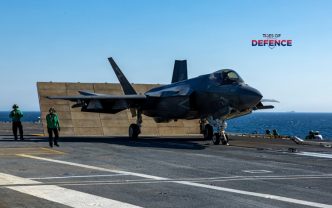
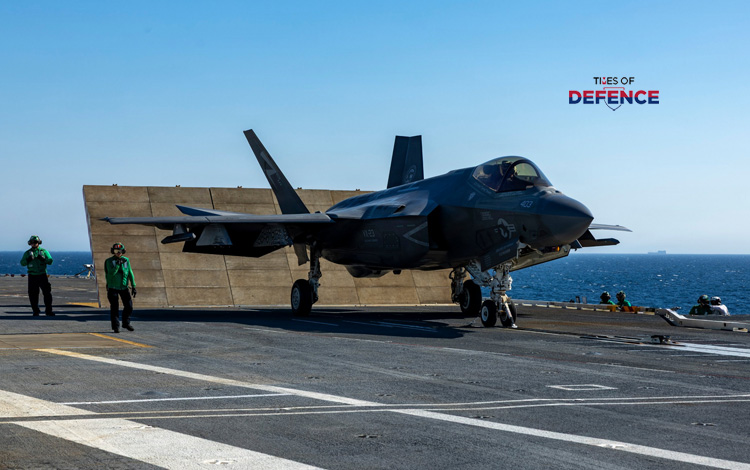
WESTERN ATLANTIC OCEAN — A U.S. Navy F-35C Lightning II carrier variant fighter aircraft attached to Air Test and Evaluation Squadron (VX) 23 “Salty Dogs” executed its first-ever catapult launch from a Gerald R. Ford-class aircraft carrier aboard Pre-Commissioning Unit (PCU) John F. Kennedy (CVN 79) on October 14, 2026.
The catapult launch followed the aircraft’s initial arrested recovery on October 13, marking the first time a fifth-generation stealth fighter operated from the flight deck of the Navy’s newest aircraft carrier class. Operating off the U.S. East Coast, PCU John F. Kennedy is executing Aircraft Compatibility Testing (ACT) under the oversight of the Patuxent River F-35 Integrated Test Force (ITF) and Naval Air Warfare Center Aircraft Division (NAWCAD). The sea trials validate the operational synchronization between the aircraft’s carrier-suite airframe and the ship’s Next-Generation Flight Deck Machinery—specifically General Atomics’ Electromagnetic Aircraft Launch System (EMALS) and the Advanced Arresting Gear (AAG) system.
TECHNICAL SPECIFICATIONS: LOCKHEED MARTIN F-35C / GERALD R. FORD-CLASS (CVN 79) FLIGHT DECK INTEGRATION 
* Platform & Testing Detachment: Lockheed Martin F-35C Lightning II / Air Test and Evaluation Squadron (VX) 23 “Salty Dogs” (NAS Patuxent River, MD)
* Vessel & Class Architecture: Pre-Commissioning Unit (PCU) John F. Kennedy (CVN 79) / Gerald R. Ford-class Nuclear-Powered Aircraft Carrier
* Flight Deck Launch Architecture:
* System: Electromagnetic Aircraft Launch System (EMALS) (General Atomics)
* Operating Principle: Linear Induction Motor (LIM) technology delivering smooth, controllable acceleration across variable aircraft mass profiles
* Advantage for F-35C: Reduces peak structural stress during launch cycles compared to traditional steam catapults, extending airframe fatigue life
* Flight Deck Recovery Architecture:
* System: Advanced Arresting Gear (AAG) (General Atomics)
* Operating Principle: Rotary electric motor energy absorbers with digital control architecture, replacing hydromechanical systems
* Performance: Tailored energy absorption for high-gross-weight carrier recoveries and low-speed landing profiles
* F-35C Airframe & Carrier Suitability Parameters:
* Wingspan & Folding Sweep: 13.1 m (43 ft) wingspan | Heavy-duty folding wing mechanism for deck-space conservation
* Landing Gear Suite: Reinforced dual-wheel nose gear with catapult launch bar + heavy-duty main landing gear and tailhook assembly
* Fuel & Payload Envelope: Internal fuel capacity ~8,900 kg (19,600 lbs) | Max Takeoff Weight (MTOW) ~31,800 kg (70,000 lbs)
* Programmatic Timeline & Delivery Status:
* Compatibility Milestones: First carrier trap Oct 13, 2026 | First EMALS catapult launch Oct 14, 2026
* Ship Delivery Schedule: Aircraft Compatibility Testing (ACT) leading to formal U.S. Navy fleet delivery targeted for March 2027
TIMES OF DEFENCE ASSESSMENT:
The successful execution of the first F-35C EMALS launch and AAG recovery aboard PCU John F. Kennedy (CVN 79) represents a major technical validation for the U.S. Navy’s carrier air wing modernization strategy. Integrating fifth-generation stealth fighters with the Gerald R. Ford-class’s high-efficiency electromagnetic launch and digital recovery gear resolves long-standing technical risk vectors that delayed early class operations, proving that EMALS can safely handle the high-gross-weight acceleration envelopes of heavy strike fighters.
Achieving seamless flight deck compatibility between the F-35C and CVN 79 allows the Navy to transition away from retrofitting legacy steam carriers and deploy fully integrated Ford-class Carrier Strike Groups (CSGs). Operating F-35Cs alongside F/A-18E/F Super Hornets and EA-18G Growlers on Ford-class flight decks—which feature higher sortie generation rates (SGR) due to optimized deck layouts and Advanced Weapons Elevators—significantly elevates carrier strike power, stealth penetration, and sensor-fusion C4ISR capabilities in contested anti-access/area-denial (A2/AD) maritime environments.

