


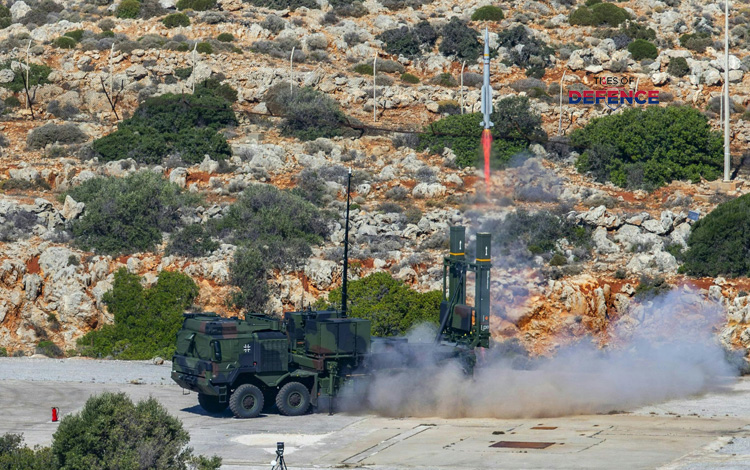
NAMFI, Crete — Airbus Defence and Space successfully demonstrated bi-national multi-layered ground-based air defense (GBAD) integration during NATO Exercise Spartan Arrow 26 at the NATO Missile Firing Installation (NAMFI) in Crete.
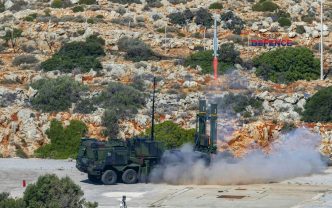
The operational milestone marked the first time the German Air Force (Luftwaffe) Diehl IRIS-T SLM (Surface Launched Medium Range) system and the Swedish Air Force (Flygvapnet) Raytheon MIM-104 Patriot (Luftvärnssystem 103) were concurrently networked into the German SAMOC (Surface to Air Missile Operations Centre) C4I command post. Acting as the central tactical software brain, SAMOC harmonized sensor data, engagement planning, and fire control across short-, medium-, and long-range air defense layers. Under realistic electronic warfare (EW) conditions, an all-German crew from Flugabwehrraketengruppe 61 executed the first live firing of the IRIS-T SLM under SAMOC control—a mandatory prerequisite for official NATO certification. Simultaneously, Sweden validated its Patriot system through its first independent, networked live-fire engagement, confirming bi-national interoperability and operational NATO compliance.
TECHNICAL SPECIFICATIONS: SAMOC NETWORKED MULTI-LAYER AIR DEFENSE ARCHITECTURE 
* Systems Integrator & C2 Developer: Airbus Defence and Space / Tactical Command & Control Systems
* Central Command & Control Hub: SAMOC (Surface to Air Missile Operations Centre)
* Functional Role: Joint/Combined Ground-Based Air Defence (GBAD) tactical operations center and Air Defense C2 software hub
* Data Links & Protocols: NATO Link 16, Link 11B, JREAP-C, and STANAG 4586 compliant interfaces
* Real-Time Telemetry Performance: Evaluated real-time bandwidth allocation, latency response times, and RF electronic anti-jamming resilience
* Integrated Tiered Weapon Subsystems (Spartan Arrow 26 Profile):
* Long-Range Tier (High-Altitude Ballistic/Cruise Interception):
* System: Swedish Air Force MIM-104 Patriot (LvS 103)
* Effectors: GEM-T / PAC-3 MSE hit-to-kill interceptors
* Medium-Range Tier (Medium-Altitude Cruise Missile/Drone Interception):
* System: German Air Force IRIS-T SLM (operated by Flugabwehrraketengruppe 61 / Todendorf)
* Effectors: Diehl IRIS-T SL guided missiles with thrust-vector control and imaging IR seekers
* Short/Very Short-Range Tier (VSHORAD / Counter-UAS):
* System: German Army (Deutsches Heer) LeFlaSys (Leichtes Flugabwehrsystem / Ozelot weapon carrier)
* Effectors: FIM-92 Stinger / ASRAD short-range surface-to-air missiles
* Tactical Achievements & Certifications:
* German Luftwaffe: Live-fire validation of IRIS-T SLM by an all-German unit toward formal NATO operational status
* Swedish Flygvapnet: Formal NATO certification and validation of Swedish Patriot units via networked remote fire direction
TIMES OF DEFENCE ASSESSMENT:
The successful multi-tiered integration of German IRIS-T SLM, Swedish Patriot, and German Army LeFlaSys batteries via Airbus’s SAMOC C4I hub during Spartan Arrow 26 represents a major operational advancement for the European Sky Shield Initiative (ESSI) and NATO’s Integrated Air and Missile Defence (IAMD) framework. Establishing real-time target data fusion across heterogeneous short-, medium-, and long-range effectors directly addresses the lessons of modern high-intensity conflict, where massed drone swarms and low-altitude cruise missiles routinely attempt to saturate single-tier defenses.
Furthermore, enabling Sweden’s Patriot systems and Germany’s IRIS-T SLM to execute synchronized live firings through a shared command post validates cross-border sensor-to-shooter networking without forcing allies onto a single proprietary missile platform. The key challenge moving forward will be scaling this bi-national C2 architecture into continuous, permanent operational deployments across NATO’s northern and eastern flanks to ensure seamless, real-time engagement delegation during complex multi-vector air attacks.

