


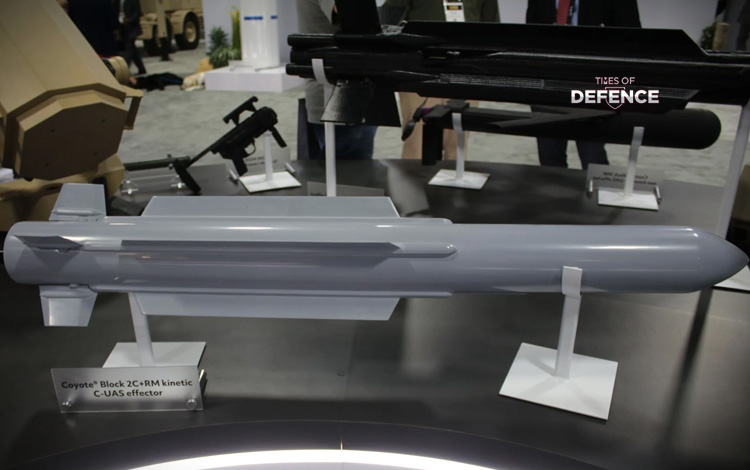
WASHINGTON — During AUSA 2026, RTX’s Raytheon business unit confirmed the successful execution of three flight tests for its new Coyote Block 2C+RM counter-unmanned aerial system (C-UAS) interceptor.
Developed via a 15-month company-funded initiative, the Block 2C+RM replaces the baseline Coyote Block 2’s sustaining turbojet engine with a high-thrust solid-fuel tactical rocket motor (RM). This propulsion transformation eliminates turbojet spool-up delays, enabling instantaneous acceleration, higher burnout velocity, expanded engagement reach, and compressed response timelines against fast-moving Class 3 unmanned aerial systems (UAS), fixed-wing kamikaze drones, and multi-drone salvo attacks. The variant integrates an upgraded seeker suite and enhanced fragmentation warhead while maintaining 100% architectural compatibility with existing fielded KuRFS (Ku-band Radio Frequency System) radars, pneumatic/canister launch cells, and Forward Area Air Defense Command and Control (FAAD C2) networks.
TECHNICAL SPECIFICATIONS: RTX RAYTHEON COYOTE BLOCK 2C+RM C-UAS INTERCEPTOR 
* Systems Developer & Integrator: Raytheon (RTX Land & Air Defense Systems / Tucson, AZ)
* Development Program & Timeline: 15-Month Rapid Development Cycle (Internal RTX Funding / Joint USAF & U.S. Army Testing)
* Physical Test Validation: Three successful flight tests completed, including July 2026 live-fire trials at Dugway Proving Ground, Utah
* Propulsion Architecture:
* Baseline Comparison: Replaces turbojet engine (Block 2 / Block 2C) with high-density solid-fuel tactical rocket motor (RM)
* Performance Advantage: Instantaneous thrust generation, higher maximum speed, increased engagement altitude/range, and reduced time-to-target
* Primary Target Spectrum:
* Drone Classes: Class 1–3 uncrewed aerial systems, high-speed jet-powered one-way attack drones (loitering munitions), and massed UAV swarms
* Track Record Context: Builds upon >600 confirmed operational drone kills recorded by the baseline Coyote Block 2
* Guidance, Seeker & Warhead Subsystems:
* Target Seeker: Advanced RF/radar seeker optimized for high-speed dynamic tracking against small Radar Cross Section (RCS) aerial targets
* Lethality Package: Modernized proximity-fuzed blast-fragmentation warhead optimized for Class 3 UAV destruction
* System Architectural Compatibility & C4ISR Integration:
* Launcher Interface: Drop-in compatibility with standard multi-cell box launchers (including 4-cell, 8-cell naval, and trailer-mounted LIDS arrays)
* Tracking Sensor Integration: Interfaces natively with Raytheon KuRFS (Ku-band Radio Frequency Sensor) 360-degree AESA radar
* Command & Control: Fully integrated with FAAD C2 within the U.S. Army LIDS (Low, Slow, Small Unmanned Aircraft Integrated Defeat System) architecture
* Export & International Context: Commonality with $729 million LIDS foreign military sales (FMS) contracts awarded for U.S. forces, Qatar, and Jordan