

“Yee-haw, she’s airborne!”
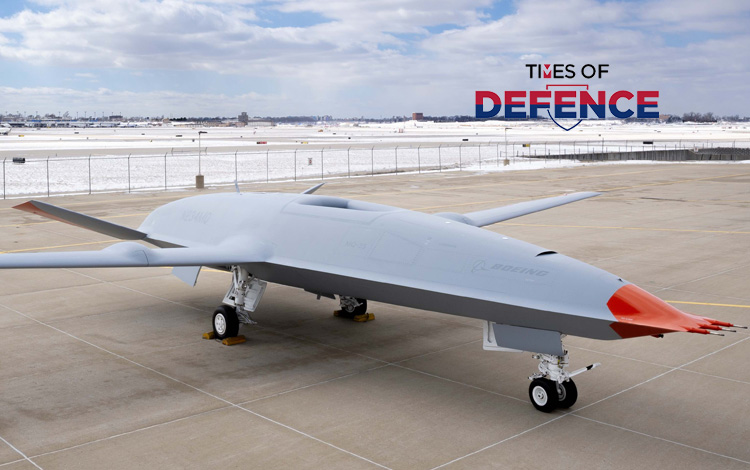
The U.S. Navy’s MQ-25A Stingray has taken a major step toward transforming carrier aviation, completing the first flight of an operational-production aircraft and formally beginning a demanding flight-test campaign.
The aircraft took off from Boeing’s facility at MidAmerica Airport in Mascoutah, Illinois, on April 25, 2026. The roughly two-hour flight tested the Stingray’s basic flight controls, engine performance, handling characteristics, navigation and integration with the Navy’s Unmanned Carrier Aviation Mission Control System. Navy and Boeing air vehicle pilots controlled and monitored the aircraft through the MD-5 ground control station.
From Prototype to Operational Aircraft
The 2026 flight should not be confused with the MQ-25 program’s earlier first flight.
In September 2019, Boeing’s T1 test aircraft completed the first flight of the MQ-25 program. T1 was a developmental test asset used to mature the aircraft’s aerodynamics, propulsion, guidance and control systems. It later demonstrated unmanned aerial refueling with an F/A-18E/F Super Hornet, E-2D Advanced Hawkeye and F-35C.
The April 2026 event was different: it marked the first flight of an MQ-25A operational configuration aircraft, representing the aircraft that will eventually enter carrier service.
Designed to Give Fighter Aircraft More Reach
The Stingray’s primary mission is aerial refueling.
The Navy intends to use MQ-25A to take over much of the carrier air wing’s organic tanker workload currently performed by F/A-18E/F Super Hornets. This would allow more manned fighters to remain available for strike and other combat missions while extending the effective operating radius of the carrier air wing.
The aircraft is therefore not simply another unmanned aircraft. Its importance lies in how it changes the composition of the carrier air wing.
Instead of using a manned fighter to carry fuel to other aircraft, the Navy can dedicate an unmanned platform specifically to the tanker mission.
MQ-25A Stingray — Publicly Disclosed Specifications
| Feature | MQ-25A |
|---|---|
| Manufacturer | Boeing |
| Primary mission | Carrier-based aerial refueling |
| Propulsion | Rolls-Royce AE3700N |
| Length | 51 ft / 15.5 m |
| Wingspan, spread | 75 ft / 22.9 m |
| Wingspan, folded | 31.3 ft / 9.5 m |
| Control system | Unmanned Carrier Aviation Mission Control System |
| Carrier integration | Designed for aircraft-carrier operations |
| Secondary capability | ISR planned/possible within Navy mission concept |
The Navy’s published fact file identifies the MQ-25’s propulsion as the Rolls-Royce AE3700N and gives the aircraft’s basic dimensions. Detailed performance figures such as maximum speed, combat radius and complete fuel-transfer capacity are not fully disclosed in the Navy’s current public fact file.
The Carrier Deck Is the Real Test
Flying from an airport is only the beginning.
The MQ-25A ultimately has to operate from a carrier deck, where space is limited, aircraft movements are tightly coordinated and environmental conditions are significantly more demanding.
The Navy’s test program will progressively expand the aircraft’s flight envelope, verify mission systems and prepare the aircraft for carrier integration. The Navy has said the aircraft will transition to Naval Air Station Patuxent River for further testing and eventual preparation for carrier qualification.
The aircraft’s unmanned architecture is also central to this effort. Rather than placing a pilot inside the aircraft, operators control and monitor the Stingray through the MD-5 ground-control architecture.
A Foundation for Unmanned Carrier Aviation
The significance of MQ-25 extends beyond refueling.
The Navy describes the Stingray as a foundational platform for integrating unmanned aircraft into the carrier air wing and for developing future manned-unmanned teaming concepts. The long-term vision involves manned fighters, unmanned aircraft, sensors and weapons operating as an interconnected force.
The program has already demonstrated that the MQ-25 concept can interact with several different carrier aircraft. The T1 test aircraft previously conducted refueling demonstrations with the F/A-18, F-35C and E-2D, providing aerodynamic and control data for future operational integration.
Production Has Now Begun to Move Forward
Following the successful first flight, the Navy announced Milestone C approval in May 2026, allowing the program to enter Low-Rate Initial Production.
The Navy said the first LRIP lot is expected to cover three aircraft, with priced options for additional aircraft in later lots.
That means the Stingray has moved beyond being purely a technology-development effort. It is now progressing through the acquisition, flight-test and carrier-integration process required to become an operational naval aircraft.
What Comes Next?
The next milestones are considerably more demanding than the first flight:
- Expanded flight-envelope testing
- Mission-system verification
- Continued autonomous-control testing
- Carrier integration
- Deck-handling demonstrations
- Carrier qualification
- Aerial-refueling certification
- Operational testing
- Fleet introduction
The ultimate objective is straightforward: put an unmanned tanker on the carrier deck that can safely launch, recover, refuel aircraft and operate as part of a carrier air wing.
The MQ-25A Stingray’s first flight does not mean that mission is complete.
It means the Navy has entered the next phase of making it possible.
Editorial note: The 2019 T1 flight was the first flight of the MQ-25 program, while the April 2026 event was the first flight of an operational MQ-25A aircraft. The distinction is important when describing the program’s development timeline.