

Anduril’s FQ-44 Fury Collaborative Combat Aircraft is being developed with a substantially broader weapons envelope than its initial air-to-air role suggests, with the company now conducting integration and fit checks for guided bombs, Small Diameter Bombs, cruise missiles, rocket pods and targeting pods.
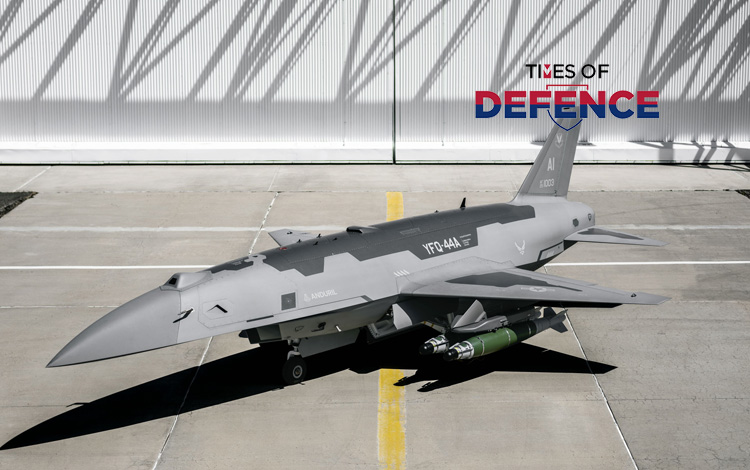
New imagery released in September 2026 shows the YFQ-44A Fury configured with air-to-ground stores, providing the clearest public indication yet that the U.S. Air Force’s future Collaborative Combat Aircraft could evolve into a multi-role unmanned strike platform.
The development is significant because the Air Force’s initial CCA Increment 1 requirement places strong emphasis on air dominance, but Anduril is already exploring ways to give Fury additional strike and counter-unmanned-aircraft missions.
From Air-to-Air to Multirole Combat
The FQ-44 is one of two aircraft selected for the U.S. Air Force’s Collaborative Combat Aircraft (CCA) Increment 1 programme, alongside General Atomics’ YFQ-42A.
The aircraft is intended to operate alongside crewed fighters as a semi-autonomous combat aircraft, using onboard autonomy and network connectivity to extend the capabilities of manned platforms.
Fury has already demonstrated its ability to participate in a complete air-to-air engagement chain.
In July 2026, a YFQ-44A successfully launched an AIM-120 AMRAAM during testing with the Air Force’s Experimental Operations Unit. The test represented the first publicly acknowledged live weapon release from a CCA aircraft.
Anduril subsequently began expanding its weapons integration work.
500-Pound Guided Bombs and Small Diameter Bombs
The company has begun integration and fit checks for 500-pound-class guided bombs, including JDAM-family weapons, as well as GBU-39/B Small Diameter Bombs.
Recent imagery shows the YFQ-44A carrying a twin-rack arrangement loaded with two GBU-39/B SDBs beneath a wing station.
The SDB is a compact precision-guided weapon designed to provide a relatively large number of precision weapons from a limited number of aircraft stations.
For Fury, this creates the possibility of using a relatively small autonomous aircraft as a precision strike platform while retaining its ability to perform other missions.
Importantly, these air-to-ground weapons have been fit-checked and are undergoing integration work. Anduril has not stated that JDAM or SDB have already been released from a Fury in flight.
Barracuda 500 and Low-Cost Cruise Missiles
Anduril is also working toward integrating low-cost cruise missiles, including its own Barracuda 500 family.
This could give Fury a substantially different mission profile.
Rather than using the CCA only as a direct weapons carrier, the aircraft could potentially act as an airborne launch platform for longer-range autonomous weapons.
The combination of an autonomous aircraft and a low-cost cruise missile could also allow commanders to distribute weapons across a larger number of platforms.
However, the Barracuda integration remains an engineering effort rather than a publicly demonstrated operational capability on Fury.
Rocket Pods and Targeting Pods
Anduril has also begun integration work involving:
- 2.75-inch rocket pods
- Guided or unguided rockets
- Targeting pods
- Additional air-to-air weapons
The rocket pods are particularly interesting because they could give Fury another relatively inexpensive weapon option for engaging smaller or less heavily protected targets.
A targeting pod could provide additional electro-optical/infrared sensing and precision targeting capability for air-to-ground missions.
Together, these integrations could support missions including:
Counter-UAS → Counter-cruise missile → Air-to-ground strike → Air-to-surface attack
Anduril has specifically identified these mission areas as potential applications for the expanded weapons architecture.
Four AMRAAMs on the Production FQ-44
The production configuration is also expected to have a larger air-to-air weapons capacity than the current prototype.
Anduril says the production FQ-44 is being designed with four external hardpoints, allowing it to carry up to four AIM-120 AMRAAMs for the Air Force’s primary air-to-air mission.
The current YFQ-44A test aircraft has been operating with two external weapon stations, including during its successful AMRAAM live-fire demonstration.
This gives the production aircraft a potential configuration such as:
4 × AIM-120 AMRAAM
for an air-to-air mission, while alternative configurations could exchange those weapons for air-to-ground stores or other mission equipment.
Fury’s Published Performance
Publicly available technical information on the production FQ-44 remains limited, but open-source estimates and previously released information indicate a high-subsonic autonomous aircraft.
Commonly reported figures include:
- Engine: Williams FJ44-4M turbofan
- Thrust: approximately 18 kN / 4,000 lbf
- Maximum speed: approximately Mach 0.95
- Ceiling: approximately 50,000 ft / 15,240 m
- Length: approximately 6.1 m
- Wingspan: approximately 5.2 m
- Crew: none
- Configuration: autonomous/semi-autonomous CCA
These figures should be treated as open-source or estimated specifications, because Anduril has not publicly released a complete production FQ-44 technical datasheet.
The Role of Lattice Autonomy
Fury’s weapons flexibility is closely connected to Anduril’s Lattice software architecture.
During the July live-fire demonstration, Fury received an externally generated track through a beyond-line-of-sight connection. Lattice processed the information, the operator tasked the aircraft to engage, and the aircraft executed the engagement before launching an AIM-120 against the target.
This illustrates the intended CCA operating concept:
External sensor → network → Lattice → human authorization/tasking → autonomous aircraft → weapon
The aircraft therefore does not necessarily need to detect every target independently. It can receive information from other aircraft, ships, ground systems or networked sensors.
A Potential “Weapons Truck” in the Air
The expanded weapons work also points toward a broader concept for CCAs.
A Fury carrying several precision weapons could potentially operate as a semi-autonomous airborne weapons carrier, receiving targeting information from other platforms while remaining relatively inexpensive compared with a crewed fighter.
For example, a CCA could potentially:
- Receive target information from an F-35 or another sensor.
- Navigate toward the assigned engagement area.
- Use onboard sensors and autonomy to refine the tactical picture.
- Receive human authorization.
- Deliver an appropriate weapon.
- Return or continue to another assigned mission.
This is still an evolving concept rather than a fully operational capability.
Why the Weapon Integration Matters
The significance of the latest Fury imagery is therefore not simply that the aircraft can physically carry bombs.
It demonstrates that Anduril is designing the platform around modular weapons integration, allowing the same basic aircraft to be configured for different mission sets.
A single CCA fleet could potentially contain different configurations:
Air Dominance
AIM-120 AMRAAM + air-to-air sensors
Precision Strike
JDAM/SDB
Counter-UAS
Rocket pods + sensors + autonomy
Counter-Cruise Missile
Air-to-air weapons + networked sensors
Stand-Off Strike
Low-cost cruise missiles such as Barracuda 500
This modularity is consistent with the wider CCA concept of fielding relatively affordable autonomous aircraft that can perform different tasks alongside crewed fighters.
Production Status
The FQ-44 is moving toward production as part of CCA Increment 1, but the production programme is not yet at full-scale operational deployment.
Anduril has already invested in production infrastructure and long-lead components, while company officials said in September 2026 that the company still requires FY2027 procurement funding before it can fully begin the production contract.
At the same time, the company is using its own funding to accelerate additional weapons integration and testing.
That means some of the capabilities currently being demonstrated or fit-checked may mature before the final operational configuration is established.
The Bigger Picture
The FQ-44 Fury is increasingly being presented not simply as an unmanned escort fighter, but as a modular autonomous combat aircraft.
Its successful AIM-120 launch has already demonstrated an air-to-air weapons capability. The ongoing integration of JDAM-class weapons, SDBs, cruise missiles, rocket pods and targeting pods indicates that Anduril is seeking to expand that capability into a broader family of missions.
The most important caveat is that not every weapon shown or discussed has been flight-tested or operationally cleared on Fury.
For now, the confirmed picture is:
Air-to-air capability demonstrated.
Air-to-ground weapons integration underway.
Multiple additional weapon classes being evaluated.
Production FQ-44 planned with four external hardpoints.
If these integrations progress successfully, Fury could become a highly flexible autonomous weapons platform rather than a CCA designed around a single mission.
The “fight unfair” concept is therefore less about one specific weapon and more about giving an autonomous aircraft the ability to switch between multiple mission and weapons configurations within the same basic platform.
