


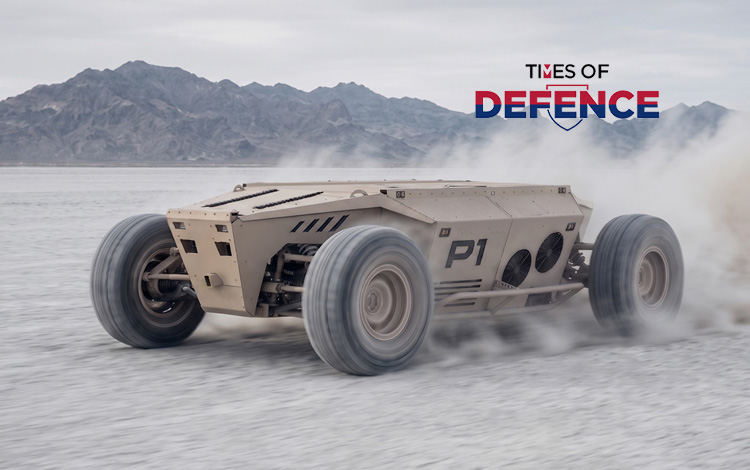
WASHINGTON, United States — Hypercraft’s Razorback autonomous unmanned ground vehicle (UGV) has been designated “awardable” through the U.S. Army Applications Laboratory’s DevX Autonomy platform, giving the company a faster pathway to government procurement and further military evaluation.
The designation places Razorback among autonomy and unmanned-system solutions that have undergone the DevX assessment process and are considered ready for government buyers to evaluate for potential awards. It does not, however, represent a completed Army procurement, operational fielding decision or formal production contract.
Hypercraft is positioning Razorback as a software-defined tactical ground platform capable of carrying mission payloads, supporting autonomous operations and providing substantial electrical power to equipment operating at the tactical edge.
What Is DevX Autonomy?
The U.S. Army Applications Laboratory’s DevX Autonomy is designed to accelerate the transition of autonomous and unmanned technologies from industry into government programs.
Instead of requiring companies to begin with lengthy traditional proposals, the platform uses a six-minute vendor demonstration video as the core submission.
Solutions are assessed by subject-matter experts against published criteria. Once a solution is considered “award-ready,” it is added to the DevX repository, where authorized government users can discover technologies and potentially move toward an award much faster than through conventional acquisition processes.
The platform covers several technology categories, including:
- Autonomous ground, maritime and air platforms
- Sensors and communications payloads
- Mission-planning technologies
- Lethal capabilities
- Sustainment systems
- Autonomous-system components such as motors, sensors and controllers
For Hypercraft, the Razorback designation therefore represents an important step from prototype/development technology toward potential government acquisition.
Razorback: A Software-Defined UGV
Hypercraft describes Razorback as a software-defined unmanned ground vehicle designed for operations in austere and contested environments.
Rather than treating the vehicle as a fixed hardware platform, Hypercraft has built the system around its Carbon vehicle operating system.
Carbon is described as an open-architecture, Modular Open Systems Approach (MOSA)-compliant vehicle operating system that connects the vehicle’s physical hardware with software, autonomy functions, sensors and mission payloads.
This architecture is intended to allow the platform to receive new software capabilities and integrate different payloads without requiring the entire vehicle to be redesigned.
Hypercraft says the system is designed around:
Mobility + autonomy + computing + power generation + modular payload integration.
Razorback Technical Characteristics
Publicly reported specifications give an indication of the vehicle’s intended capabilities.
Key figures
Vehicle: Hypercraft Razorback
Type: Autonomous unmanned ground vehicle
Powertrain: Hybrid diesel-electric
Payload capacity: Up to 2,400 lb / approximately 1,090 kg
Range: Reported at approximately 280 miles / 450 km
Exportable electrical power: Up to 38 kW
Chassis wheelbase: 148 inches / 3.76 m
Tires: 37-inch
Steering: Four-wheel hydraulic steering
Special maneuvering: Neutral-steer capability
Architecture: MOSA-compliant, software-defined
Autonomy: Designed for autonomous operation and mission-specific autonomy integration
Some published third-party material also reports a rated top speed of approximately 60 mph (97 km/h) and SAE Level 4 autonomy capabilities. These figures are not currently presented with the same level of detail on Hypercraft’s current official product material, so they should be treated as reported specifications rather than definitive Army-certified performance figures.
A Mobile Power Station on the Battlefield
One of Razorback’s most distinctive characteristics is its ability to export electrical power.
The platform is designed to provide approximately 38 kW of tactical power to external equipment.
That capability could allow a single unmanned vehicle to act as a mobile energy node for:
- ISR sensors
- Communications equipment
- Electronic-warfare systems
- Counter-UAS equipment
- Drone charging stations
- Command-and-control equipment
- Directed-energy systems
This is an important distinction from conventional UGVs that primarily function as cargo carriers or remote weapons platforms.
Razorback can potentially become part of the electrical and digital infrastructure of a distributed battlefield.
Hybrid-Electric Propulsion
Razorback uses a hybrid diesel-electric powertrain.
The architecture is intended to provide both sustained range and electrical power for mission systems.
The electric component also supports lower-signature operation. Hypercraft describes its technology as enabling silent operations and tactical power export, allowing the vehicle to operate some mission functions without continuously relying on the diesel engine.
This could be particularly useful when a UGV needs to remain stationary while powering sensors, communications or other equipment.
Instead of bringing a separate generator into a forward position, the unmanned vehicle itself can become the generator and mobility platform.
Autonomy and Carbon Architecture
The Carbon software architecture is central to Razorback’s concept.
Hypercraft describes Carbon as a vehicle operating system designed to integrate:
- Vehicle controls
- Autonomy software
- Sensors
- Mission payloads
- Communications
- Computing
- Software applications
The company says the architecture supports rapid integration of new software and mission payloads while maintaining separation between vehicle hardware and higher-level applications.
This is particularly relevant to military autonomy because autonomy technology is evolving much faster than traditional vehicle platforms.
A software-defined vehicle can potentially receive new autonomy behaviors, sensor-processing capabilities or mission applications without requiring a completely new vehicle.
Counter-UAS Capability
Razorback has also been positioned as a potential counter-UAS platform.
Hypercraft has partnered with Fortem Technologies to integrate radar and drone-mitigation technologies for airspace protection. The company’s stated mission applications include countering Group 1 and Group 2 UAVs.
The platform can therefore potentially operate as a mobile counter-drone node while simultaneously providing electrical power to the associated equipment.
This could be particularly relevant for distributed military formations that need to protect forward positions without deploying large fixed installations.
Contested Logistics
Another major mission is autonomous logistics.
A Razorback could potentially transport supplies into areas where sending a crewed vehicle would expose personnel to unnecessary risk.
Its approximately 2,400-pound payload capacity gives the vehicle enough carrying capacity for significant tactical loads while allowing the platform to operate without a driver.
Possible missions include:
- Ammunition resupply
- Fuel and energy support
- Water and sustainment cargo
- Forward equipment delivery
- Autonomous resupply between distributed units
This concept aligns closely with the U.S. Army’s growing interest in autonomous logistics and reduced personnel exposure.
Casualty Evacuation
Hypercraft has also identified casualty evacuation as a potential Razorback mission.
An autonomous vehicle could potentially enter a dangerous forward area, retrieve casualties and transport them toward a medical collection point without requiring another crewed vehicle to enter the same threat zone.
The platform’s electrical architecture could also support medical equipment requiring continuous power.
This illustrates the broader philosophy behind Razorback: the same physical platform can be reconfigured for different missions through software and modular payloads.
Communications and Electronic Warfare
Razorback can also serve as a mobile node for communications and electronic warfare.
A UGV positioned forward of the main force could potentially carry radios, antennas, sensors or EW equipment while using its onboard power generation to keep those systems operating.
In a contested environment, this could allow commanders to push sensing and communications capabilities farther forward without exposing additional personnel.
Hypercraft specifically describes Razorback as a platform capable of supporting communications extension and mobile sustainment functions.
Why the DevX Designation Matters
The significance of the DevX designation is less about the word “awardable” itself and more about the acquisition pathway it creates.
The Army is attempting to shorten the traditional distance between:
Commercial technology → military evaluation → government acquisition → field experimentation
DevX Autonomy is specifically designed to identify technologies that have already undergone competitive assessment and make them easier for government users to discover and potentially award.
For a relatively young defense technology company, gaining this status can therefore be an important milestone.
But it is critical to distinguish:
Awardable ≠ Awarded
Awardable ≠ Army fielded
Awardable ≠ Full-rate production
The designation means the technology has reached a level where it can be considered for rapid government acquisition through the appropriate authorities.
Why Razorback Fits the Current U.S. Army Environment
The U.S. Army is increasingly looking for systems that can operate in distributed, contested and communications-degraded environments.
The Ukraine war and other modern conflicts have demonstrated the importance of:
- Autonomous logistics
- Persistent ISR
- Counter-UAS systems
- Electronic warfare
- Distributed communications
- Mobile power
- Reduced personnel exposure
Razorback attempts to combine several of these requirements into a single unmanned platform.
Its most interesting feature may therefore not be its autonomous driving capability alone.
It is the combination of autonomous mobility and tactical energy generation.
Bottom Line
Hypercraft’s Razorback has now moved into the U.S. Army’s DevX Autonomy award-ready ecosystem, giving the platform a clearer route toward potential government procurement and further experimentation.
With a reported 2,400-lb payload, approximately 280-mile range and 38 kW of exportable power, the hybrid-electric UGV is being positioned as more than an autonomous transport vehicle.
It is designed to function as a mobile logistics carrier, power source, communications node, counter-UAS platform and mission-support vehicle.
The next important milestone will be whether the Army or another government organization actually places a contract or orders Razorback systems.
For now, the key development is that the platform has passed the DevX Autonomy process and is award-ready — but not yet an Army-fielded system.
