


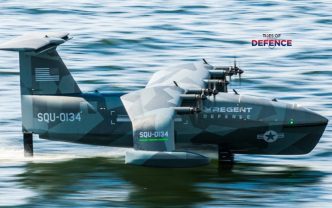
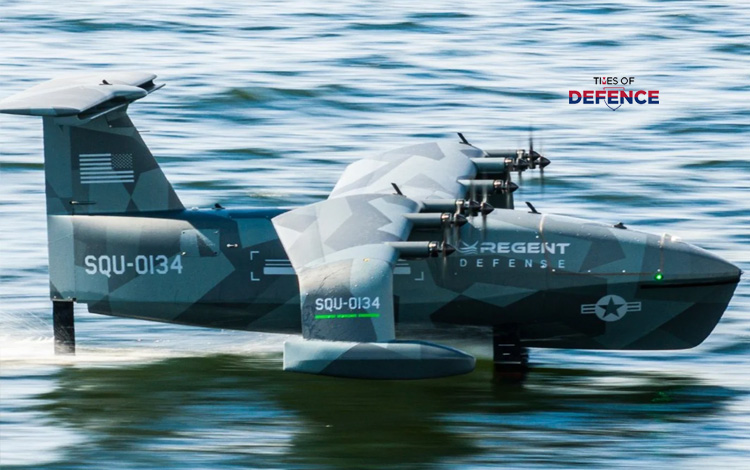
Maritime mobility firm REGENT has signed its first production contract to deliver a fleet of autonomous Squire seaglider uncrewed vehicles to a U.S. government customer, with operational deployment slated for the Middle East in 2027, co-founder and CEO Billy Thalheimer announced on November 18, 2026.
First previewed at the UP.Summit on November 6, 2026, the agreement marks REGENT’s transition from experimental testing and demonstrations into commercial defense sales. While the specific buying agency, exact unit count, and contract value remain undisclosed, Thalheimer confirmed that the electric hydrofoiling wing-in-ground-effect (WIG) drones will execute multi-domain perception—including underwater sensing, sensor emplacement, and over-water surveillance—in the U.S. Central Command (CENTCOM) theater next year. Weighing under 181 kg (400 lbs) at maximum takeoff weight and cruising up to 70 knots just above the wave tops, Squire bridges the gap between slow uncrewed surface vessels (USVs) and conventional uncrewed aerial vehicles (UAVs) while operating without dedicated launch or recovery infrastructure.
TECHNICAL SPECIFICATIONS: REGENT SQUIRE SEAGLIDER ARCHITECTURE
1. Airframe, Hydrofoil Takeoff & Wing-in-Ground-Effect Performance
⚡ Prime Developer & Manufacturer: REGENT (North Kingstown, Rhode Island; 255,000-sq-ft production facility scaled up to 300 Squires annually)
⚡ Dimensions & Weight Class: Approximately 4 meters (13 ft) long with a 5.5-meter (18 ft) wingspan and 1.7-meter (5.5 ft) height; maximum takeoff weight under 181 kg (400 lbs) with a 23 kg (50 lb) payload capacity (Group 3 UAS class) and a 14 x 12 x 14-inch internal payload bay
⚡ Three-Mode Maritime Operation: Operates on the surface like a boat/USV, lifts clear of wave chop on hydrofoils (foil speed around 35 knots), and skims in wing-in-ground-effect flight within roughly one wingspan above the water at top speeds up to 70 knots
⚡ Range & Low-Signature Profile: Rated for ranges exceeding 100 nautical miles (185 km), flying below line-of-sight radar horizons while using hydrofoils to clear surface chop during takeoff and landing without runways or cranes 
2. Autonomy Stack, Sensor Roles & Test Maturity
💥 Autonomy & C2 Integration: Driven by REGENT’s proprietary autonomous flight/surface control software and integrated with Team Awareness Kit (TAK) situational awareness tools and Anduril’s Lattice command-and-control platform
💥 Multi-Domain Mission Set: Engineered for underwater perception, deploying sensors across dispersed maritime sites, electro-optical/infrared (EO/IR) intelligence, surveillance, reconnaissance (ISR), ad hoc communications relay, and contested littoral logistics
💥 Validation & Scaling Milestones: Conducted its first U.S. test flight in April 2026, completed a 13-day evaluation at the Silent Swarm electronic warfare exercise in Michigan in July 2026, and follows REGENT’s $15 million U.S. Marine Corps contract and $240 million August 2026 funding round
TIMES OF DEFENCE ASSESSMENT
REGENT’s first production contract for the Squire seaglider ahead of a 2027 Middle East deployment highlights three critical shifts in uncrewed maritime warfare and littoral sensing:
1. Resolving the Speed-Versus-Stealth Tradeoff in Contested Waters: Traditional surface drones offer persistent loitering at low speeds (typically 5–20 knots), whereas conventional aerial drones fly faster but face higher radar exposure and weather constraints. Skimming at up to 70 knots in ground effect combines rapid point-to-point transit with low-altitude radar masking.
2. Enabling Rapid, Infrastructure-Free Sensor Distribution: Using hydrofoils to lift out of choppy seas allows Squire to transit between locations, place or network underwater and surface sensors, and reposition without specialized launch-and-recovery ships or coastal runways.
3. Moving From Experimental WIG Concepts to Operational Theater Fielding: While wing-in-ground-effect craft have historically struggled with rough-water takeoff limits and niche roles, pairing modern autonomy, TAK/Lattice integration, and dedicated factory capacity brings compact WIG drones into active theater service.

