


RTX business Raytheon has awarded a joint multi-year contract to Ursa Major and Avio USA to design, develop, and qualify a new solid rocket motor (SRM) booster for the U.S. Navy’s Tactical Tomahawk long-range cruise missile program, creating a qualification pathway for both firms to enter future Tomahawk propulsion production.
Announced in mid-November 2026, the joint development award pairs Ursa Major’s additive manufacturing and agile propulsion engineering with Avio USA’s established solid rocket propulsion heritage and expanding domestic U.S. production footprint. Rather than an immediate serial production order, the contract establishes the design and qualification baseline required for both partners to become qualified domestic propulsion suppliers supporting high-rate Tomahawk manufacturing and multi-domain naval, submarine, and ground-launched strike requirements.
TECHNICAL SPECIFICATIONS: TOMAHAWK BOOSTER & PROPULSION ARCHITECTURE
1. Joint Development Team & Propulsion Industrial Model
⚡ Prime Contractor & Program Lead: Raytheon (an RTX business) for the U.S. Navy Tactical Tomahawk cruise missile family
⚡ Strategic Propulsion Partners: Ursa Major (headquartered in Berthoud, Colorado, with manufacturing in Youngstown, Ohio) and Avio USA (headquartered in Arlington, Virginia, subsidiary of Avio S.p.A.)
⚡ Manufacturing & Design Approach: Combines Ursa Major’s additive manufacturing and adaptable solid rocket motor design processes with Avio USA’s solid propulsion expertise and domestic U.S. manufacturing investments (including Virginia motor facility expansion)
⚡ Qualification Pathway: Covers design, development, and qualification of a new solid rocket motor booster to establish eligibility for future Tomahawk production orders 
2. Tomahawk Cruise Missile Flight Profile & Operational Envelope
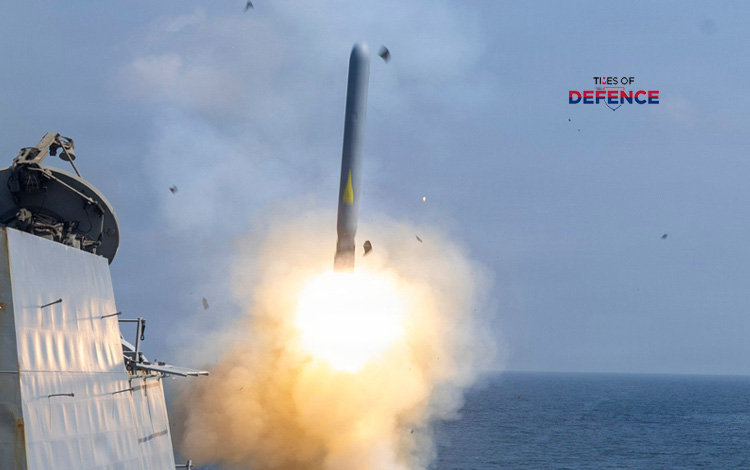
💥 Booster & Cruise Propulsion: Solid rocket motor booster provides initial launch impulse prior to transition to a subsonic turbofan cruise engine (such as the Williams F107 family) for sustained low-altitude flight
💥 Range, Speed & Payload: Block IV and Block V variants achieve ranges exceeding 1,600 km (1,000 miles) at high subsonic cruise speeds (~Mach 0.74), carrying approximately 454 kg (1,000 lb) class conventional payloads with a launch weight around 1,510 kg including booster
💥 Guidance & Multi-Domain Launchers: Utilizes INS, GPS, TERCOM, and DSMAC navigation with in-flight retargeting/communications updates on Block V variants, launched from surface combatants, submarines, and ground-based launchers
TIMES OF DEFENCE ASSESSMENT
Raytheon’s decision to award a joint Tomahawk solid rocket motor booster development and qualification contract to Ursa Major and Avio USA highlights three critical shifts in U.S. missile propulsion and defense industrial strategy:
1. Expanding Domestic Solid Rocket Motor Capacity and Supplier Redundancy: Solid rocket motors have long represented a critical bottleneck in scaling U.S. precision-strike production. Bringing a new strategic team through qualification broadens industrial capacity and reduces single-point supply vulnerabilities for a high-demand long-range munition.
2. Blending NewSpace Agile Manufacturing with Established Propulsion Heritage: Pairing Ursa Major’s additive and flexible manufacturing methods with Avio USA’s solid propulsion pedigree and U.S. industrial buildout illustrates how legacy primes are tapping non-traditional and trans-Atlantic-backed domestic entrants to accelerate throughput.
3. Sustaining Long-Range Strike Mass Across Naval and Land Fires: As demand for Tomahawk Block IV and Block V missiles expands across U.S. Navy surface and submarine fleets, allied buyers, and ground-launched batteries, resilient booster supply chains are essential to maintaining production velocity.

