


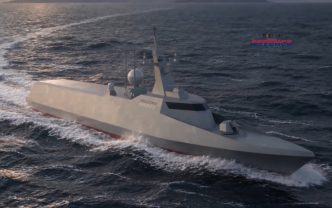
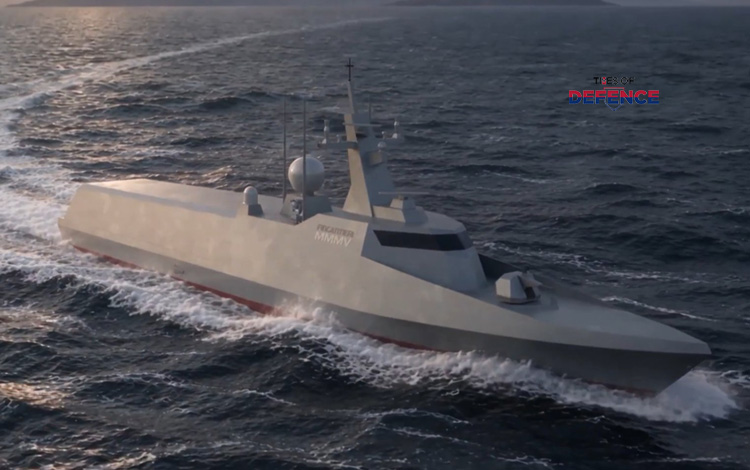
Italian shipbuilding major Fincantieri unveiled its new Multi-Mission Modular Vessel (MMMV) at the Euronaval 2026 international naval defense exhibition in Paris.
Built around a “one hull, many missions” design philosophy, the compact 50-meter, 500-ton surface platform utilizes an open, plug-and-play modular architecture capable of embarking up to six standardized 20-foot (or equivalent 10-foot) ISO containerized mission modules. Engineered with a low radar cross-section (RCS) and high onboard automation, the vessel operates with a baseline core crew of just six personnel (expandable to eight, or fully uncrewed as an Unmanned Surface Vehicle in future configurations). By enabling rapid quayside reconfiguration without structural hull modifications, the MMMV allows navies and coast guards to seamlessly pivot between maritime law enforcement, Exclusive Economic Zone (EEZ) patrol, seabed warfare, signals intelligence, and kinetic strike missions.
TECHNICAL SPECIFICATIONS: FINCANTIERI MULTI-MISSION MODULAR VESSEL (MMMV) ARCHITECTURE
1. Hull Dimensions, Signature Reduction & Manning Profile
⚡ Prime Contractor & Designer: Fincantieri S.p.A. (Naval Vessels Division, Italy)
⚡ Dimensions & Displacement: Overall length of 50.0 meters with a full-load displacement of approximately 500 metric tons, optimized for agile littoral and offshore operations
⚡ Performance & Endurance: Achieves a maximum sprint speed of 23 knots, an economical cruising speed of 14 knots, and an autonomous operational endurance of 7 to 10 days
⚡ Stealth & Lean Manning Architecture: Features a low radar cross-section (RCS) topside geometry and advanced bridge/machinery automation supporting a core crew of 6 personnel (up to 8 with mission specialists) while remaining “ready to be unmanned” for autonomous USV deployment 
2. Containerized Mission Modules & Multi-Domain Payloads
💥 Modular Payload Capacity: Accommodates up to six 20-foot ISO containers (or combinations of 10-foot and 20-foot modules) connected via standardized electrical power, cooling, and combat-management data interfaces
💥 Uncrewed & Kinetic Payloads: Integrates containerized loitering munitions, Unmanned Aerial Vehicles (UAVs), Unmanned Underwater Vehicles (UUVs), and automated launch-and-recovery systems (LARS) for seabed scanning and mine countermeasures
💥 Six Core Mission Configurations: Rapidly reconfigurable for (1) EEZ protection and anti-trafficking/piracy law enforcement, (2) ISR and communications intelligence (COMINT), (3) critical undersea infrastructure protection, (4) seabed and underwater operations, (5) disaster recovery/SAR, and (6) distributed littoral combat
TIMES OF DEFENCE ASSESSMENT
Fincantieri’s unveiling of the Multi-Mission Modular Vessel (MMMV) at Euronaval 2026 highlights three critical strategic shifts in modern naval shipbuilding and littoral warfare:
1. Decoupling Hull Construction from Specialized Mission Payloads: Traditional bespoke warships lock navies into rigid operational roles and lengthy, expensive shipyard refits. By standardizing on a 500-ton hull capable of swapping up to six 20-foot ISO containers quayside, Fincantieri enables smaller navies and export customers to field adaptable multi-role fleets at a fraction of conventional acquisition costs.
2. Addressing Naval Manpower Shortages Through Lean Manning and USV Readiness: Operating a 50-meter surface combatant with a core crew of just six personnel directly mitigates chronic naval recruitment bottlenecks while establishing an evolutionary bridge toward fully autonomous Unmanned Surface Vehicle (USV) operations.
3. Enhancing Critical Undersea Infrastructure and Seabed Security: Amid escalating hybrid threats to submarine telecommunications cables and offshore energy pipelines, deploying modular vessels equipped with containerized UUVs, seabed-scanning sonars, and loitering munitions provides persistent, cost-effective deterrence across congested littoral zones.

