


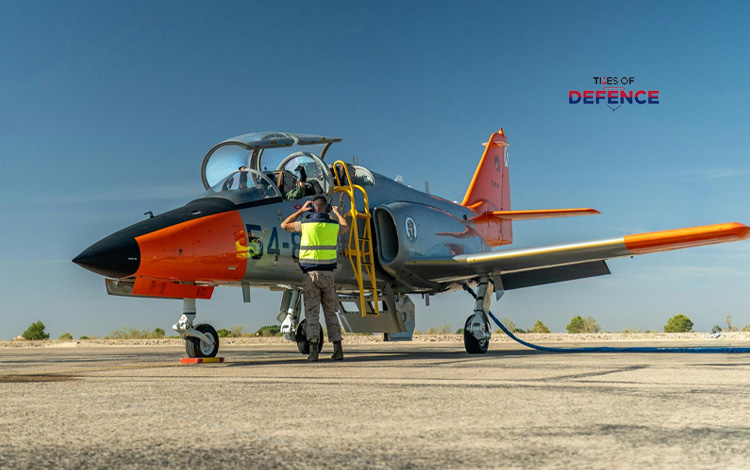
Airbus Defence and Space, in collaboration with the Spanish Air and Space Force (Ejército del Aire y del Espacio), has successfully completed flight trials in Albacete validating a new high-capacity, sovereign air-to-air connectivity system linking two C-101 Aviojet aircraft in mid-air.
Executed as part of the Spanish Air and Space Force’s BACSI (Base Aérea Conectada, Sostenible e Inteligente — “Connected, Sustainable, and Smart Air Base”) modernization initiative, the flight test campaign represents the first validation in Spain of an indigenous air-to-air networking architecture built entirely on Internet Protocol (IP) standards and domestic technology. During the trials, the airborne mesh link enabled continuous, real-time exchange of high-definition video, tactical situational data, and live aircraft telemetry between the two C-101 platforms, while simultaneously downlinking the data stream to a ground control station—maintaining resilient connectivity throughout dynamic flight maneuvers and deliberate network interruption tests.
TECHNICAL SPECIFICATIONS: NATIONAL IP AIR-TO-AIR CONNECTIVITY & BACSI TESTBED ARCHITECTURE
1. Network Architecture, Resilience & Data Throughput
⚡ Prime Industry & Military Partners: Airbus Defence and Space (Spain) and the Spanish Air and Space Force (Ejército del Aire y del Espacio) under the BACSI program framework
⚡ Protocol & Sovereign Design: Built on a native Internet Protocol (IP) network architecture utilizing 100% Spanish national technology to ensure cryptographic sovereignty, modular scalability, and seamless integration into multi-domain cloud networks
⚡ Multi-Stream Payload Capability: Supports simultaneous, bidirectional transmission of live electro-optical/infrared video feeds, tactical command-and-control (C2) data, and real-time flight telemetry across airborne nodes and ground stations
⚡ Anti-Drop & Maneuver Resilience: Validated during high-agility flight profiles and intentional link disruptions, demonstrating automated network self-healing, dynamic routing, and uninterrupted data recovery under degraded electromagnetic conditions 
2. Airborne Testbed & BACSI Operational Ecosystem
💥 Flight Test Platforms: Two CASA C-101 Aviojet jet trainers operated out of Los Llanos Air Base / Albacete Air Maestranza, providing an agile, representative airborne test environment for high-speed relative motion and attitude changes
💥 Ground Infrastructure Integration: Directly supports the BACSI initiative’s core pillars of strengthening operational effectiveness, digitized flightline logistics, predictive maintenance telemetry, and base-level flight safety
💥 Combat Cloud Scalability: Establishes a foundational airborne tactical data-link building block transferable to frontline Spanish fleets—such as Eurofighter Typhoon, Airbus A400M, C295, and future uncrewed Collaborative Combat Aircraft (CCA) / FCAS architectures
TIMES OF DEFENCE ASSESSMENT
The successful flight validation of a sovereign IP-based air-to-air connectivity system by Airbus Defence and Space and the Spanish Air and Space Force highlights three critical shifts in European aerospace modernization and network-centric warfare:
1. Transitioning Tactical Aviation to Native IP Combat Clouds: Legacy military datalinks often suffer from rigid bandwidth constraints and proprietary message formats. Demonstrating high-capacity IP networking between fast-moving jets enables true plug-and-play sharing of sensor video and telemetry, laying the groundwork for collaborative manned-unmanned teaming.
2. Preserving Sovereign Control Over Tactical Communications: Developing the system entirely with national Spanish technology ensures Madrid retains full cryptographic and architectural autonomy over its frontline airborne networks—a vital strategic asset within broader European programs such as the Future Combat Air System (FCAS).
3. Extending Predictive Maintenance and Smart Base Operations into the Air: By streaming live aircraft telemetry directly to ground stations during flight under the BACSI framework, airbase sustainment teams can diagnose subsystem health prior to landing, dramatically accelerating sortie turnaround times and fleet availability.

