


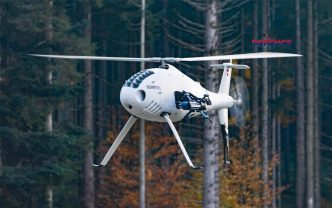
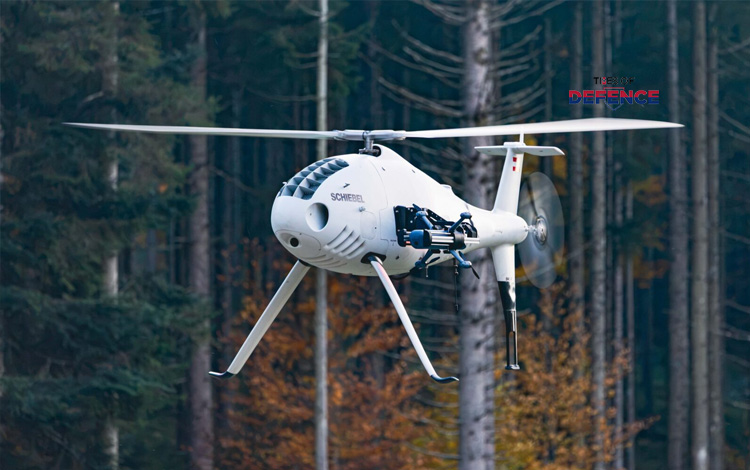
Austrian unmanned systems manufacturer Schiebel, in strategic partnership with OSIRIS Poland, has successfully demonstrated the CAMCOPTER S-100 rotary-wing uncrewed aerial system (UAS) operating as a mothership and airborne communications relay platform for a deployed small drone during a proof-of-concept trial in Austria.
Conducted under simulated tactical flight conditions, the demonstration proved the feasibility of launching sub-systems from a larger uncrewed rotorcraft platform in mid-air. During forward flight, the CAMCOPTER S-100 successfully carried and deployed an OSIRIS HSCD-1 small uncrewed aerial vehicle. Following release, the S-100 maintained a secure tactical data link, serving as an airborne command, control, and video relay station to pilot and monitor the smaller drone remotely. By pairing the long endurance and heavy payload capacity of the S-100 with the high speed and localized agility of a miniature drone, the architecture significantly expands multi-domain operational flexibility—with immediate utility across Counter-Unmanned Aircraft System (C-UAS), intelligence, surveillance, and reconnaissance (ISR), and targeted kinetic engagement missions.
TECHNICAL SPECIFICATIONS: SCHIEBEL CAMCOPTER S-100 & OSIRIS MOTHER-DRONE ARCHITECTURE
1. CAMCOPTER S-100 Rotary-Wing Mothership Platform
⚡ Prime Contractor & System Base: Schiebel (Vienna, Austria); heavy-duty rotary-wing uncrewed aerial system designed for vertical takeoff and landing (VTOL) from unpaved terrain and naval combatant flight decks
⚡ Endurance & Range: Delivers up to 6 hours of powered flight endurance with standard auxiliary fuel tanks and an operational data-link range exceeding 200 km (line-of-sight)
⚡ Payload Integration & Deployment Mechanism: Features a modular internal and external payload architecture modified to securely house, transport, and execute remote in-flight mechanical release of subsidiary uncrewed platforms 
2. OSIRIS HSCD-1 Small Drone & Airborne Relay Subsystem
💥 Deployed Munition/UAV Profile: OSIRIS HSCD-1 (High-Speed Combat Drone / small uncrewed system) engineered for agile maneuverability, high-speed dash capability, and localized tactical interdiction
💥 Airborne Communications Relay: The S-100 acts as an airborne tactical gateway, extending radio-frequency (RF) and video control links over-the-horizon and around terrain obstacles that would normally block ground-station line-of-sight
💥 C-UAS & Interdiction Applications: Enables distributed operational concepts where a long-range mothership loiters near contested zones, deploying agile interceptor or reconnaissance drones precisely where needed while keeping human operators safely out of harm’s way
TIMES OF DEFENCE ASSESSMENT
The successful proof-of-concept demonstration of the CAMCOPTER S-100 deploying an OSIRIS HSCD-1 drone highlights three critical strategic innovations in unmanned warfare:
1. Expanding Operational Reach Through Airborne Mothership Concepts: Small tactical drones inherently suffer from limited battery life, range, and communication line-of-sight when launched from the ground. By using a heavy-endurance rotary platform like the S-100 as an airborne carrier, tactical operating radii are multiplied exponentially.
2. Solving Terrain and Horizon Constraints in Contested Environments: Operating small drones behind hills, urban terrain, or across maritime horizons typically requires forward-deployed relay stations vulnerable to enemy fire. Leveraging a loitering uncrewed helicopter as an airborne communications relay preserves robust C2 links without exposing ground crews.
3. Innovating Flexible C-UAS and Multi-Tiered Swarming Tactics: Combining rotary-wing persistence with fixed-wing or agile high-speed small drones opens up innovative tactical paradigms—allowing commanders to deliver specialized effector drones directly into threat sectors to investigate or neutralize hostile aerial targets.

