


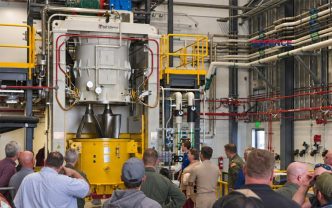
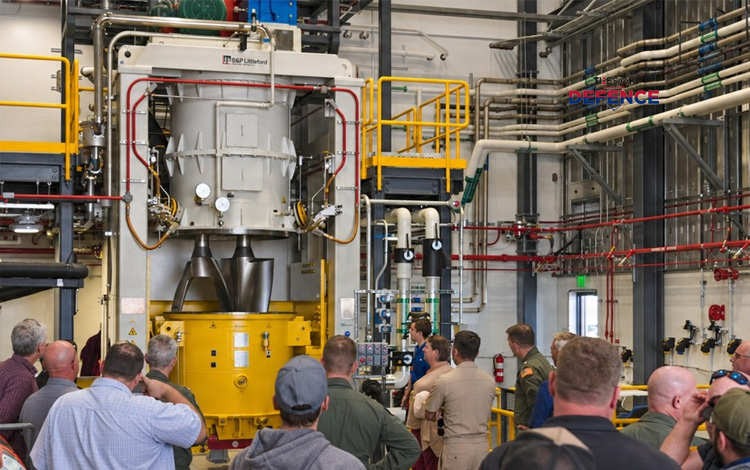
The Naval Air Warfare Center Weapons Division (NAWCWD) at China Lake has successfully filled its first seven initial-article **WDU-36/B Tomahawk cruise missile warheads**, establishing a vital organic surge and fallback production source to support the U.S. Navy’s mass inventory ramp-up.
Unveiled alongside the dedication of a new state-of-the-art **300-gallon heavy-capacity mixer** built by B&P Littleford on November 9, 2026, the naval lab initiative addresses critical defense production bottlenecks. Operating in coordination with prime contractor Raytheon (which secured a $22.9 billion multi-year production contract to scale output beyond 1,000 missiles annually) and General Dynamics Ordnance and Tactical Systems (contracted for 559 warhead cases), China Lake’s pilot facility is slated to reach full-rate warhead assembly and explosive casting by June 2027.
TECHNICAL SPECIFICATIONS: CHINA LAKE TOMAHAWK WARHEAD PRODUCTION ARCHITECTURE
1. WDU-36/B Warhead Configuration & Explosive Chemistry
⚡ Weapon Payload: Standard unitary warhead configuration utilized across modern Tomahawk Block IV/V cruise missile variants
⚡ Energetic Fill: Cast-cured **PBXN-107 plastic-bonded explosive**, chosen for its high blast performance and thermal insensitivity compliance
⚡ First-Article Qualification: Seven initial-article units fabricated to validate newly rewritten military specifications, standardized supplier lists, and strict quality-assurance tolerances following historical museum-case baseline tests 
2. Advanced Manufacturing & Facility Infrastructure
💥 300-Gallon B&P Littleford Mixer: Double the capacity of the legacy 150-gallon mixing plant, engineered to dramatically elevate batch throughput for high-explosive casting
💥 Rebuilt Motor Assembly Compound: Situated within modern facilities reconstructed following the July 2019 Ridgecrest earthquakes; features an optimized layout where a ~9,070 kg (20,000 lb) bowl moves directly to an internal lift via rolling tracks
💥 Streamlined Workflow & Cure Margins: Eliminates historical half-mile transit loops between mixing and casting structures, reducing transport time from one hour to 15 minutes and clawing back crucial processing window time before the PBXN-107 compound begins setting

