


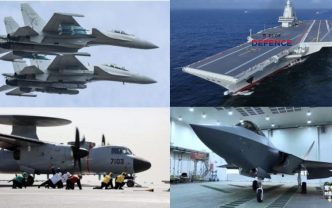
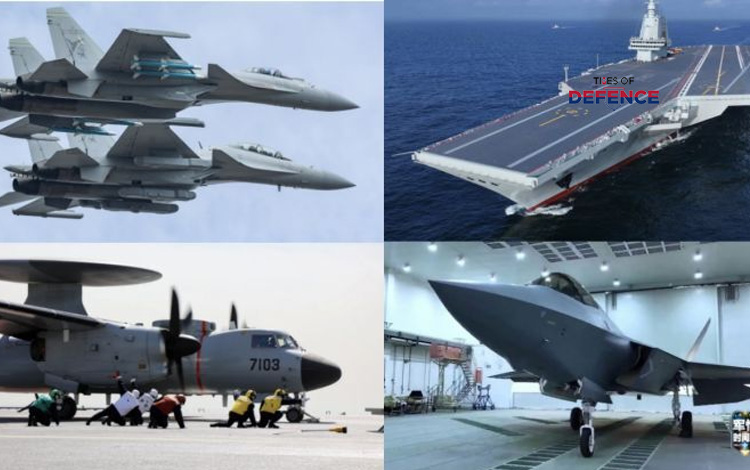
One year following its official fleet commissioning on November 5, 2025, the People’s Liberation Army Navy (PLAN) supercarrier Fujian (Type 003, Hull 18) has entered an optimized operational phase focused on high-intensity, integrated flight operations.
Following a series of blue-water exercises across the Bohai Sea, South China Sea, and Western Pacific through late 2026, the 80,000-ton conventionally powered supercarrier is advancing beyond initial launch and recovery trials toward full deck sortie generation. Operating three Electromagnetic Aircraft Launch Systems (EMALS), the vessel is integrating a multi-role air wing consisting of fifth-generation J-35 stealth fighters, heavy J-15B/T multi-role fighters, J-15D electronic warfare aircraft, and KJ-600 Airborne Early Warning & Control (AEW&C) platforms. The PLAN is coordinating these aerial assets alongside Type 055 guided-missile destroyers, Type 052D destroyers, and Type 054A/B frigates to establish Beijing’s first fully functional CATOBAR (Catapult Assisted Take-Off But Arrested Recovery) Carrier Strike Group (CSG).
TECHNICAL SPECIFICATIONS: TYPE 003 FUJIAN & EMBARKED AIR WING ARCHITECTURE
Carrier Platform & Launch Recovery Suite
⚡ Displacement & Hull Profile: ~80,000+ tons full load; length ~316 meters, beam ~76 meters
⚡ Propulsion Architecture: Integrated Electric Propulsion (IEP) system powered by heavy diesel-generator sets and steam turbines powering high-efficiency electrical buses
⚡ Launch & Arrestment Suite: 3× linear Electromagnetic Aircraft Launch Systems (EMALS) paired with an advanced Advanced Arresting Gear (AAG) recovery system
⚡ Maximum Sortie Rate Surge Capacity: Projected >160 to 180 total sorties per 24-hour combat flight deck cycle under sustained high-tempo operational envelopes 
Embarked Fixed-Wing Carrier Air Wing (CVW) Matrix
💥 Medium Stealth Fighter (J-35): Twin-engine stealth multi-role fighter featuring internal weapons bays, low-observable shaping, and AESA radar for air dominance and penetrating strike missions
💥 Heavy Multi-Role Fighter (J-15B/T): Catapult-compatible variant of the Flanker-series, optimized for heavy fuel and payload launch capacity, including long-range anti-ship cruise missiles (ASCMs)
💥 Dedicated Airborne Electronic Attack (J-15D): Twin-seat platform outshone by wingtip tactical jamming pods and anti-radiation missiles (ARM) for stand-in electronic attack and escort jamming
💥 Tactical Airborne Early Warning (KJ-600): Twin-turboprop AEW&C platform carrying a dorsal rotodome radar array, expanding air group detection horizons for low-altitude cruise missiles and stealth targets
TIMES OF DEFENCE ASSESSMENT
The transition of the Fujian carrier strike group to complex, multi-domain operations marks a strategic shift in Indo-Pacific naval dynamics:
1. **Unlocking Maximum Payload and Fuel Envelopes via EMALS**: Transitioning from STOBAR (ski-jump) platforms (Liaoning and Shandong) to EMALS allows the PLAN to launch heavy combat platforms at maximum takeoff weight (MTOW). This permits J-15B and J-35 fighters to launch fully loaded with heavy long-range anti-ship missiles and internal precision ordnance without fuel penalty, substantially expanding the strike group’s offensive engagement radius.
2. **Integrating Sea-Based Force Multipliers via the KJ-600**: Operable only from catapult-equipped carriers, the KJ-600 AEW&C aircraft removes the PLAN’s historic reliance on land-based radar coverage or short-range helicopter AEW nodes. Tethering the KJ-600’s long-range radar tracking to the dual-band S/X-band radar architecture of escorting Type 055 destroyers creates a dense, cooperative engagement network capable of directing long-range SAMs (e.g., HHQ-9B) beyond the horizon.
3. **Challenging Carrier Strike Group Parity in the Second Island Chain**: Operating a balanced 50+ aircraft CATOBAR air wing comprising stealth fighters, heavy strike platforms, and electronic attack jets gives China carrier capabilities comparable to U.S. Nimitz- and Ford-class supercarriers. Sustaining carrier strike operations in the Philippine Sea and Western Pacific alters access dynamics, complicating third-party naval intervention during regional contingencies.

