


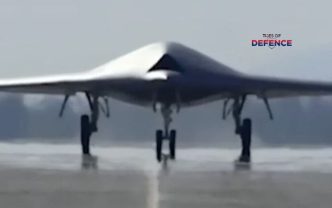
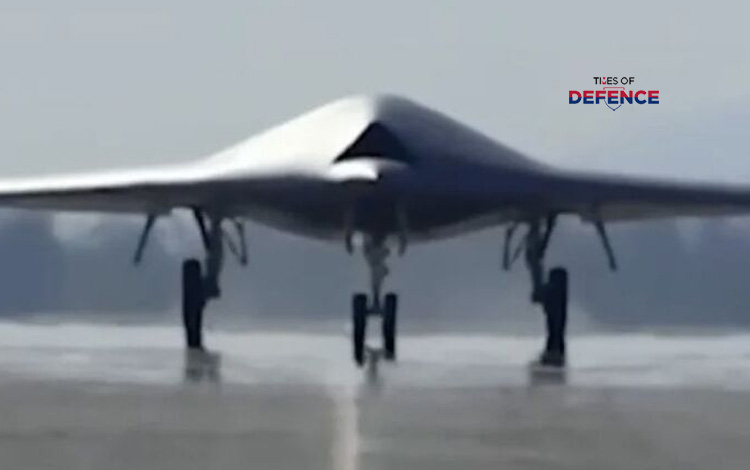
China Central Television (CCTV) released official operational flight and hangar footage on November 9, 2026, showcasing the People’s Liberation Army Air Force (PLAAF) GJ-11 “Sharp Sword” (Xuanlong) unmanned combat aerial vehicle (UCAV). Released in advance of the PLAAF’s 77th anniversary, the footage provides the first detailed visual verification of the aircraft’s internal weapons carriage, low-observable (LO) surface treatments, and sensor suite while highlighting frontline operational integration.
The platform represents the world’s first operational frontline deployment of a flying-wing stealth UCAV, following initial unit placement at high-altitude bases (including Shigatse Air Base in Tibet). The footage validates the GJ-11’s dual ventral internal weapons bays, serrated bay door architecture, dorsal S-duct engine air intake, and faceted Electro-Optical Targeting System (EOTS), confirming its role as a low-observable forward node for strike, suppression of enemy air defenses (SEAD), and manned-unmanned teaming (MUM-T).
TECHNICAL SPECIFICATIONS: PLAAF GJ-11 STEALTH UCAV ARCHITECTURE
Low-Observable (LO) Airframe & Propulsion Integration
⚡ Operating Force: People’s Liberation Army Air Force (PLAAF) / PLA Navy (Naval variant: GJ-21)
⚡ Aerodynamic Configuration: Tailless flying-wing layout optimizing wideband, multi-aspect radar cross-section (RCS) reduction across VHF, UHF, and X-band frequencies
⚡ Propulsion & Thermal Signature Control:
• Air Intake: Top-mounted (dorsal) flush S-duct air intake shielding engine fan blades from frontal radar returns
• Exhaust Architecture: Top-mounted, flattened, thermal-shielded planar jet nozzle embedded within the upper wing surface to minimize infrared (IR) signatures from surface-based trackers
⚡ Surface Architecture & Sensors:
• Low-Visibility Coating: Radar-absorbent material (RAM) application across leading edges and composite panels
• Electro-Optical Targeting System (EOTS): Under-nose faceted sapphire-window sensor housing (sharing design heritage with the Chengdu J-20 EOTS) for passive target detection, laser designating, and optical tracking 
Internal Payload Carriage & Manned-Unmanned Teaming (MUM-T) Matrix
💥 Weapons Carriage Architecture: Twin (dual) ventral internal weapons bays integrated between the main landing gear wells, featuring serrated-edge bay doors to maintain low-observable characteristics during weapon door cycles
💥 Payload Envelopes: Internal carriage engineered for precision-guided air-to-surface munitions (e.g., LT-series satellite-guided bombs, FT-series small diameter glide bombs) and standoff anti-radiation/air-to-ground missiles
💥 Command, Control & MUM-T Networks:
• Tactical Teaming Platforms: Controlled via encrypted wideband datalinks from twin-seat Chengdu J-20S fighters or ground-based mobile transportable control shelters
• Tactical Roles: Forward sensor node (“eyes of the fleet”), electronic warfare decoy, stand-in jammer, and autonomous strike effector executing high-risk SEAD/DEAD missions ahead of crewed strike packages
💥 Naval Platform Derivative (GJ-21): Catapult-assisted take-off and barrier-arrested recovery (CATOBAR) variant configured for electromagnetic catapult deployment from Type 076 amphibious assault ships (e.g., Sichuan) and Fujian-class supercarriers
TIMES OF DEFENCE ASSESSMENT
The operationalization of the GJ-11 Sharp Sword UCAV underscores major strategic developments in unmanned combat aviation:
1. **Pioneering Operational Stealth UCAV Integration in Frontline Units**: By fielding the GJ-11 in active PLAAF combat squadrons, China moves ahead of Western operational timelines for stealth UCAVs. Operating flying-wing stealth drones provides practical experience in maintaining low-observable skin coatings, managing semi-autonomous datalinks under contested EW conditions, and refining operational logistics for uncrewed strike assets.
2. **Expanding Stand-In ISR and SEAD Volleys via Manned-Unmanned Teaming**: Teaming the GJ-11 with J-20 air superiority fighters and J-16D electronic warfare aircraft changes air combat dynamics. Acting as a forward sensor node, the GJ-11 can penetrate integrated air defense system (IADS) envelopes to track targets, draw SAM fire, or launch guided munitions—allowing crewed command platforms like the J-20S to remain outside engagement ranges.
3. **Establishing Dual-Domain Carrier and Land-Based Unmanned Strike**: Parallel development of the land-based GJ-11 for the PLAAF and the carrier-capable GJ-21 for the PLAN highlights a unified unmanned strategy. Deploying stealth UCAVs on Type 076 drone carriers and supercarriers expands China’s standoff power-projection capability, establishing continuous stealth ISR and strike bubbles across contested maritime operational zones.

