


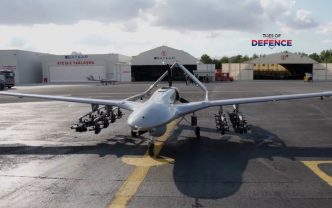
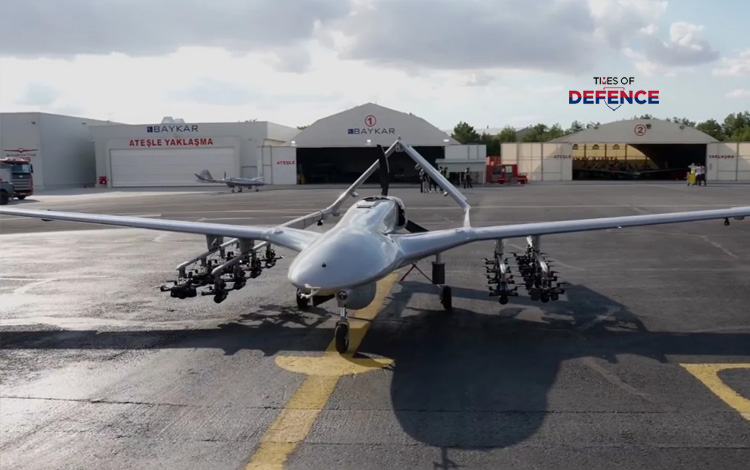
Turkish defense technology prime Baykar announced on November 4, 2026, the successful flight-test execution of its Bayraktar TB2 Medium-Altitude Long-Endurance (MALE) Tactical Unmanned Combat Aerial Vehicle (UCAV) operating as an airborne launch platform and communications relay for first-person-view (FPV) loitering attack munitions.
Conducted from Baykar’s Keşan Flight Training and Test Center in Edirne province, the flight demonstration saw a modified Bayraktar TB2 carry 16 Skydagger FPV kamikaze drones underwing (eight per underwing pylons/rack assemblies). During transit over the target grid, the TB2 air-released two Skydagger FPV units. Operating through an airborne digital data-link relay hosted aboard the parent UCAV, ground-based pilots remotely navigated the released micro-drones directly into designated surface targets with precision kinetic impacts.
TECHNICAL SPECIFICATIONS: BAYRAKTAR TB2 airborne FPV MOTHER-SHIP ARCHITECTURE
Platform Lineage, Payload Racks & Airborne Relay Envelope
⚡ Lead Integrator & OEM: Baykar Technology (Istanbul / Özdemir Bayraktar National Technology Center, Türkiye)
⚡ Host Airframe Baseline: Bayraktar TB2 MALE Tactical UCAV (12-meter wingspan, 700 kg MTOW, 150 kg payload capacity)
⚡ Airborne Launcher Configuration: 2× multi-dispenser underwing carriage racks accommodating up to 16× total folded/compact FPV kamikaze drones (8 units per wing station)
⚡ Carrier Test Location: Keşan Flight Training and Test Center, Edirne, Türkiye
⚡ Data Link & C2 Relay Architecture: High-bandwidth airborne line-of-sight (LOS) / SATCOM datalink transceiver hosting dynamic signal repeaters to extend operator ground control signals and live video streams over low-altitude terrain obstacles 
Offboard Effector Ordnance & Engagement Dynamics
💥 Air-Dispensable Loitering Munition: Skydagger FPV Kamikaze Drone (developed by Skydagger / integrated under Baykar-ORQA tactical UAV ecosystem framework)
💥 Operational Launch Procedure: Parent TB2 loiters at standoff operational altitude (16,000–20,000 ft); remote mechanisms release FPV drones into high-speed gliding descent profiles prior to motor ignition
💥 Target Engagement Vector: Terminal high-angle dive attack controlled via independent ground operators utilizing the parent TB2’s elevated relay node
💥 Standoff Distance Scaling: Bypasses standard ground-launched FPV range limitations (~15 km / 9.3 miles), leveraging the TB2’s operational range (up to 300+ km LOS / unlimited SATCOM) to project FPV strikes deep into adversary rear sectors
TIMES OF DEFENCE ASSESSMENT
The airborne deployment of FPV strike drones from the Bayraktar TB2 platform represents a major structural shift in counter-A2/AD and asymmetric drone-swarm tactics.
From an aerospace engineering and unmanned doctrine perspective, this milestone offers three main strategic insights:
1. **Solving the FPV Operational Line-of-Sight & Battery Ceiling**: Tactical FPV quadcopters are fundamentally constrained by small battery capacities (limiting flight endurance to ~10–15 minutes) and ground-level RF signal horizon loss caused by terrain, buildings, or trees. Using the TB2 as an airborne carrier allows FPV drones to conserve battery power during transit, while the high-altitude UCAV maintains an uninterrupted airborne line-of-sight data link to relay control commands around physical barriers.
2. **Mitigating MALE UCAV Vulnerability to Frontline Air Defenses**: Advanced short/medium-range air defense networks (such as Tor-M2, Pantsir-S1, or Buk-M3) have increased the operational risk for slow-flying MALE UCAVs operating directly over contested frontlines. By functioning as a mothership, the TB2 can remain outside the engagement envelopes of tactical short-range air defense systems while launching standoff waves of 16 precision FPV loitering munitions to saturate target areas.
3. **Establishing High-Density Low-Cost Kinetic Magazine Depth**: Traditional UCAV strike operations rely on high-cost laser-guided micro-munitions (e.g., Roketsan MAM-L / MAM-C). Integrating multi-cell FPV dispenser racks dramatically lowers the per-shot engagement cost, allowing a single TB2 to engage multiple soft targets, radar emitters, unarmored transport vehicles, and troop emplacements in a single mission sortie.

