


According to operational monitoring data compiled by the conflict tracking group Oko Gora, Russian Aerospace Forces (VKS) released 8,016 guided aerial bombs (UMPK series) across Ukrainian frontlines in October 2026.
This represents an 11% reduction compared to September’s record high of approximately 9,000 strikes (averaging 259 sorties/day in October versus over 300/day in September). The decline breaks an upward operational trend maintained since May 2026. Defense analysts link this drop to deep standoff strikes executed by Ukrainian Naval Forces using RK-360MC Neptune cruise missiles against forward VKS tactical air bases—specifically targeting frontline Sukhoi Su-34/Su-34M fighter-bomber hubs at Borisoglebsk (Voronezh Oblast) and Marinovka (Volgograd Oblast).
TECHNICAL SPECIFICATIONS: UMPK GLIDE BOMB MODULE & SU-34 CARRIER ARCHITECTURE
Conversion Module Kinematics & Aerodynamic Control
⚡ Guidance Module Baseline: UMPK (Unifitsirovannyi Modul Planirovaniya i Korrektsii / Unified Gliding and Correction Module)
⚡ Ordnance Compatibility Range: FAB-250 M-62 (250 kg), FAB-500 M-62 (500 kg), FAB-1500 M-54 (1,500 kg), and FAB-3000 M-54 (3,000 kg) high-explosive general-purpose bombs
⚡ Flight Control & Aerodynamics: Spring-loaded pop-out planar wing assembly with a 2.1-meter wingspan, dual electromechanical tail-fin actuators, and autonomous thermal battery power unit
⚡ Target Acquisition & Guidance Suite: Strapdown Inertial Navigation System (INS) integrated with a jam-resistant Kometa-M 8-channel CRPA (Controlled Radiation Pattern Antenna) satellite navigation receiver
⚡ Release Kinematics & Standoff Range: Released at altitudes between 9,000 m and 12,000 m (29,500–39,300 ft) at speeds of Mach 0.8 to 0.95; effective standoff glide range spans 55 km to 70 km (up to 80 km for smaller FAB-250/UMPB variants) 
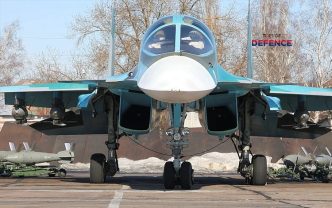
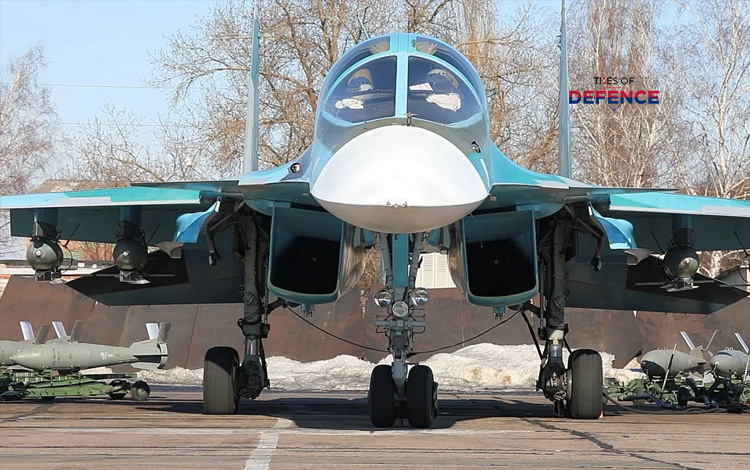
Primary Delivery Platform: Sukhoi Su-34 / Su-34M Fullback
💥 Aircraft Type: Twin-engine, twin-seat tactical strike fighter / fighter-bomber
💥 Payload Capacity & Hardpoint Dynamics: Up to 8,000 kg (17,600 lbs) weapon load across 12 external hardpoints; typical UMPK strike loading consists of 4× FAB-500 M-62 or 2× FAB-1500 M-54 modules on wing/centerline pylons
💥 Combat Avionics & Targeting: Khibiny-M (L175M) electronic warfare suite paired with the Sh141 radar complex and Platan electro-optical targeting system for pre-briefed coordinate targeting
TIMES OF DEFENCE ASSESSMENT
The 11% reduction in Russian glide bomb usage in October 2026 highlights the vulnerability of the VKS tactical aviation network to standoff strike operations.
From an aerospace engineering and air campaign perspective, this operational shift provides three key insights:
1. **Impact of Forward Airfield Attrition**: Ukrainian Neptune missile strikes against Borisoglebsk and Marinovka destroyed or damaged multiple Su-34 fighter-bombers and targeted forward arming/refueling points (FARP) and ordnance storage depots. Because the Su-34 serves as the main carrier for UMPK kits, losing airframes and ground crew directly reduces daily sortie capacity.
2. **Continued High Operational Baseline**: Despite the 11% drop, an average of 259 glide bombs per day remains near peak summer levels. The low unit cost of converting unguided Soviet-era FAB bombs into satellite-guided weapons allows the VKS to maintain heavy bombardment along high-priority assault axes (e.g., Pokrovsk, Kurakhove, Kupyansk).
3. **Disruption of Frontline Support Operations**: Forcing VKS tactical aviation units to redeploy Su-34 squadrons to deeper interior airfields (such as Lipetsk or Engels-2) increases transit distances to release points. This extends turn-around times between sorties, reduces daily wave frequency, and forces aircraft to carry additional fuel at the expense of heavy payload configurations (such as FAB-1500/FAB-3000).

