


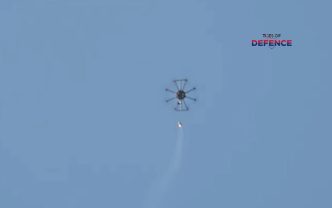
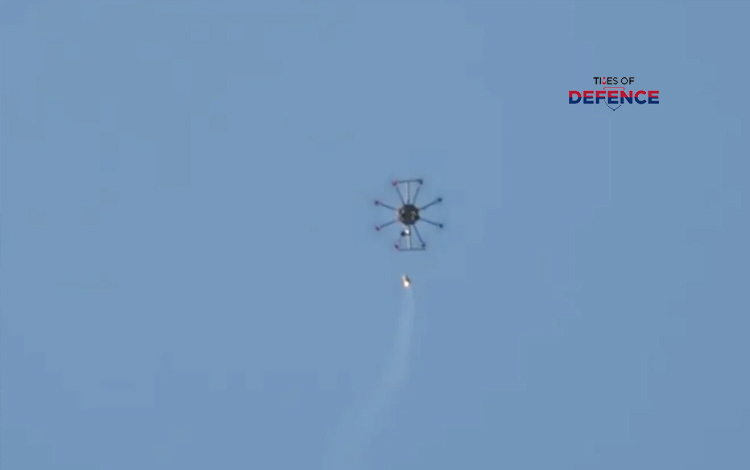
Texas-based defense technology startup Perseus Defense released live-fire test footage on November 2, 2026, demonstrating its low-cost “Harpe” guided missile intercepting a hovering multirotor drone during counter-uncrewed aerial system (C-UAS) trials.
Co-founded by former NASA engineer Jason Cornelius and former Boeing engineer Steve Messinger, Perseus Defense is developing compact, software-guided kinetic interceptors designed to solve the cost-asymmetry crisis in modern drone warfare. The flight milestone follows recent live-fire evaluations at the U.S. Army’s Golden Shield exercise and the U.S. Northern Command (USNORTHCOM) Falcon Peak 26.2 counter-drone experiment at Yuma Proving Ground, Arizona, where the company demonstrated its Mk-III interceptor launched from a lightweight, multi-cell pod.
TECHNICAL SPECIFICATIONS: PERSEUS DEFENSE HARPE INTERCEPTOR ARCHITECTURE
Platform Kinematics & Physical Airframe Profile
⚡ OEM & Developer: Perseus Defense (Austin, Texas — Y Combinator S25 Alum)
⚡ Missile Classification: Attritable Short-Range Kinetic Counter-UAS Interceptor
⚡ Airframe Dimensions: Length: ~61 cm (24 inches) | Diameter: ~7.6 cm (3 inches)
⚡ Unit Production Cost Target: Sub-$10,000 per interceptor (Mk-III prototype bill of materials ~$2,500)
⚡ Operational Intercept Envelope: Range: 2.0 km (1.2 miles) | Target Class: Group 1 and Group 2 Unmanned Aerial Systems (FPV quadcopters, commercial multirotors, loitering munitions)
⚡ Launcher Deployment Footprint: 8-round canister launcher weighing <36 kg (79 lbs), enabling man-portable setup or rapid integration onto light tactical vehicles (JLTV/ISV) and static perimeter defenses 
Guidance, Sensor Fusion & Target Engagement Dynamics
💥 Offboard Radar Cueing: Integrates with short-range tactical 3D search and tracking radars for initial target lock and cueing via secure datalink
💥 Onboard Active Guidance: Features a miniaturized terminal seeker suite providing autonomous target acquisition and dynamic proportional navigation guidance
💥 Soft-Kill & Hard-Kill Synergy: Fills the defense gap between electronic warfare (EW) jammers and high-cost surface-to-air missiles (SAMs), providing kinetic hard-kill capabilities without exhausting expensive air defense magazines
💥 Cold/Hot Launch Mechanics: Multi-cell pod fires high-acceleration solid-rocket motors, driving high G-force maneuvers to intercept fast-moving, evasive quadcopters
TIMES OF DEFENCE ASSESSMENT
The flight intercept by Perseus Defense’s Harpe missile highlights an important evolution in short-range counter-drone doctrine.
From an aerospace engineering and air defense procurement perspective, this milestone offers three key insights:
1. **Correcting the C-UAS Cost Asymmetry**: Traditional air defense systems rely on multi-hundred-thousand-dollar interceptors (e.g., AIM-9X, Stinger, Tamir) to defeat weaponized commercial quadcopters or FPV drones that cost under $1,000. Firing a sub-$10,000 (and eventually $2,500) guided interceptor allows military units to maintain magazines without running into economic depletion.
2. **Expeditionary Base and Force Protection**: Weighing under 36 kg (79 lbs) for an 8-round launcher, the Harpe system can be deployed by small infantry squads, airfield protection teams, or mobile convoys without requiring heavy transport vehicles or complex radar trailers.
3. **Complementing Directed Energy and Gun Systems**: While high-energy lasers and automated gun CIWS (like 30mm/35mm airburst) perform well against line-of-sight drone threats, guided mini-missiles provide over-the-horizon or terrain-masked intercept capability. The Harpe missile can maneuver around obstacles to neutralize low-altitude loitering threats before they enter direct line of sight.

